In recent years, more and more international students have chosen to attend top U.S. undergraduate programs by transferring from community colleges.
However, misconceptions and doubts about community colleges persist.
"Are community colleges third-rate or diploma mills? Are they only for poor students?"
"Are they like junior colleges in China?"
"Are they recognized by the Ministry of Education? What about the faculty?"
It's time for the long-misunderstood community colleges to clear their name.
Community Colleges vs. Four-Year Universities
Community colleges are U.S. two-year institutions recognized by China’s Ministry of Education, offering associate degrees.
Community college students can transfer to any four-year comprehensive university that meets the requirements and earn a bachelor’s degree.
Upon graduation, transfer students receive the exact same diploma as direct applicants, and the total time to degree is the same.
Community colleges are a vital part of the U.S. education system and receive substantial state funding. The curriculum is aligned, and credits are transferable between community colleges and four-year universities.
After completing two years of foundational courses (typically 60 transferable credits) at a community college, students have the opportunity to transfer to a four-year university to continue their junior and senior years. It’s worth noting that even for direct admits, the first two years at a four-year university mainly consist of general education and introductory major courses.
Specific transfer requirements vary by school, but they generally boil down to credits and GPA. Credits represent the quantity of coursework, tracking progress in foundational courses. GPA represents the quality of coursework, serving as the admission benchmark.
Standardized test scores like IELTS, TOEFL, and SAT are not mandatory when applying for transfer.
According to statistics, there are over 1,100 community colleges across the U.S. with more than 10 million enrolled students, accounting for 45% of all undergraduates. And among four-year comprehensive universities, 60% of students transferred in from community colleges.
All faculty and staff at community colleges hold graduate degrees or higher and are certified by academic departments. Many professors choose to teach at community colleges because of the small class sizes, with an average student-faculty ratio of 20:1.
Compared to large lectures with nearly a hundred students at four-year universities, professors prefer teaching small classes at community colleges. As a result, community college professors can provide more academic support to students.
Many community college professors also teach part-time at four-year universities, bringing world-class academic perspectives and educational resources to community college students.
A student at Glendale Community College shared that his marine biology professor also conducts research at USC and once organized a visit to the USC marine biology lab to learn about the latest experimental findings.
Research institutions have tracked community college transfer students and found that these transfers often achieve better grades and higher graduation rates than students who spent all four years at a university.
Transferring vs. Direct Admission
It can be said that transferring is a path chosen by many ordinary Americans. So, compared to direct admission, what are the advantages of transferring? And which groups is it suitable for?
1. Community colleges have low entry requirements and serve as a springboard for comebacks.
Applying directly to a top 100 or top 30 undergraduate university requires preparation like TOEFL/IELTS, SAT, and extracurricular enhancement, with high requirements and intense competition that demand advance planning.
However, applying to a community college often requires a minimum TOEFL score of 60 or 45, no SAT, and a short application cycle. Some community colleges even offer "unconditional admission without language scores." These colleges provide ESL courses, and some ESL credits can even transfer to four-year universities. Students can take ESL while completing foundational courses.
Low entry barriers do not justify the stereotype of being "diploma mills." Even a student with low English proficiency can undergo adaptation and growth at a community college and transform into a success story within two years. There are countless such comeback stories.
A student from a big city or an international program might dismiss this path. However, many are from second- or third-tier cities who took the gaokao.
Some students regret not starting their U.S. applications earlier, others decide to study abroad in their senior year and don’t want a gap year, some unfortunately underperform on the gaokao, and even some international program students feel stuck in the middle. For them, community college is a "roundabout rescue" solution.
2. Transfer students receive priority.
In fact, public university systems like the UC do not distinguish between domestic and international students when admitting transfer students from community colleges.
Moreover, the UC system has long worked closely with California community colleges through programs like the TAG (Transfer Admission Guarantee) to ensure that community college applicants can transfer to UC as smoothly as possible, prioritizing transfer students. It can be said that when applying to UC, international students from California community colleges are treated as in-state students, enjoying the same priority admission rights.
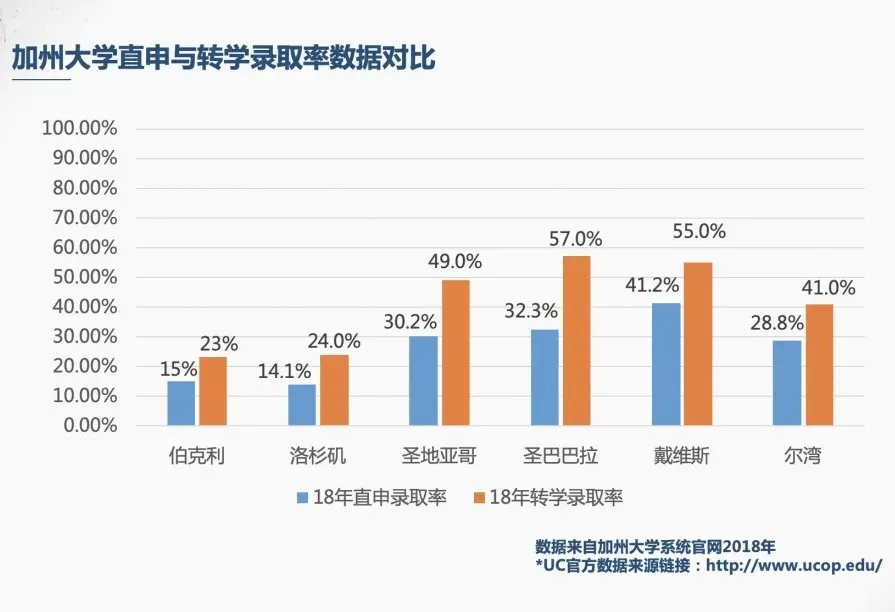
Some may ask, "With direct admission, you only apply once; with transferring, you go through two application processes—doesn’t that increase the risk?"
In reality, it's just a difference in application timelines and focus.
Direct admission typically requires preparation from the 11th grade, while transfer applications also demand early planning. For fall admission, most top public universities have application deadlines at the end of November of the previous year, while most private institutions are slightly later, around February of the admission year.
If the focus of direct admission is on test preparation, score drilling, and exam results, then transfer applications hinge on academic performance during the two years at community college. For transfers, course selection planning at the community college is crucial to meet the "quantity" requirement.
Additionally, in general, it is easier to earn good grades in a given subject at a community college than at a four-year university. Coupled with small class sizes, meeting the "quality" requirement is also not difficult.
3. Let's talk about tuition, campus life, and employment.
Community colleges are grassroots campuses designed to provide high-quality higher education to the masses and facilitate upward social mobility.
Consequently, they not only have low entry barriers but also affordable tuition. Spending the first two years of a bachelor’s degree at a community college can indeed save a significant amount of money.
For ordinary Americans, community colleges offer not only savings and small classes but also proximity to home. Community colleges are spread across cities large and small. Many top students in the U.S. opt out of direct admission because they don’t want to move far away or need to earn their own tuition.
Community colleges are entirely non-residential, with no on-campus dorms. Whether staying with a host family or renting an apartment, it becomes an unforgettable part of the study-abroad experience. Meanwhile, community colleges offer numerous student organizations and activities, enriching extracurricular life and providing material for the “activities and awards” section of transfer applications.
If a student chooses to earn an associate degree at a community college, they will receive one year of OPT (Optional Practical Training), which is legal work authorization in the U.S. Note that if you use OPT after community college, you cannot apply for TAG transfer, because TAG requires going directly from community college to UC without an OPT break in between.
For most community college students, transferring remains the top priority. However, having more internship or work experience will certainly be beneficial for future job searches. And HR professionals do not discriminate against applicants with community college backgrounds.
They Were Once Community College Students?!
As mentioned earlier, community colleges are a pathway to higher education for many ordinary Americans. Many public figures, before their rise to fame, came from humble backgrounds, transferred from community colleges to prestigious institutions, and climbed the ladder of success step by step.
For example, former California Governor and famous Hollywood action star Arnold Schwarzenegger, after immigrating from Austria at age 21, attended Santa Monica College (SMC) in Los Angeles, starting from ESL classes. In 2005, a successful Schwarzenegger returned to his alma mater and gave a commencement speech, saying that community college was the "beginning of his American dream."
Steve Jobs is also a notable alumnus of De Anza College, a community college in Silicon Valley. After high school, he was admitted to Reed College, a private liberal arts college in Oregon, but after a brief period of uncertainty there, he decided to transfer from the liberal arts school to a community college. After two semesters at De Anza, he was hired by the video game company Atari, and two years later, he co-founded Apple.
Additionally, celebrities like Ang Lee, Tom Hanks, and Morgan Freeman are all renowned community college alumni.
In short, community colleges act as a springboard, ready for ambitious ordinary people; and transferring is also a choice that is helping more and more students take a roundabout route to elite schools, achieving an overtaking maneuver on the path to U.S. education.
For some students, two years at a community college also serves as a "buffer period." Through gradual, step-by-step learning during community college, students of all levels can better adapt to the American campus environment and learning style, thus laying a stronger foundation for future development.
Community colleges have long borne many misunderstandings, and we hope everyone can recognize their true value anew.