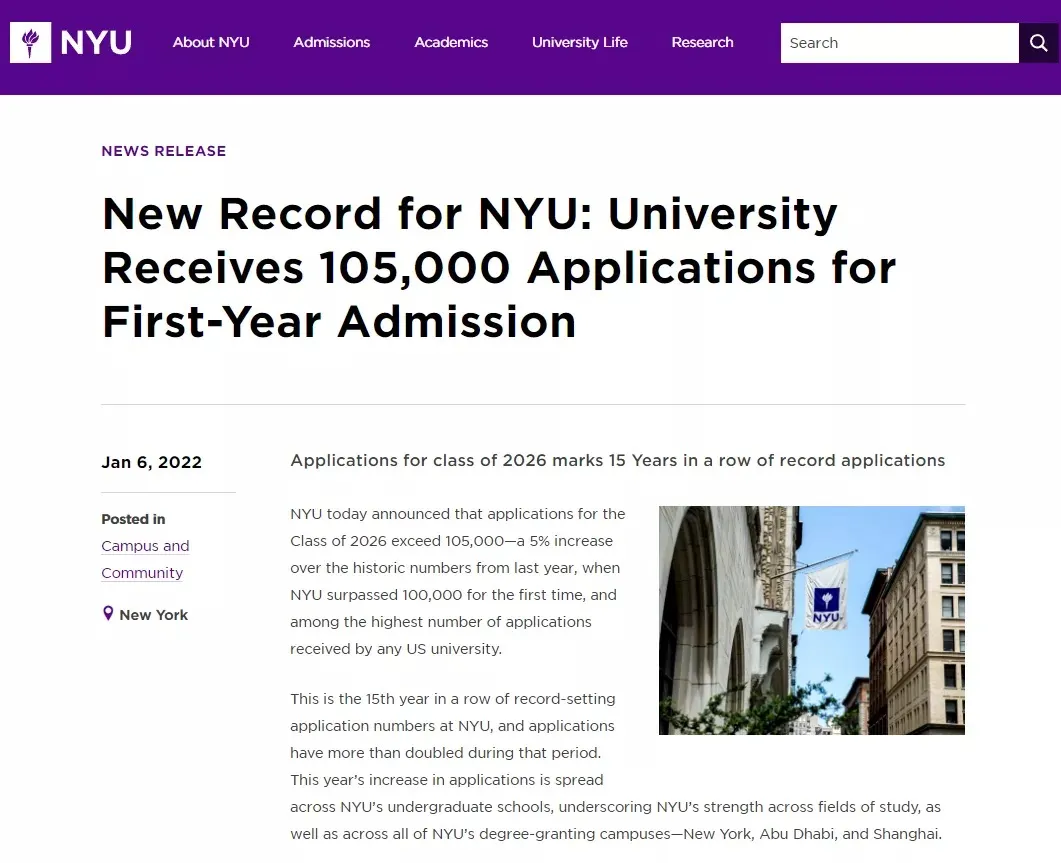
Last week, NYU officially announced that the number of freshman applicants for the Class of 2026 exceeded 105,000, up 5% from last year's record-breaking 100,000, marking the 15th consecutive year of record applicant numbers.
In early admissions, NYU received 19,000 early applications this year, a 12% increase over last year.
NYU says: I can't help being this popular!
Despite the pandemic-fueled negativity online, such as the "studying is useless" and "studying abroad is useless" rhetoric, undergraduate application numbers at top US universities have only increased, even surging dramatically...
According to Common App data, as of November 16 last year, over 780,000 applicants applied early in the 2021-22 cycle, submitting more than 3 million applications, with an average of about 4 applications per person.
By December 16 last year, the number of application accounts created by 12th graders had increased by 12.1%, the number of applicants by 13%, and the total number of applications by 18.6%.
The main reasons for the sharp increase are as follows:
1. Most schools continued test-optional policies, lowering the barrier.
2. Due to the pandemic, more applicants seek high returns from prestigious schools.
3. Many schools extended application deadlines, giving students more time to prepare.
Currently, many top US universities have released early admission results for the Class of 2026. While waiting for regular decision outcomes, let's take a look at these early figures for reference.
Early Admission Results at Top US Universities
Harvard University
Harvard's early admission rate for the Class of 2026 was 7.9%, noticeably lower than previous years. However, the number of international students admitted actually increased slightly, from 12.2% to 12.6% this year.
Harvard will remain test-optional for the next four years, meaning students applying through the Class of 2031 can choose not to submit standardized test scores.
University of Pennsylvania
Penn's early admission rate saw a slight increase, from 15% last year to 15.63% this year. International students made up 12% of admitted students, hailing from 60 different countries.
Although Penn maintained a test-optional policy for the 2021-22 cycle, many students still submitted scores, with average SATs around 1500-1560 and ACTs around 34-35.
These near-perfect scores underscore the intense competition for US undergraduate admissions, especially at top schools. Even with test-optional policies, many students choose to submit scores to boost their competitiveness.
Duke University
Duke admitted 855 students early this year, with a 21% admission rate, 4 percentage points higher than the historic low for the Class of 2025.
Duke has always been highly competitive. Last year saw a record high of 5,040 early applicants. The higher admission rate this year is mainly due to a drop in applications; compared to last year's 840 admits, there isn't much change.
Brown University
Brown received 6,146 early applications for the Class of 2026 and admitted 896, yielding a 14.6% admission rate, a record low for early admissions for the fourth consecutive year.
Admitted international students predominantly come from China, the UK, Canada, India, and other places.
Yale University
Yale admitted 800 early applicants this year, down from 909 last year.
The early admission rate was 10.9%, slightly up from 10.5% last year. In recent years, Yale has become more selective in early admissions.
Dartmouth College
Dartmouth admitted 560 students early for the Class of 2026, with an early admission rate of 20.38%, lower than last year.
This marks the second year that early applications to Dartmouth exceeded 2,600, sustaining last year's historic 29% increase.
Beyond the universities that have released early data, many others, such as Columbia, Cornell, Princeton, and Stanford, have said they will not disclose early admission information.
Overall, early application numbers at most top US universities continued to rise, leading to corresponding declines in admission rates. While test-optional policies appear to offer more opportunities, in reality they have raised the bar for other application components like GPA and extracurricular backgrounds.
With expanding applicant pools and only a few schools indicating enrollment growth, competition will only intensify. Whether applying early or regular in the future, students must be fully prepared.