
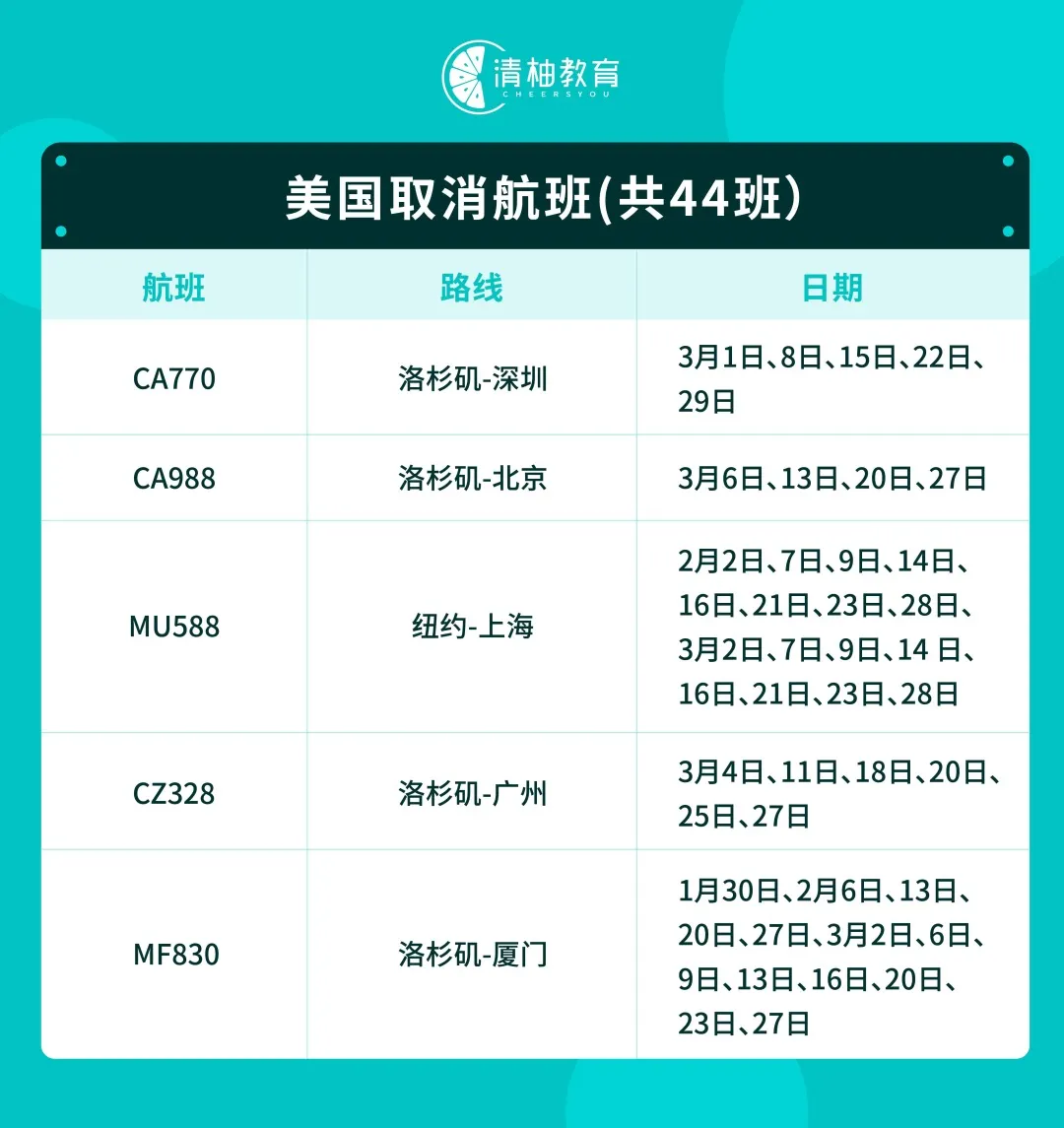
In late January, the U.S. Department of Transportation announced the suspension of 44 flights from the U.S. to China operated by four Chinese airlines, including Xiamen Airlines, Air China, China Southern Airlines, and China Eastern Airlines.
Among them, Xiamen Airlines' Los Angeles to Xiamen route will be suspended until March 29, and other routes of Xiamen Airlines and some flights of Air China, China Southern, and China Eastern will also be significantly reduced.
Previously, due to a high number of passengers testing positive for COVID-19 on flights to China, China suspended a total of 44 flights operated by United Airlines, American Airlines, and Delta Air Lines on December 31, 2021.
According to the U.S. Department of Transportation, it was based on China's routine circuit breaker measures that they decided to suspend the 44 Chinese airline routes.
March U.S.-China Flights Confirmed
As of now, the U.S. Department of Transportation has not made any changes to this decision, and Chinese airlines' China-bound routes in March will remain in the circuit breaker status.
Meanwhile, according to regulations of relevant Chinese departments, starting April 1, in addition to the existing testing requirements, travelers flying from the U.S. to China must undergo an additional antigen test before boarding.
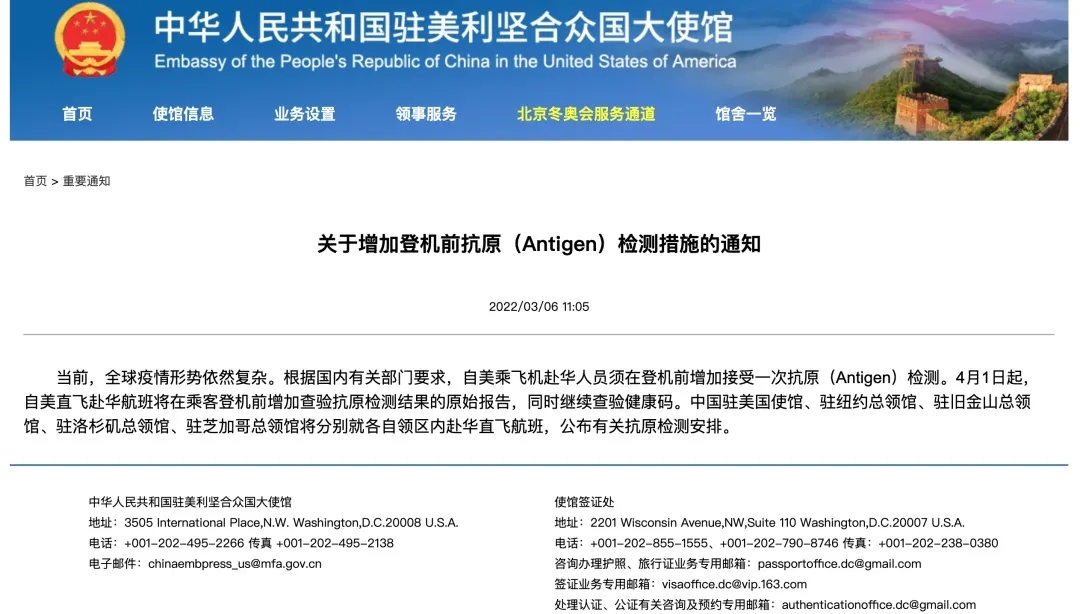
The sample collection time must be in the afternoon the day before departure. For example, if a China-bound flight departs on April 10 local time, the sample must be collected in the afternoon of April 9 local time. Specific antigen testing arrangements will be announced by Chinese consulates in the U.S.
Thus, together with the original three tests, starting April, those planning to fly from the U.S. back to China will need to visit designated laboratories at least three times for a total of four tests.
As for flights, U.S.-operated flights from the U.S. to China are generally normal, but individual flights may be canceled due to weather, crew, and other factors.
Confirmed March Operations for U.S. to China Flights:
United Airlines - UA857: San Francisco - Shanghai Pudong
(Wed, Fri, Sat, Sun flights, stopover in Seoul)
Delta - DL283: Detroit - Shanghai Pudong
(Monday, Friday departures, stopover in Seoul)
Delta - DL287: Seattle - Shanghai Pudong
(Tuesday, Thursday departures, stopover in Seoul)
American Airlines - AA127: Dallas - Shanghai Pudong
(Monday, Thursday departures, stopover in Seoul)
China Eastern Submits Next Season's Plan
Although it is unclear when the U.S. will change or terminate this decision, Chinese airlines have not been affected.
In early February, China Eastern Airlines submitted its 2022 summer season schedule to the U.S. Department of Transportation as usual, and as expected, it will continue to maintain a twice-weekly flight plan.
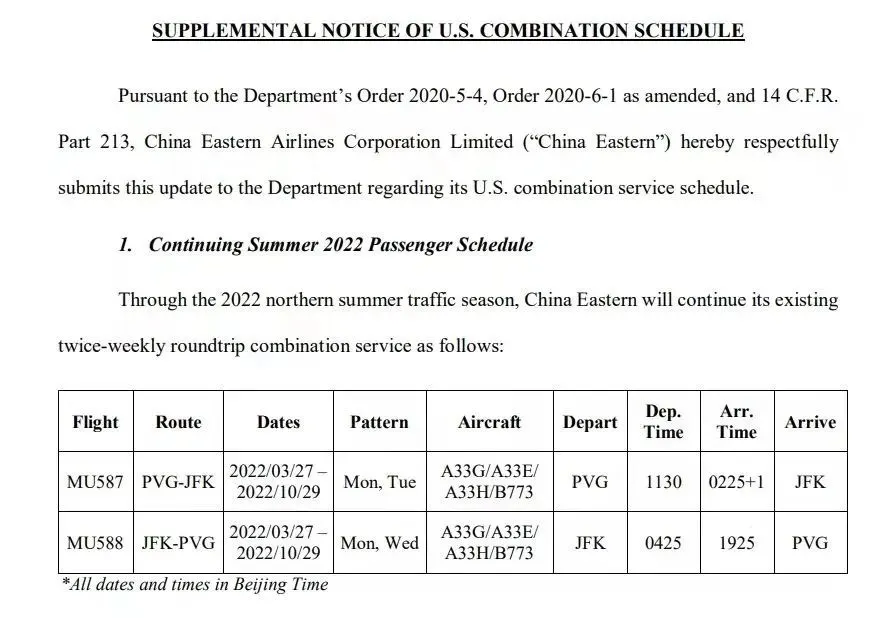
From this document, it can be seen that China Eastern will continue to operate two weekly round-trip flights between Shanghai and New York during the 2022 Northern Hemisphere summer-autumn season (March 27 to October 29):
MU587:
Shanghai Pudong (11:30 AM) – New York JFK (2:25 PM), every Monday and Tuesday
MU588:
New York JFK (4:25 PM) – Shanghai Pudong (7:25 PM+1), every Monday and Wednesday
In addition to China Eastern, all U.S. airlines have also adjusted their schedules before October 29, which are basically consistent with the current ones; Air China, Xiamen Airlines, and China Southern have not yet updated their schedules, but the updated available flights can be seen in the ticketing system and remain the same as before.
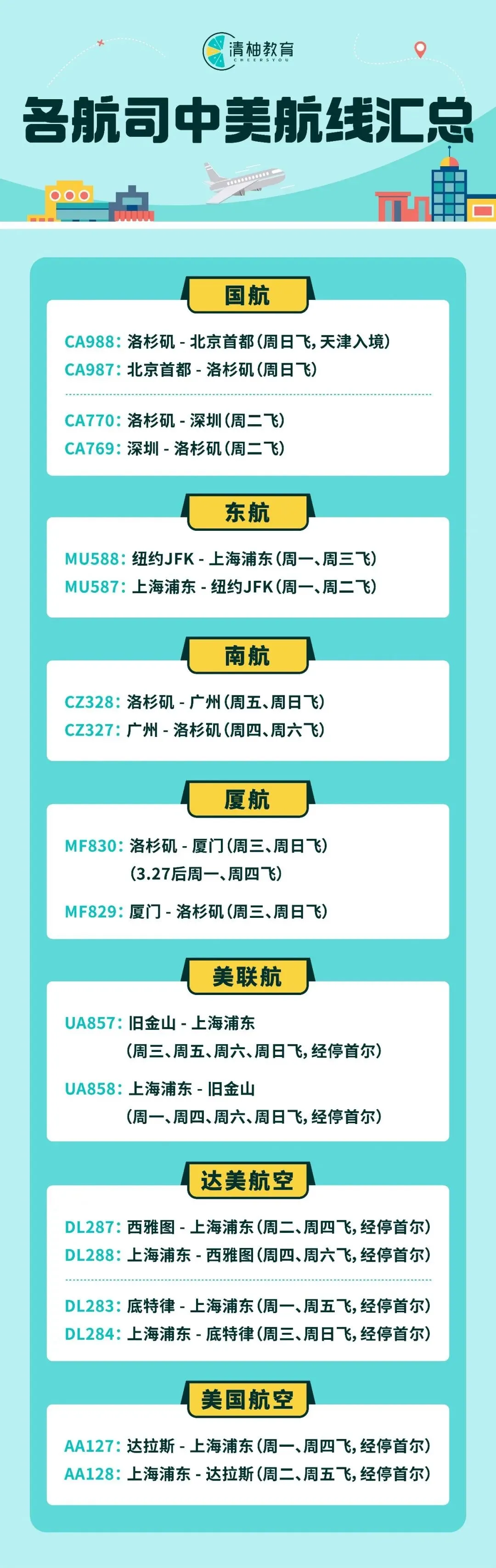
CheersYou(清柚教育) has also compiled a detailed list of routes from China to the U.S. for everyone, including direct and connecting flights—let's take a look!
To the U.S. - Direct Flights
Non-stop Direct Flights
· Air China - CA987: Beijing Capital - Los Angeles (every Sunday)
· Air China - CA769: Shenzhen - Los Angeles (every Tuesday, not operating before April)
· China Southern - CZ327: Guangzhou - Los Angeles (Thursday, Saturday; Saturday flights not operating before April)
· Xiamen Airlines - MF829: Xiamen - Los Angeles (Wednesday, Sunday)
· China Eastern - MU587: Shanghai Pudong - New York JFK (Monday, Tuesday)
Technical Stopover - Seoul, South Korea
United Airlines - UA858: Shanghai Pudong - San Francisco
(Monday, Thursday, Saturday, Sunday flights, stopover in Seoul)
Delta - DL288: Shanghai Pudong - Seattle (Thursday, Saturday flights, stopover in Seoul)
Delta - DL284: Shanghai Pudong - Detroit (Wednesday, Sunday flights, stopover in Seoul)
American Airlines - AA128: Shanghai Pudong - Dallas (Tuesday, Friday flights, stopover in Seoul)
(Note: This stopover is a technical one; no visa is required, and passengers do not need to disembark.)
To the U.S. - Connecting Flights
The advantages of connecting flights include through-checked baggage, shorter transfer times, convenient involuntary rebooking, and a relatively wider choice of destination cities.
Direct from Shekou via Hong Kong
Through the Skypier connection between Shenzhen Shekou Port and Hong Kong International Airport, passengers can check in and drop off luggage at the port, then fly directly to the U.S. after boarding.
Cathay Pacific – CX892: Hong Kong – San Francisco
American Airlines – AA8911: Hong Kong - San Francisco
Transit in Asia
Mainly via Hong Kong, Tokyo Narita, and Seoul Incheon; common routes include:
Cathay Pacific: Beijing/Shanghai/Guangzhou/Fuzhou/Xiamen/Chengdu/Wuhan/Hangzhou/Chongqing/Qingdao - Hong Kong - U.S. cities such as San Francisco, Los Angeles, etc.
Korean Air: Tianjin/Guangzhou/Dalian/Shenyang - Seoul - U.S. (Los Angeles, San Francisco, New York, Boston, Seattle, Washington, D.C., Dallas, Atlanta, Honolulu, etc.)
Asiana Airlines: Changchun/Chengdu/Harbin/Nanjing - Seoul - U.S. (New York, Los Angeles, San Francisco, Seattle, etc.)
Japan Airlines: Dalian - Tokyo - U.S. (Seattle, Dallas, Los Angeles, Boston, Dallas, etc.)
(Note: Transit in Seoul cannot exceed 24 hours; transit in Hong Kong must be on a single ticket and cannot exceed 24 hours, and Cathay Pacific flights generally meet this requirement; transit at Tokyo Narita must be on the same day and cannot involve an overnight stay or airport change.)
Other Transits
Transits via Europe (Paris, Amsterdam, Frankfurt, etc.), the Middle East (Dubai, Abu Dhabi, Qatar), Turkey (Istanbul), and Canada (Vancouver, Toronto) can also be used.
To the U.S. - Non-Interline Flights
Non-interline flights carry certain risks, with difficult refunds and changes, and require picking up luggage at the transfer point, re-checking in, going through security and even immigration; however, they are much cheaper. For students who have confirmed their return to campus in the summer, they can consider purchasing such tickets.
Tokyo, Japan and Seoul, South Korea are generally the preferred transit points. You can purchase separate tickets to fly to Tokyo/Seoul and then from Tokyo/Seoul to the U.S.
However, note that when purchasing tickets to Tokyo/Seoul, remember to buy officially scheduled flights and try to avoid low-cost carriers.
Flight policies may change at any time; students should remember to check the official website of the Civil Aviation Administration and major airline websites to avoid travel disruptions.
Whether returning home after graduation or going back to school in the U.S., remember to take precautions! The global pandemic is not over yet; may everyone complete their studies smoothly while staying safe and healthy!