The past year's application season is drawing to a close, and looking back, it can be described as "hell-level" difficulty.
A quick search on Xiaohongshu reveals visible carnage. Whether you're a mainland Chinese undergrad or an overseas undergrad, applying to the UK/Hong Kong or the US/Canada, "full rejections" will treat everyone equally.
Source: rednote
SPS colleges are flexing their muscles, rejecting even high-GPA students who don't match the program. UK "master's mills" keep raising requirements and even revoke offers already issued. Even the traditional "safe harbor" for mainland Chinese students is crumbling—Australian programs are tightening background screening and freely sending rejection letters...
Facing such fierce competition, mixed-country and multi-region applications can reduce risk and improve acceptance rates to some extent.
To help everyone understand the features and requirements of major application destinations more intuitively and comprehensively, CheersYou(清柚教育) has compiled a 2025 US-UK-Canada-Hong Kong-Singapore-Australia study-abroad comparative table to help you screen information and better plan your study-abroad path.
Comparison of Popular Global Study Destinations
According to the Institute of International Education (IIE), international student numbers in the US continued to grow in the 2023-2024 academic year, nearing historical highs. Among them, 502,291 international students were pursuing master's, doctoral, or professional degrees.
Source: IIE
Official data from the Higher Education Statistics Agency (HESA) shows that the number of postgraduate students from mainland China has been on an upward trend. Students from India and mainland China account for 48% of all non-EU international students.
Source: HESA
Since the post-pandemic era, global study-abroad enthusiasm has been rebounding, and application competition has intensified. Add to that ongoing policy changes in each region, which bring even more uncertainty to studying abroad.
By 2025, study-abroad families' choices have become more diverse and rational, with mixed-country and multi-region applications becoming the norm.
In the early preparation stage, what factors need to be taken into consideration? CheersYou(清柚教育) will now provide a detailed interpretation.
United States
Program Length
US master's programs range from one to two years, with the fastest completing in as little as 10 months. In addition, entry terms include both spring and fall semesters, with fall offering generally more program choices.
Application Timeline
Generally, graduate applications at top universities open sequentially from September to October, with priority deadlines usually in December-January, and final round deadlines continuing until February-May of the following year.
Admission Requirements
GPA: A minimum of 3.0+ is recommended, equivalent to an overall average of 80% or above across all subjects.
Language: For mainland Chinese applicants targeting top 30 schools, IELTS 7.0/TOEFL 100 is usually required; some schools may relax this to IELTS 6.5/TOEFL 90.
GRE/GMAT: For 25Fall, many programs still allow optional submission, but most business-related programs either require or strongly recommend scores. A GRE 325+ or GMAT 700+ is competitive.
Personal Statement & Essay: Typically, applicants need to cover their views on the chosen field, academic background and past projects, motivation for applying, and more. Many programs now also include video essays. This section offers extensive room for expression and is highly valued by admissions officers.
Letters of Recommendation: Most schools require 2-3 letters.
Work Experience: Some programs (e.g., business) explicitly require relevant internship/work experience.
Application Priorities
- Personal Statement / CV relevant experiences / Recommendation letters
- GRE/GMAT scores
- No hierarchical preference for undergraduate institution; emphasis on overall competitiveness
Visa Policy
The US government has extended the issuance date for new F and M student visas from 120 days before the program start date to 365 days, giving new students much more time for visa processing.
Source: USTravelDocs
For F-1 visa holders studying in the US, there are two types of practical training work visas: CPT (Curricular Practical Training) applied for during the program, and OPT (Optional Practical Training) applied for after graduation.
International students in STEM-designated programs (Science, Technology, Engineering, and Math) are eligible for a 36-month OPT extension after graduation, while non-STEM students only receive 12 months.
Over the past year, several new STEM programs have been introduced, such as Northwestern University's MTePP (Master of Science in Technology, People and Policy). Increasingly, there are also composite STEM programs in the humanities and social sciences fields available.
Source: @CheersYou(清柚教育) Application Archive
For students who wish to stay long-term in the US after graduation, they need to apply for an H-1B work visa, which is obtained through a lottery system.
This year, H-1B continues to implement the "one person, one lottery" rule: each registered beneficiary can only be drawn once, regardless of how many employers submit registrations. This brings more favorable odds for international students.
Source: USCIS
United Kingdom
Program Length
UK master's programs generally come in two types:
1. Taught Postgraduate Courses, commonly known as one-year programs, including MSc, MA, MBA, etc., lasting 9-12 months.
2. Postgraduate Research Programs, including MPhil, MRes, etc., typically lasting around 2 years.
Application Timeline
The application timeline has a broad span, varying by program and university. Most institutions open applications from mid-September to early October, with deadlines typically from January to March of the following year.
UK universities primarily use rolling admissions, operating on a first-come, first-served basis. Popular programs can fill up quickly once applications open. Even for projects with round-based admissions, international students are advised to submit materials early.
Admission Requirements
GPA: Similar to the US, a GPA above 3.0 is recommended. Different tiers have different requirements, and mainland Chinese applicants' grades are scrutinized quite strictly.
Language: Top 10 universities generally require IELTS 7.0, while standard universities typically need IELTS 6.5. It is permissible to submit applications without IELTS scores, receiving a conditional offer. If language requirements are not met, students can take a pre-sessional course or language program.
GRE/GMAT: Most do not mandate, but for targeting G5 and other top universities, submitting scores is advisable, and many G5 programs are mandatory.
Personal Statement & Essay: Most requirements align with the US. Some programs require a 2,000-word academic paper or research proposal.
Letters of Recommendation: Each university typically requires 2-3 letters.
Work Experience: Having relevant internship/work experience is advantageous for popular universities and programs.
Application Priorities
- GPA
- Undergraduate institution tier
- Personal statement
- IELTS score
Visa Policy
The UK provides the PSW (Post-Study Work) visa for international students. Eligible graduates can obtain a PSW visa valid for over 2 years (3 years for PhD graduates).
Last April, the UK government officially announced that the minimum salary requirement for the Skilled Worker Visa would increase from £26,200 to £38,700, bringing greater challenges for international students wishing to work and live in the UK.
Source: gov.uk
Canada
Program Length
Canadian master's programs (Master's Degree) are typically 2-3 years. Local applicants need an Honours Bachelor's Degree.
Application Timeline
Applications open mainly from September to the following January. Deadlines vary by institution, with some using rolling admissions.
Admission Requirements
GPA: An overall average of 80% or above is recommended.
Language: Top 5 universities require IELTS 7.0; for other schools, IELTS 6.5 is sufficient.
GRE/GMAT: Apart from some hardcore programs, most have no mandatory standardized test requirements.
Personal Statement & Essay: Requirements are largely similar to the US; some programs may have special essay requirements.
Letters of Recommendation: Each university typically requires 2-3 letters.
Work Experience: Some programs require work experience.
Application Priorities
- Personal Statement / CV relevant experiences / Recommendation letters
- No hierarchical preference for undergraduate institution; emphasis on overall competitiveness
- Canadian undergraduate background
Visa Policy
After graduating from a Canadian institution, you can apply for a Post-Graduation Work Permit (PGWP) within 180 days. Previously, programs lasting eight months to under two years yielded a PGWP for the same duration as the study period, while programs of two years or more received a three-year PGWP.
Starting February 15, 2024, for master's degrees: those graduating from a master’s program of less than 2 years (at least 8 months) and meeting all other PGWP eligibility criteria can also obtain a longer 3-year post-graduation work permit.
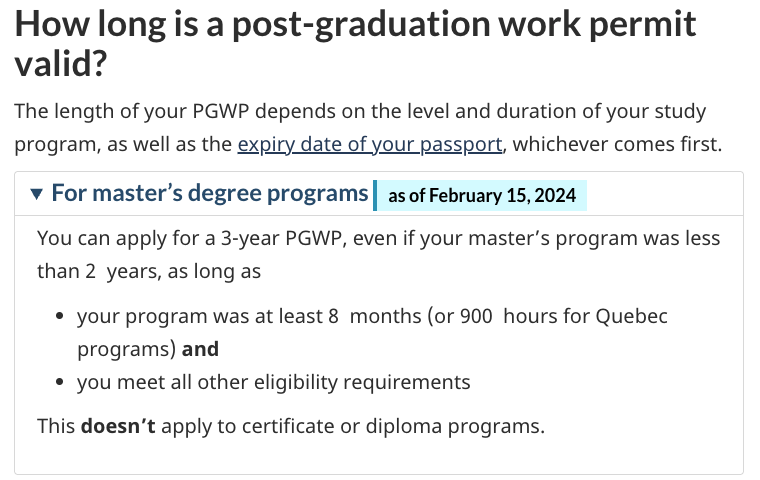
Source: Canada.ca
For students with immigration intentions, they must go through the provincial nomination and federal stage application before obtaining permanent resident status. After completing subsequent procedures, they can become full Canadian citizens.
Last year, Canada announced the cancellation of the previous BC PNP International Post-Graduate stream. Master's graduates in BC can no longer directly obtain PR; they must now meet additional requirements to apply for the maple leaf card. Policy tightening is intensifying the competition for studying and immigrating to Canada.
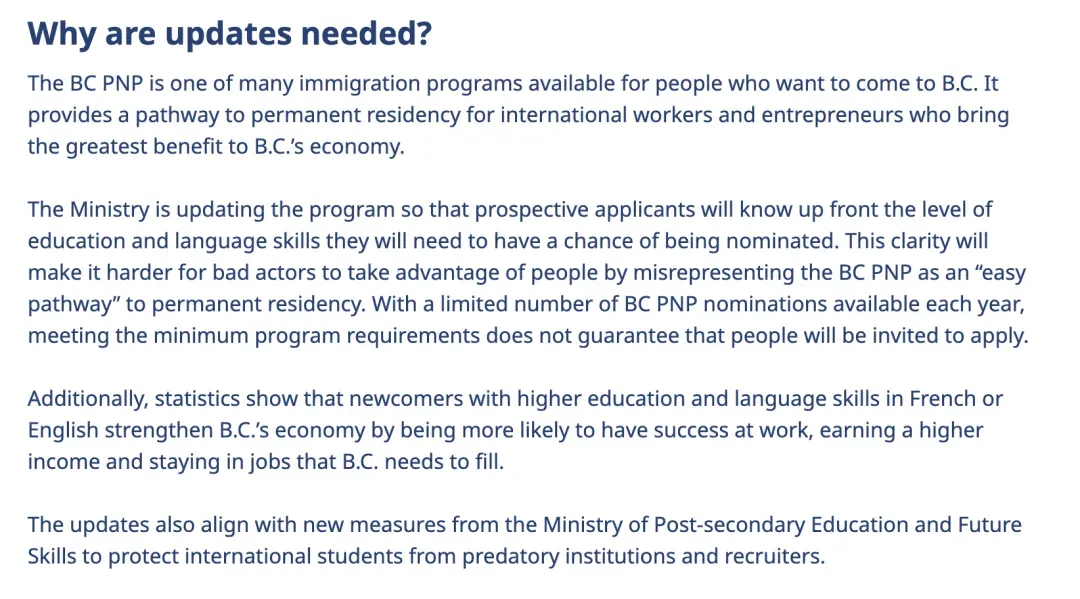
Source: Canada.ca
Hong Kong, China
Program Length
Similar to UK master's types:
1. Taught Postgraduate Courses, including MSc, MA, MBA, etc., lasting about 1 year.
2. Postgraduate Research Programs, divided into M.Phil and PhD, typically around 2 years.
Application Timeline
Similar to UK applications, the timeline has a broad span.
The top three Hong Kong universities open applications from mid-September to early October, with deadlines mostly from January to March.
Admission Requirements
GPA: HKU, HKUST, and CUHK require an average of 80% or above, with higher requirements based on mainland Chinese undergraduate institution tier.
Language: IELTS 7.0+ is recommended.
GRE/GMAT: No hard requirement but recommended for submission.
Personal Statement & Essay: Requirements mostly align with the US. Some programs require a 2,000-word academic paper or research proposal.
Letters of Recommendation: Typically 2-3 letters required.
Work Experience: Some programs require work experience.
Application Priorities
- GPA
- Undergraduate institution tier
- Personal statement
- IELTS score
Visa Policy
Non-local students enrolled in bachelor's degree or above can apply for on-campus part-time work, capped at 20 hours per week, with no limit during summer break.
After graduation, students can apply for the IANG (Immigration Arrangements for Non-local Graduates) work visa and work in Hong Kong for up to 6 subsequent years. After 7 years of continuous residence through study and work in Hong Kong, applicants and their dependents can obtain a Hong Kong Special Administrative Region passport.
Singapore
Program Length
Like Hong Kong, similar to UK master's types:
1. Master's by coursework, including MSc, MA, MBA, etc., lasting 1-1.5 years.
2. Master's by research, typically 2 years.
Application Timeline
Similar to Hong Kong and UK applications, with a broad timeline span.
Applications generally open from mid-September to early October, with deadlines mostly from January to March.
Admission Requirements
GPA: 985/211 mainland applicants require 80+; double non-affiliated universities require 85+.
Language: IELTS 7.0+ is recommended.
GRE/GMAT: Some programs require submission.
Personal Statement & Essay: Requirements mostly align with the US. Some programs require a 2,000-word academic paper or research proposal.
Letters of Recommendation: Typically 2-3 letters required.
Work Experience: Some programs require work experience.
Application Priorities
- GPA
- Personal statement
- IELTS score
- Overall competitiveness
Visa Policy
Post-graduation work visas are divided into three types: Work Permit (WP), S Pass (SP), Employment Pass (EP), with EP being the highest tier.
After graduating, if hired by a local Singapore company, you can apply for an Employment Pass (EP) from the immigration authority. After working for six months, you can apply for Permanent Residence (PR).
Australia
Program Length
Australian master's programs are also divided into taught and research types, with flexible course structures. Duration can be 1 year, 1.5 years, or 2 years, though 1.5 and 2 years are most common.
Application Timeline
Australian universities generally have intakes in February and July, requiring preparation six months to one year in advance.
International applications usually close 2-3 months before the start of the term, using rolling admissions, first-come, first-served.
Admission Requirements
GPA: 985/211 students are advised to have an average of 80+; double non-affiliated students, 85+.
Language: Some disciplines require IELTS 7.0 or above; other programs require 6.5.
GRE/GMAT: Virtually no standardized test requirements.
Personal Statement & Essay: It is recommended to keep word count within 500-800.
Letters of Recommendation: Typically 2-3 letters required.
Work Experience: Some programs require work experience.
Application Priorities
- GPA
- IELTS score
Visa Policy
After graduation, international students can apply for a 485 Temporary Graduate visa valid for 2-3 years, depending on qualifications.
Last year, the Australian Department of Education cancelled the policy that granted an additional two-year extension on post-study work visas for graduates in specific degree programs, no longer showing favor to international students.
Source: education.gov.au
Mixed-Country Application Advice
Mixed-country and multi-region applications disperse risk, but that absolutely does not mean blindly applying everywhere.
UCL allows students to apply for a maximum of two programs
When selecting schools and programs, we always discourage a "promiscuous" approach. We advise students to carefully consider their intended field and program positioning before applying.
For increasingly competitive Commonwealth region programs, the trend is moving closer to US admission policies. Evaluation factors include, but are not limited to, personal statement, internships, undergraduate tier, standardized test scores, interview performance, internship experience, and other comprehensive background aspects.
At the same time, policies in each region change annually. Students should also combine their own development intentions with local policies, comprehensively evaluate and adjust as appropriate, and ultimately make the most rational choice regarding study destinations and programs.
CheersYou(清柚教育) hopes all students can plan and prepare early! Determine your application direction, strike fast, accurately, and decisively to secure offers and realize your dream school aspirations!