
The Fall 22 application season is drawing to a close, and students are gradually receiving admission decisions from their target schools.
What gives applicants the most anxiety, however, is the waitlist email from schools.
Waitlist decisions are a common outcome in college admissions. Each year, the number of offers a university can extend is generally determined before the admissions cycle begins. Given the consistently high demand for spots, some applicants will inevitably end up on the waitlist without a direct offer of admission.
Yet, because this result is neither an acceptance nor a rejection, it leaves many students in a state of uncertainty, and their judgment can easily be swayed — leading to mistakes in handling the waitlist that do more harm than good.
Three Common Waitlist Misconceptions
Unlike a rejection, being placed on a waitlist means the school has determined you are qualified after a holistic review, but there simply aren't enough offers available.
Since not every admitted student will choose to attend, if some of those admitted decline their offers, candidates on the waitlist with similarly strong profiles get a chance. The school then conducts further screening among waitlisted applicants and eventually extends admissions offers to selected students.
Example of a university waitlist notification email
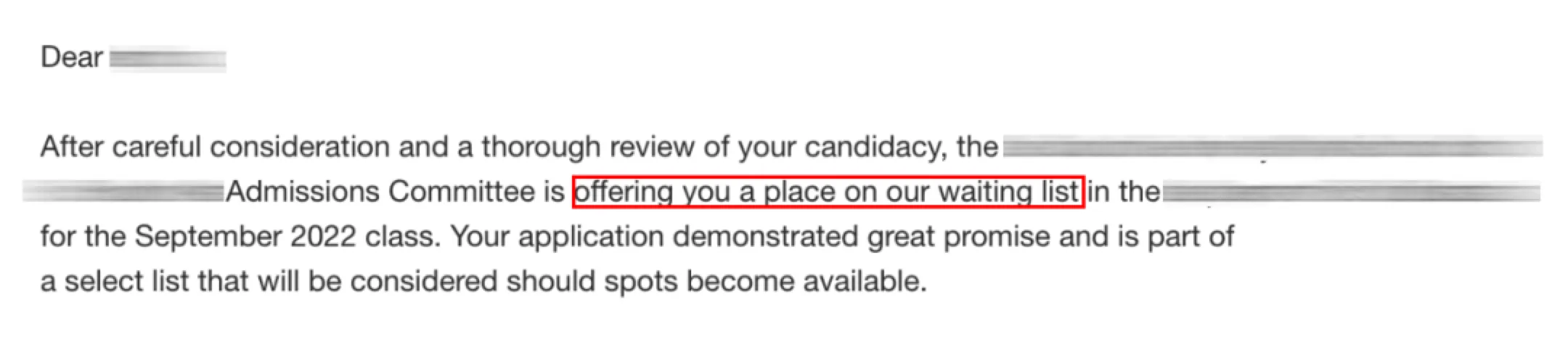
Ultimately, the final decision rests with the university. Any actions taken by the applicants may not necessarily influence the outcome. In fact, excessive or inappropriate efforts can backfire.
Here are some common mental or strategic pitfalls waitlisted students often fall into:
"My friend got into the same program and isn't attending — can they give their spot to me?"
A common question seen online is whether you can ask an admitted student who isn't enrolling to decline their offer and refer you for waitlist admission.
Such tactics are generally impossible to pull off.

Getting off the waitlist isn't like riding a bus or subway where someone can just give up their seat for you.
Schools have their own ordered list and criteria for selection; they won't allocate a spot to a specific person simply because you are friends or acquaintances.
Moreover, waitlists are generally not ranked, so there's no need to worry about your position on the list. However, schools often categorize candidates based on their background and experiences — such as the competitiveness of your undergraduate institution, your academic performance, and the quality of your internships or research — to select the most suitable students for admission.
"If I bombard the school with love letters and enthusiasm, they'll be won over"
As mentioned above, when evaluating waitlisted candidates, schools look at their background and experiences — meaning that simply writing a love letter won't get you admitted.
Some students are easily influenced by what they see online and think that if they act like an obsessive admirer, their "dream school" will eventually be moved. As a result, they send countless "harassment love" emails.
But this kind of obsessive, one-sided chasing has no future!
Take Yale University as an example — they officially state:
1. Unless your decision changes, do not contact the admissions office.
2. Do not submit additional materials; they will not be considered.
In plain terms: Stop bothering us; we only look at your original application.
Yale University's instructions regarding the waitlist
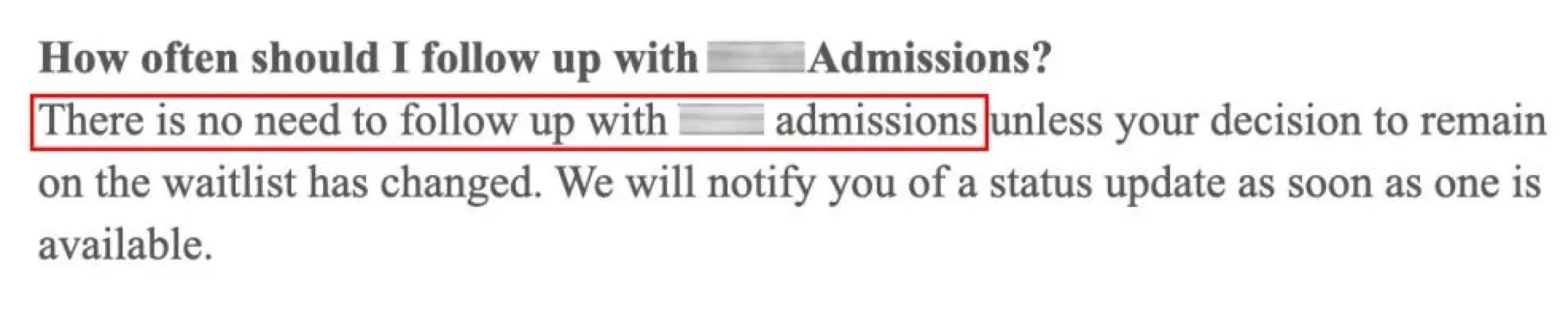
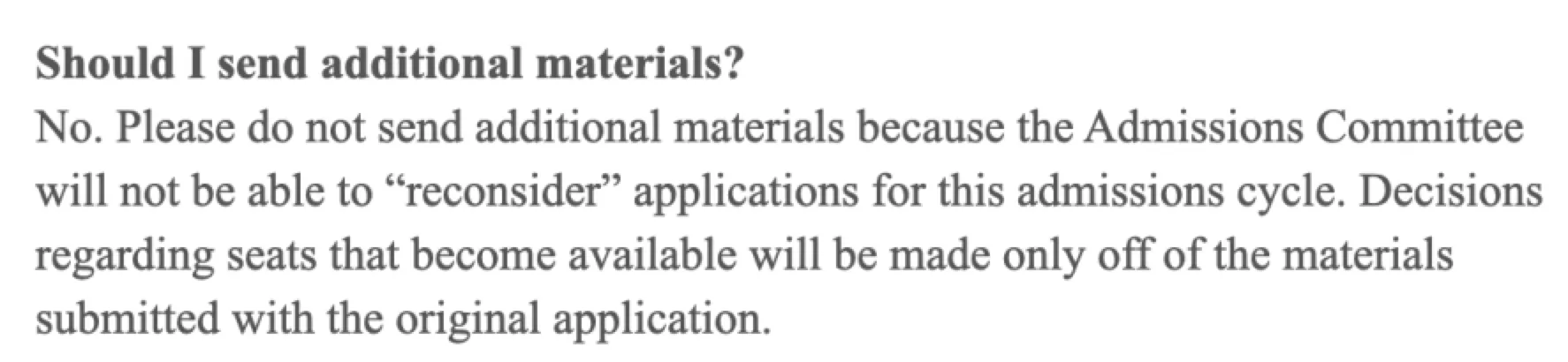
Faced with such a reserved admissions office, excessive love letters may simply land you on the program's email blocklist.
"If my love letter is deeply moving and heartfelt, the admissions officer will accept me"
Some students treat love letters like personal statements, believing that if every line is heartfelt and conveys a "if you don't accept me, my life is over" sentiment, the admissions officer will be emotionally overwhelmed.
If that were true, then humanities students with stellar writing skills would be unbeatable in waitlist competitions...
The so-called "love letter leads to immediate admission" stories you see online generally only apply to applicants who have made genuine improvements to their profile.
If there have been no changes in your background or experiences since being waitlisted, rushing to send a love letter can backfire.
Example of a school email noting insufficient supplementary materials in a love letter
.jpg?x-oss-process=style/opt-webp)
The school may even perceive your letter as lacking sincerity and promptly send you a direct, decisive rejection.
What Should You Do After Receiving a Waitlist Notification?
After careful consideration, waitlisted students typically decide on their next step: accept the waitlist offer and remain on it, or decline the waitlist offer from the school.
Whether you choose to stay or leave the waitlist, you usually need to notify the school or admissions office. This not only clarifies your intent to the school but also improves processing efficiency so you can receive a final decision sooner!
We also remind everyone to carefully read instructions: some schools require you to fill out a response form to confirm your waitlist decision.
NYU requires applicants to complete an online form to keep their waitlist spot
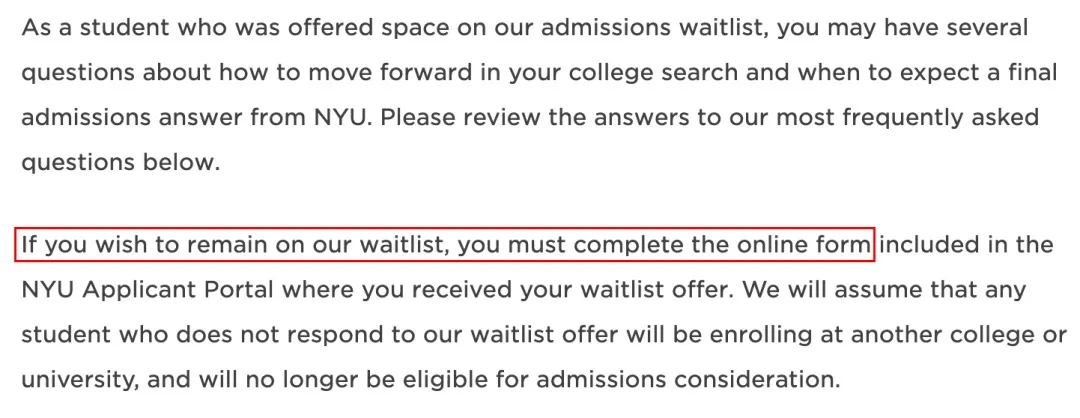
Below are several questions to consider before making your decision. Understanding your own situation is key to making the right choice.
1. When will you learn the final decision? In other words, how long are you willing to wait? Since school calendars vary, the wait could be anywhere from a few weeks to a few months. If possible, try to find out the estimated timeline.
Some programs provide an estimated notification date for waitlist decisions

2. If you are also waiting for or considering offers from other schools, you need to determine your chances of admission there, when deposit deadlines fall, etc., to ensure your overall application process stays on track and you don't miss out elsewhere while focusing on one school.
3. Think about what you can do to strengthen your application. Is there room for improvement — such as a better test score, updated background experiences, etc. — and can you submit them in time?
When Is It Appropriate to Write a Love Letter?
After deciding to accept the waitlist, if you truly want to attend that program, you can reasonably follow up to help strengthen your case.
At an appropriate time, you can consider sending an email to the admissions office, often referred to as a love letter. Its purpose is to express your continued interest and update the admissions office on your recent achievements, thereby boosting your competitiveness.
Prerequisites for Writing a Love Letter
1. The school does not discourage or prohibit follow-up emails.
2. You have sufficient substantive updates to present, including but not limited to:
1) An improvement in GPA or standardized test scores
2) New outcomes from internships or research
3) A new, stronger letter of recommendation from a professor or supervisor
If you do not meet the above prerequisites, do not rush to write a love letter.
The most crucial part of a love letter is updating the admissions office on your improvements. Such updates provide concrete evidence of your ability to succeed at their institution, which is exactly what admissions officers want to see.
Everything else is just fluff. Admissions committees have reviewed applications for years and can see right through various applicant types.
Sweet talk won't rescue you from the waitlist — real, substantive progress is what matters most.
Receiving a waitlist is both an opportunity and a challenge. In the end, it's about who can stay calm, seize the right moment, and turn the situation around.
We wish everyone the best in eventually receiving an offer from your dream school!