Over the past week or so, JD has done its best to fulfill its promise of ensuring material supply, helping everyone through difficult times with its effectively integrated supply chain logistics management during this special period.
.jpg?x-oss-process=style/opt-webp)
Earlier, a JD "Logistics Management" recruitment notice also went viral.
No work experience required? Fresh graduates can start directly after graduation? Starting salary of 10,000 RMB? Is logistics management some kind of hidden high-paying career? JD is really generous toward fresh graduates!
.jpg?x-oss-process=style/opt-webp)
.jpg?x-oss-process=style/opt-webp)
Remembering some time ago, JD gobbled up Deppon in one move, and the former "Less-than-Truckload Champion" thus fell. JD truly deserves to be called the king of involution in e-commerce.
.jpg?x-oss-process=style/opt-webp)
Goodbye, Deppon Express!
JD Logistics acquired a total of 66.49% of Deppon Logistics' shares, and after the completion of the acquisition, JD Logistics will become the controlling shareholder of Deppon Logistics. Deppon's chairman, Cui Weixing, will also no longer be the actual controller of Deppon.
.jpg?x-oss-process=style/opt-webp)
Speaking of Deppon Express, international students who frequently ship large items should be very familiar with it. Many people find Deppon's prices for shipping large items quite affordable.
.jpg?x-oss-process=style/opt-webp)
.jpg?x-oss-process=style/opt-webp)
For many graduates moving things, Deppon is their first choice. Therefore, Deppon has long held an unshakable position in the field of shipping large items.
But competition is always brutal, and the express delivery industry has developed too rapidly. As various express and less-than-truckload logistics companies have entered the market and engaged in involution, they not only increased investment in human resources but also competed fiercely in technology.
.jpg?x-oss-process=style/opt-webp)
Technologies such as robotics automation, drones, autonomous driving, big data, cloud computing, as well as emerging technologies like artificial intelligence, 3D printing, AR, and VR, have left Deppon, which focused solely on human resource development in recent years, far behind.
Look at the online posts criticizing Deppon Express over the past two years.
.jpg?x-oss-process=style/opt-webp)
.jpg?x-oss-process=style/opt-webp)
.jpg?x-oss-process=style/opt-webp)
Complaints about poor attitude, increased prices, lost shipments, and incorrect deliveries abound, with its reputation declining day by day. It seems Deppon's acquisition was an inevitable trend.
Regarding this acquisition, it was rumored that SF Express and Yunda also secretly exerted effort, both eying the chance to compete for acquiring Deppon. After all, expansion through acquisition is a fast track for corporate growth, and everyone covets a hot commodity like this.
But in the end, Deppon chose JD. Over ten years of Alibaba's franchise expansion and deployment, China's express delivery industry is now divided among JD, SF Express, and the Tongda Group (ZTO, YTO, STO, Best, etc.).
.jpg?x-oss-process=style/opt-webp)
Foreign Logistics Companies Are Also in an Involution
It's not just domestic logistics companies that are in fierce competition; many foreign logistics companies also became industry leaders through expansion.
For example, the United Parcel Service (UPS) first established a mature express business model and then expanded outward, taking only 20 years to ascend to the top position in global logistics.
Similarly, Federal Express (FedEx) was founded only about 50 years ago, and in the latter 20 years, it has focused on expanding its global network, acquiring many local express companies abroad, eventually growing into the world's second-largest logistics express company.
.jpg?x-oss-process=style/opt-webp)
Amazon's logistics business is also still expanding. Over the past two years, Amazon has been absorbing real estate space across the United States, continuously building new logistics centers.
Dave Clark, CEO of Amazon's global consumer business, stated that Amazon is expected to surpass long-time rivals UPS and FedEx by early 2022, becoming the largest express delivery service company in the United States.
.jpg?x-oss-process=style/opt-webp)
Are There Hidden High-Paying Careers in the Logistics Industry?
With the continuous expansion of relevant logistics enterprises, it can be seen that the demand for versatile talents from global logistics giants is heating up. Therefore, the logistics/supply chain industry is hailed as "one of the most promising industries of the 21st century" and the "third source of profit".
Besides paying attention to major internet companies, logistics business positions have gradually become a popular choice for many when job hunting.
After all, at present, logistics/supply chain management related professions are well-compensated both domestically and internationally. According to data from Glassdoor, the average annual salary for supply chain management related positions in the United States is $100,000.
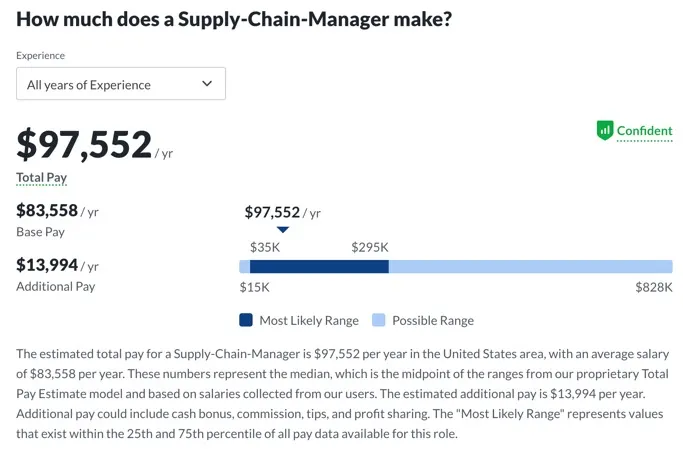
In cities like Seattle, Washington, the average annual salary can reach $120,000.
.jpg?x-oss-process=style/opt-webp)
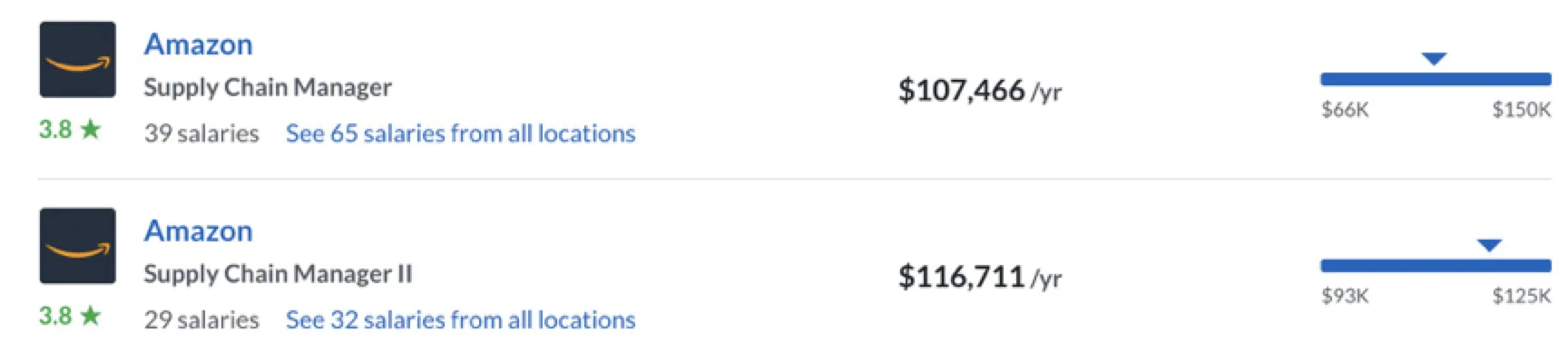
For example, Amazon's supply chain management related job postings start at a salary of $100,000.
At present, there is a severe shortage of professional technical talents in logistics and supply chain both domestically and internationally.
Outstanding management professionals in logistics/supply chain need to be able to systematically optimize and design related transportation, warehousing, and freight forwarding. Therefore, they need to have a certain reserve of knowledge in management, economics, and information technology, as well as solid English proficiency and computer skills.
Currently, such professional talents have been listed as one of the 12 types of scarce talents in China, with a gap of over 600,000.

Logistics Management = Supply Chain Management?
From a corporate perspective, supply chain management includes logistics management. Supply chain management covers the management of the entire economic chain, including suppliers and vendors, and even the formulation and matching of production plans.
In U.S. universities, logistics management and supply chain management programs are mostly housed in business schools. Additionally, some schools offer these programs within industrial engineering.
According to the characteristics of the programs offered by different schools, they can be primarily divided into three categories: the first emphasizes supply chain analysis and research; the second is a branch of an MBA program and requires applying according to MBA standards; the third focuses on logistics and supply chain management methods.
2022 QS Supply Chain Management Master's Program Rankings
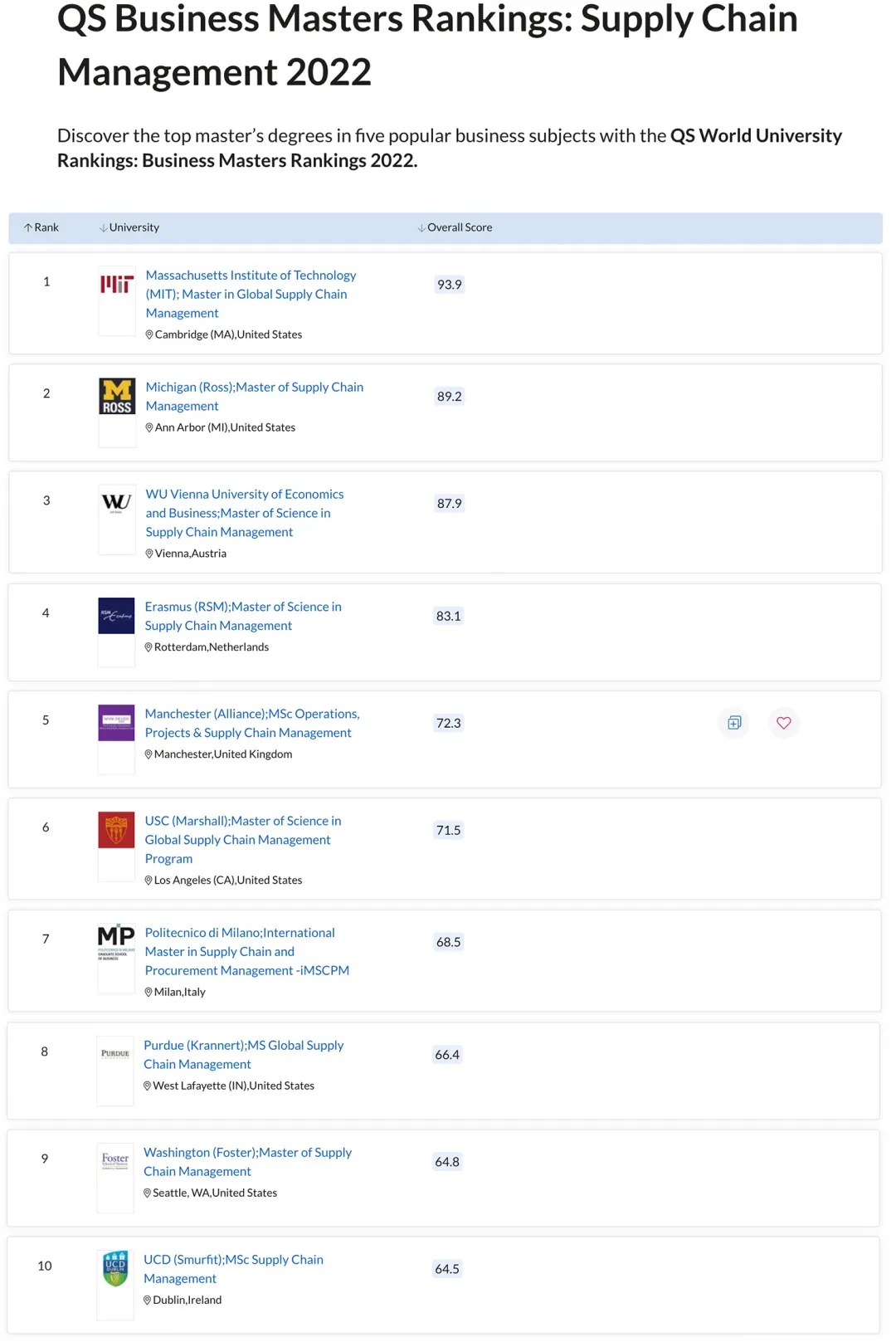
In the 2022 QS World University Rankings for supply chain management, MIT ranks first, with its logistics and supply chain program housed in the Sloan School of Management, offering a dedicated Supply Chain track. The University of Michigan follows closely.
Columbia University's supply chain management program is within the Department of Industrial Engineering in the School of Engineering, focusing mainly on logistics, supply chain, and budget management analysis, making it very suitable for applicants with a science and engineering background.

Some schools may not have a dedicated program but offer concentrations such as Operations Strategy and Management, which essentially involves the study of supply chain management.
The logistics/supply chain management profession has evolved from an unfamiliar discipline to one that is gradually understood by everyone in just a few short years. The popularity of this profession alone suggests that its future development space is quite substantial.
Applications for this major have become quite competitive in recent years. If anyone is interested in this direction, it's crucial to plan your application early!