
QuantNet has just released the latest 2023 national financial engineering program rankings!
Baruch College's Financial Engineering continues to rank first, Princeton jumps to second, Columbia Math Finance overtakes its own Financial Engineering, and MIT and Cornell edge out NYU!
This year, QuantNet surveyed financial engineering, financial mathematics, and quantitative finance programs, ultimately ranking them based on admissions, employment, and career services.
2023 QuantNet Latest Full Rankings
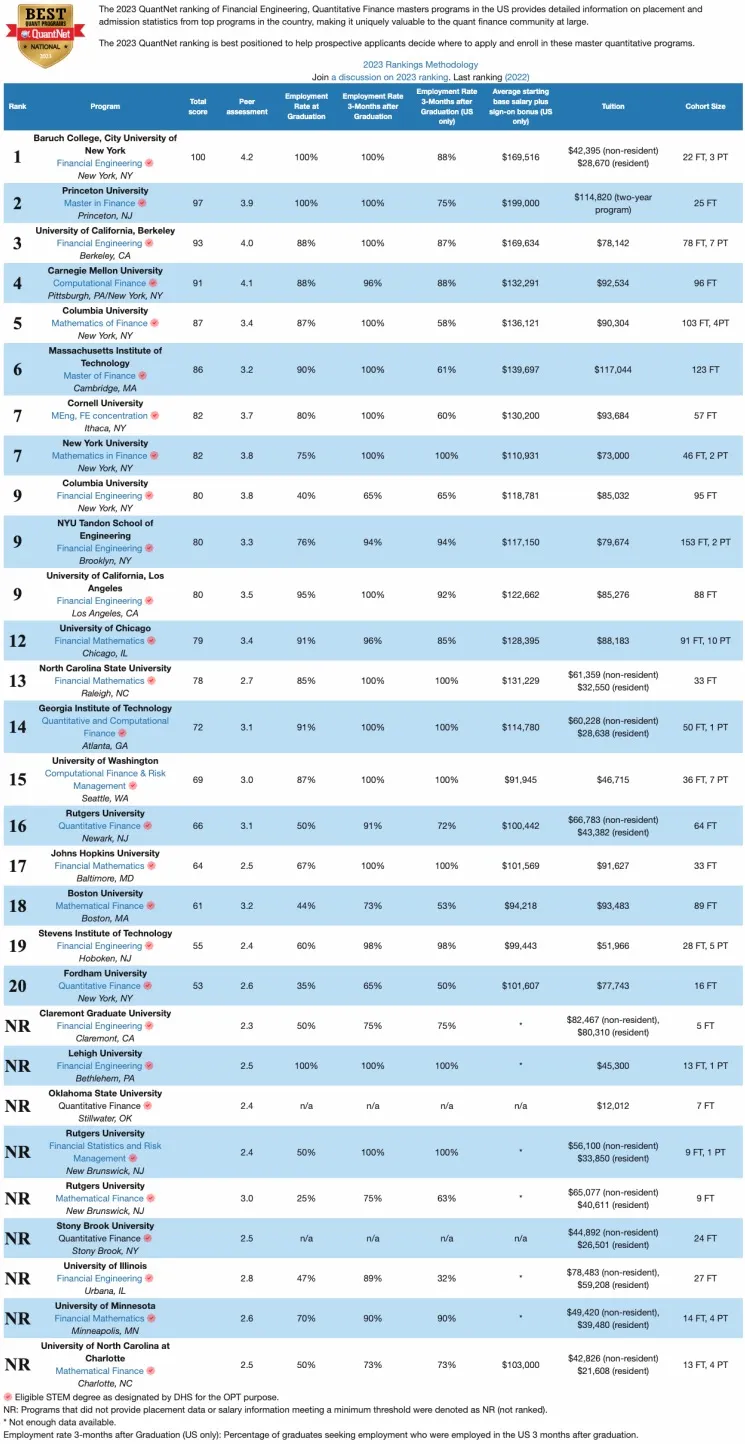
Baruch College's Master of Financial Engineering continues to top the list.
Princeton's Master in Finance rises one spot to second, edging out UCB and CMU, which rank third and fourth.
Columbia Math Finance strongly overtakes Columbia Financial Engineering, entering the Top 5, while Columbia Financial Engineering drops from 5th last year to 9th this year.
MIT and Cornell rise to 6th and 7th this year, together surpassing their previous strong rival—NYU's Math Finance and Financial Engineering.
New programs added this year:
Oklahoma State University Quantitative Finance
Rutgers University Financial Statistics and Risk Management
Overall, due to the employment ranking indicators being adjusted to US Only this year, the rankings have seen significant changes.
2023 Ranking Assessment Criteria
Peer Assessment (20%)
Employment Success (55%)
- Graduate Employment Rate (10%)
- Employment Rate Three Months After Graduation (15%) (US Only)
- Average Starting Salary and Signing Bonus (20%) (US Only)
- Employer Satisfaction (10%)
Student Selectivity (25%)
- Undergraduate GPA (17.5%)
- Program Acceptance Rate (7.5%)
In this year's latest rankings, 'Employment Rate Three Months After Graduation' and 'Average Starting Salary and Signing Bonus' have been changed to US Only indicators; the student selectivity criteria still exclude GRE score weighting.
QuantNet Ranking Significance
The QuantNet ranking has always played a crucial guiding role for students in financial engineering, especially those planning to work in the U.S. for a period. In the post-pandemic economic recovery, this ranking holds even greater value for applicants.
Take Columbia Math Finance as an example: in the latest statistics on MAFN graduate destinations, the employment rate within three months of graduation is as high as 87%.

We can also see that among the companies where graduates are headed, top employers include Goldman Sachs, J.P. Morgan, CICC, Morgan Stanley, UBS, Citigroup, Société Générale, Huatai Securities, CITIC, Barclays, and other prestigious firms.

A strong program can offer great job prospects and return on investment. With employment success being the heaviest weight in the QuantNet ranking, MFE applicants who are particularly focused on employment can use it to make better choices about programs.
In recent years, the number of MFE applicants has continued to rise, and admission thresholds have steadily increased, making it extremely popular.

For the new year's MFE program applications, CheersYou(清柚教育) still advises: Apply early!
It's crucial to have a discerning eye when selecting schools and programs; you must be able to see the strengths and prospects of each program to win in the future.
Source: QuantNet