
Recently, Purdue University's decision to reinstate SAT/ACT requirements for the Fall 2024 application cycle has once again put the SAT in the spotlight for U.S. college applicants.

In the post-pandemic era, many U.S. universities have adjusted their SAT policies. The discussions on "Should I take the SAT?" and "Does an SAT score really help my application?" are heating up again.
Together with U.S. News' recently published list of the 31 U.S. universities with the highest SAT scores for undergraduate admissions in 2021, let's take a look at which prestigious schools made the list, and understand whether you should take the SAT for U.S. college applications.
Top 31 Colleges with Highest SAT Admission Scores
Data from the College Board shows that last fall, the average SAT score for admitted freshmen at U.S. universities was 1060. But to get into top schools, applicants often need scores far above the average.
The 31 schools on this list have an average SAT score of 1494, approaching the super-high 1500 mark.

Among them, the University of Chicago tops the list with an average SAT score of 1545.
Here are the details of the ranking:
1
University of Chicago
Average SAT Score: 1545
Test Policy: Test-optional
U.S. News Ranking: #6 National University
2
Massachusetts Institute of Technology
Average SAT Score: 1538
Test Policy: Required
U.S. News Ranking: #2 National University
3
Stanford University
Average SAT Score: 1528
Test Policy: Test-optional
U.S. News Ranking: #3 National University
4
Washington University in St. Louis
Average SAT Score: 1522
Test Policy: Test-optional
U.S. News Ranking: #15 National University
5
Harvey Mudd College
Average SAT Score: 1520
Test Policy: Test-optional
U.S. News Ranking: #29 Liberal Arts College
6
University of Pennsylvania
Average SAT Score: 1513
Test Policy: Test-optional
U.S. News Ranking: #7 National University
7
Yale University
Average SAT Score: 1511
Test Policy: Test-optional
U.S. News Ranking: #3 National University
8
Harvard University
Average SAT Score: 1510
Test Policy: Test-optional
U.S. News Ranking: #3 National University
9
Pomona College
Average SAT Score: 1509
Test Policy: Test-optional
U.S. News Ranking: #3 Liberal Arts College
10
Carnegie Mellon University
Average SAT Score: 1509
Test Policy: Test-optional
U.S. News Ranking: #22 National University
11
Williams College
Average SAT Score: 1501
Test Policy: Test-optional
U.S. News Ranking: #1 Liberal Arts College
13
Northwestern University
Average SAT Score: 1496
Test Policy: Test-optional
U.S. News Ranking: #10 National University
14
Brown University
Average SAT Score: 1495
Test Policy: Test-optional
U.S. News Ranking: #13 National University
15
New York University
Average SAT Score: 1493
Test Policy: Test-optional
U.S. News Ranking: #25 National University
16
Haverford College
Average SAT Score: 1490
Test Policy: Test-optional
U.S. News Ranking: #18 Liberal Arts College
17
Swarthmore College
Average SAT Score: 1489
Test Policy: Test-optional
U.S. News Ranking: #4 Liberal Arts College
18
Cornell University
Average SAT Score: 1488
Test Policy: Test-optional
U.S. News Ranking: #17 National University
19
Tufts University
Average SAT Score: 1485
Test Policy: Test-optional
U.S. News Ranking: #32 National University
20
Northeastern University
Average SAT Score: 1481
Test Policy: Test-optional
U.S. News Ranking: #44 National University
21
Dartmouth College
Average SAT Score: 1481
Test Policy: Test-optional
U.S. News Ranking: #12 National University
22
Amherst College
Average SAT Score: 1480
Test Policy: Test-optional
U.S. News Ranking: #2 Liberal Arts College
23
Barnard College
Average SAT Score: 1478
Test Policy: Test-optional
U.S. News Ranking: #18 Liberal Arts College
24
Carleton College
Average SAT Score: 1475
Test Policy: Test-optional
U.S. News Ranking: #6 Liberal Arts College
25
Emory University
Average SAT Score: 1473
Test Policy: Test-optional
U.S. News Ranking: #22 National University
26
Boston College
Average SAT Score: 1466
Test Policy: Test-optional
U.S. News Ranking: #36 National University
27
Vassar College
Average SAT Score: 1465
Test Policy: Test-optional
U.S. News Ranking: #13 Liberal Arts College
28
University of Southern California
Average SAT Score: 1465
Test Policy: Test-optional
U.S. News Ranking: #25 National University
29
Hamilton College
Average SAT Score: 1465
Test Policy: Test-optional
U.S. News Ranking: #15 Liberal Arts College
30
Georgetown University
Average SAT Score: 1465
Test Policy: Required
U.S. News Ranking: #22 National University
31
Colby College
Average SAT Score: 1465
Test Policy: Test-optional
U.S. News Ranking: #24 Liberal Arts College
Overall, about 72% of four-year U.S. colleges still have test-optional or test-blind admission policies. Among the top 60 U.S. national universities, only six enforce a Test Required policy: MIT, Georgetown, University of Florida, Georgia Tech, University of Georgia, and Florida State University.
While SAT scores are no longer seen as a mandatory admissions criterion, admissions offices will place greater emphasis on applicants’ overall profiles. However, a strong SAT score can still add a valuable dimension to an application, especially for students who may be slightly weaker in other areas such as GPA, extracurricular activities, or essays.
How Should You Interpret Your SAT Score?
Analyze Your Performance Level
If you want to understand the overall SAT testing landscape and see how your score compares globally, you can refer to the 2022 SAT Suite of Assessments Annual Report released by the College Board not long ago.
The report shows that among the class of 2022, 1,737,678 students took the SAT during high school, with an average score of 1050.
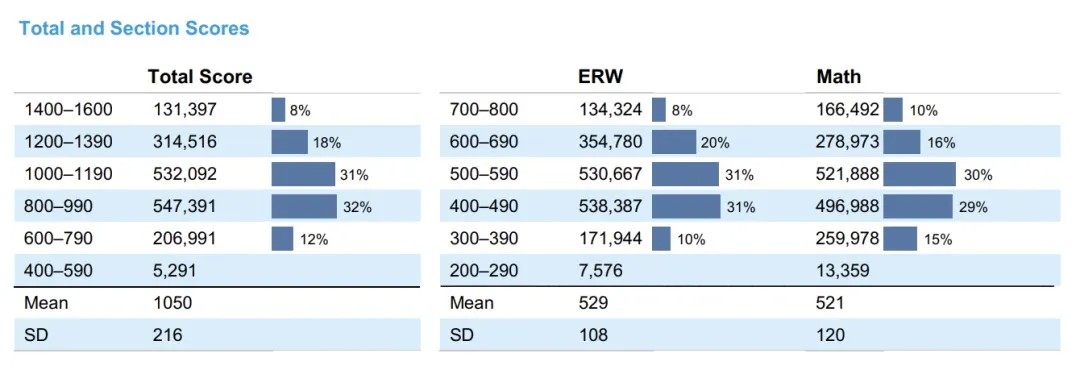
Most test-takers scored between 800 and 1190. If you achieve a score of 1400, that means you have outperformed 92% of test-takers worldwide.
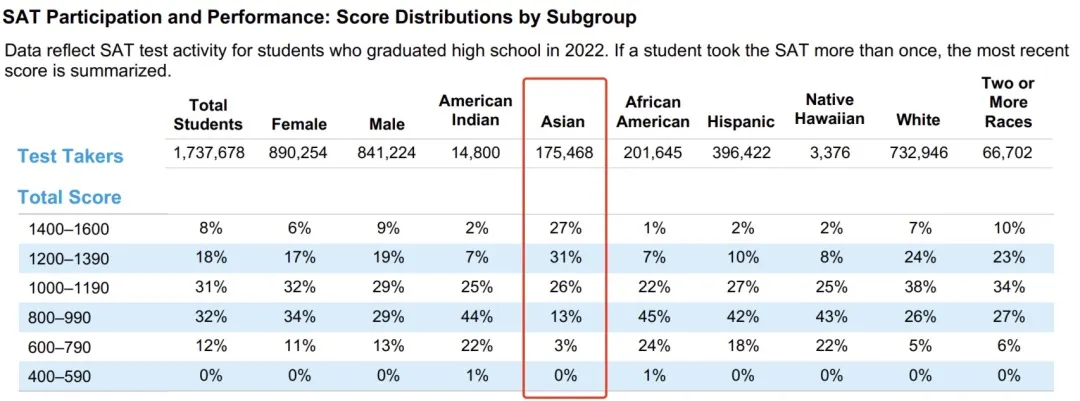
Among the group scoring 1400 or above, Asian students account for 27%. Compared with other ethnic groups, Asian test-takers far outpace the international average, with a 17 percentage point lead over the next highest group.
If we compare the SAT admission scores of the top 31 U.S. universities, even the schools at the bottom of the list—Vassar, USC, Hamilton, Georgetown, Colby—have average admitted student scores of 1465, a full 415 points higher than the global average.
In other words, if you aim to apply to top-tier U.S. schools, you'll need a sufficiently outstanding SAT score. It not only serves as proof of strong academic ability but can also give you an edge in scholarship applications.
View High SAT Scores Rationally
At the same time, we should look at high SAT scores rationally.
For most universities that do not require test scores, only applicants with high scores will submit SAT results. This partly explains why, after schools adopted test-optional policies, the SAT admission scores at many institutions have actually risen.
Therefore, don't over-mythologize the SAT. While striving for a satisfactory score, don't neglect other aspects of your application.
Always remember that college admissions evaluate each applicant holistically. A combination of strong hard and soft skills will increase your chances of receiving an offer from your dream school.