
Speaking of CS (Computer Science) and EE (Electronics Engineering), these two are unquestionably the hottest majors for students studying in the United States. Students are also very concerned about the rankings of EE and CS programs. However, many students often fail to distinguish between the concepts of EE and CS during the application process, finding them easy to confuse and not knowing how to choose. Today, let us analyze these two majors in detail, and discuss the specific differences and connections between EE and CS.
EE (Electronics Engineering) Program Overview
First, let's introduce the EE major. EE in the United States is a highly interdisciplinary field. The teaching and research areas of electrical engineering at major U.S. universities can be broadly summarized into 11 directions: communications and networking, computer science and engineering, signal processing, systems control, electronics and integrated circuits, photonics and optics, electric power, electromagnetics, microstructure, materials and devices, and bioengineering.
Of course, different schools have different focuses in their research directions.

ECE is also a program often discussed alongside EE. Taking the ECE program at Rutgers University as an example, it offers six graduate tracks:
- Communications Engineering
- Computer Engineering
- Digital Signal Processing
- Software Engineering
- Solid State Electronics
- Systems and Controls
Among these, Computer Engineering and Software Engineering are the most chosen and, in a broad sense, the most promising fields. Overall, the electrical engineering major trains mainly high-level technical talent, so graduates have a wide range of employment options and strong adaptability.
Generally speaking, EE graduate students can take on important roles in fields related to electronic engineering, such as system operation, automatic control, information processing, experimental technology, research and development, economic management, and the application of electronics and computer technology. They can also work in power plants, power supply bureaus, grid dispatch centers, and other enterprises engaged in power design, construction, commissioning, production, operation, management, market operations, technology development, and technical training; or in the maintenance, repair, installation, and commissioning of electrical equipment.

In addition, graduates can also pursue electronic technology work in other industries. Generally, the starting salary for EE master's graduates is above $65,000.
2023 U.S. News EE Program Rankings
US EE Program Ranking top1 Massachusetts Institute of Technology
US EE Program Ranking top1 Stanford University
US EE Program Ranking top1 University of California, Berkeley
US EE Program Ranking top4 California Institute of Technology
US EE Program Ranking top4 Georgia Institute of Technology
US EE Program Ranking top4 University of Illinois at Urbana-Champaign
US EE Program Ranking top7 University of Michigan, Ann Arbor
US EE Program Ranking top8 Carnegie Mellon University
US EE Program Ranking top9 Cornell University
US EE Program Ranking top9 Purdue University, West Lafayette
US EE Program Ranking top9 The University of Texas at Austin
US EE Program Ranking top12 Princeton University
US EE Program Ranking top12 University of California, Los Angeles
US EE Program Ranking top14 Columbia University
US EE Program Ranking top14 University of California, San Diego
US EE Program Ranking top16 University of Pennsylvania
US EE Program Ranking top16 University of Southern California
US EE Program Ranking top16 University of Wisconsin–Madison
US EE Program Ranking top19 Harvard University
US EE Program Ranking top19 Johns Hopkins University
CS (Computer Science) Program Overview
Computer Science (CS) is the systematic study of the theoretical foundations of information and computation, and their implementation and application in computer systems. It is often described as the systematic study of algorithmic processes that create, describe, and transform information.
The main branches of Computer Science include: software engineering, databases, computer networks, artificial intelligence, computer graphics and multimedia, architecture/compilers and parallel computing, human–computer interaction, management information systems, information security, and theory and algorithms.

CS programs are offered at almost all U.S. institutions, and there are no strict restrictions on students' previous schools or majors. If you are confident in your math or computer skills, you can also try applying.
Moreover, the job market for CS graduates in the United States has always been very broad. Depending on their specialization, CS graduates can find ample opportunities in their fields, such as high-tech development engineers, software testing, or database/network administrators who do not need to immerse themselves in code but must master relevant management software and have extensive work experience. There are many other directions, like entering schools or research institutions for scientific research, etc.

2023 U.S. News CS Program Rankings
US CS Program Ranking top1: Massachusetts Institute of Technology
US CS Program Ranking top2: Carnegie Mellon University
US CS Program Ranking top2: Stanford University
US CS Program Ranking top2: University of California, Berkeley
US CS Program Ranking top5: University of Illinois at Urbana-Champaign
US CS Program Ranking top6: Cornell University
US CS Program Ranking top6: Georgia Institute of Technology
US CS Program Ranking top6: University of Washington
US CS Program Ranking top9: Princeton University
US CS Program Ranking top9: The University of Texas at Austin
US CS Program Ranking top11: California Institute of Technology
US CS Program Ranking top11: Columbia University
US CS Program Ranking top11: University of California, Los Angeles
US CS Program Ranking top11: University of California, San Diego
US CS Program Ranking top11: University of Michigan, Ann Arbor
US CS Program Ranking top16: Harvard University
US CS Program Ranking top17: University of Maryland, College Park
US CS Program Ranking top17: University of Pennsylvania
US CS Program Ranking top17: University of Wisconsin–Madison
US CS Program Ranking top20: Johns Hopkins University
US CS Program Ranking top20: Purdue University, West Lafayette
US CS Program Ranking top20: Yale University
Differences Between CS and EE
In terms of professional distinction, EE is more inclined toward the physical layer and hardware, while CS leans more toward software. Representative hardware-oriented EE directions include electromagnetics, circuit design, control circuits, microelectronic systems, and communication systems; software-oriented CS areas involve programming, computer graphics, computer vision, mobile robotics, applied artificial intelligence, and more.
EE has higher requirements in mathematics and physics, but from an academic framework perspective, EE and CS are closely related. Therefore, whether in China or the U.S., most of the foundational courses in undergraduate programs for these two majors overlap. The main difference is that at the specialized course stage, EE tends to focus more on hardware, while CS leans more toward software.

Application Difficulty Comparison and Career Paths for CS & EE
In terms of application difficulty, compared to CS, the overall application difficulty for EE is relatively moderate. EE employment tends to be in electronic manufacturing, from the design of a small switch to the research of spacecraft, all requiring the expertise of electrical engineering. The easiest path for CS majors to enter the workforce is as a coder, but there are also roles in product design, big data, cybersecurity, image processing, and more.
In addition, many internet companies, and even the finance, service, healthcare, and transportation industries, need CS talent.
As popular STEM programs, regardless of which major you apply to, early preparation is necessary. Only with adequate preparation can you stand out in the highly competitive application season.
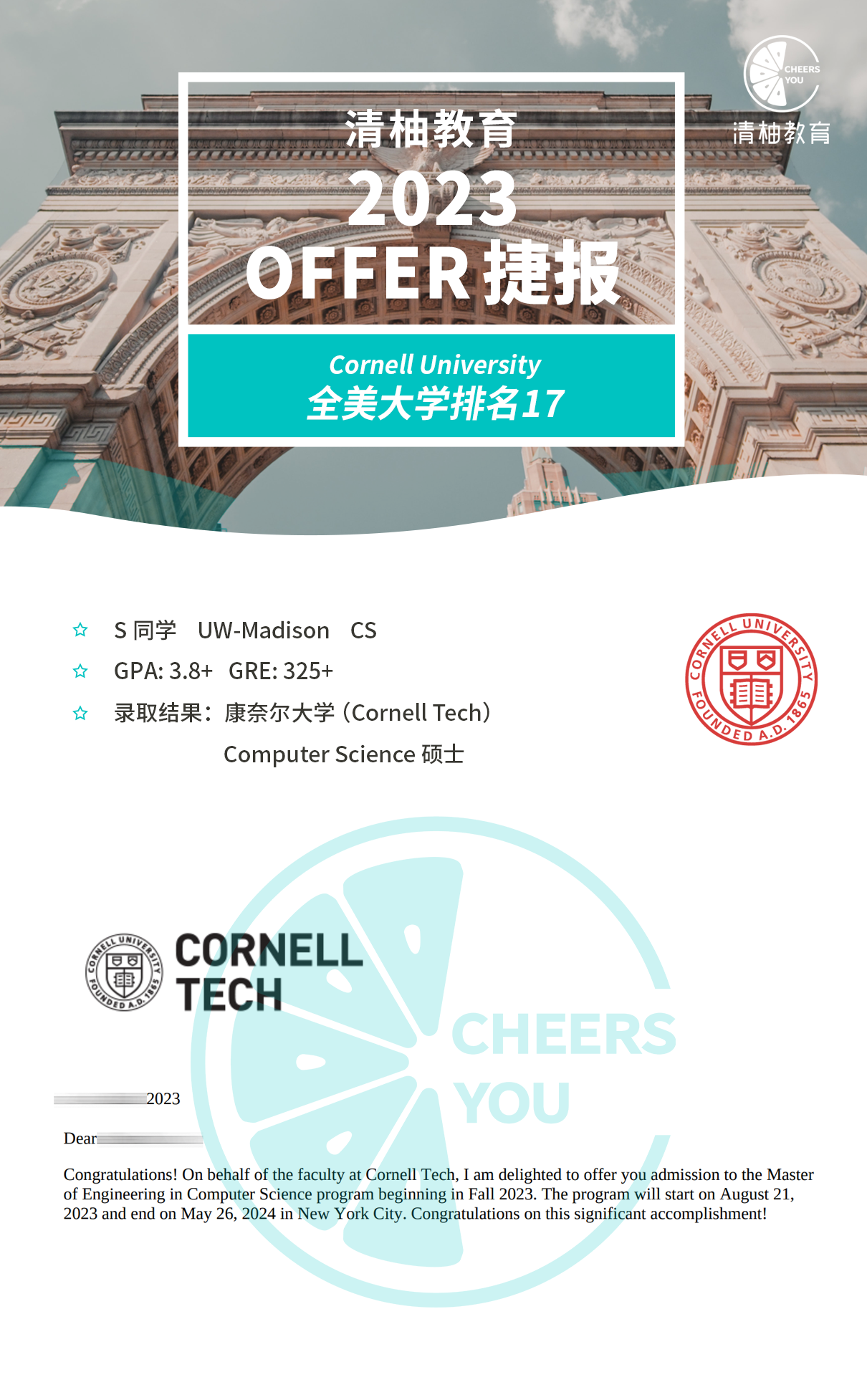
Here are some CS and EE program offers from top U.S. universities for everyone~

——————————————————
If you are interested in studying abroad in EE or CS, feel free to scan the QR code below to start a one-on-one consultation immediately~
.png)