
The Master’s in Financial Engineering (MFE) has drawn enormous attention in recent years with glamorous labels like “ultra-high salary,” “starting pay of 600,000 RMB,” and “hotly pursued by the Big Four, investment banks, and Fortune 500 companies”—the hallmarks of a top achiever. Everyone knows an MFE is impressive, but what exactly makes it so? Let’s break down what the US Master in Financial Engineering (MFE) entails, its admission requirements, and career prospects!
First, a one-sentence summary:
Financial engineering is a multidisciplinary field involving financial theory, engineering methods, mathematical tools, and programming, designed primarily for students aiming to work in securities, banking, financial management, consulting, or general manufacturing and service companies.
From this, you can imagine that if you’re looking to coast through without serious study, choosing financial engineering will likely lead to regret; and if the above industries aren’t your intended career path, you may want to deprioritize financial engineering!
When discussing financial engineering, we have to talk about “financial derivatives.” As financial markets have grown increasingly complex, traditional stocks and bonds have evolved into a range of new investment products such as futures and options—these are what we commonly call “financial derivatives.” How to price and combine these derivatives is a challenging problem faced by investment banks like JPMorgan, Goldman Sachs, Morgan Stanley, and others.
At the same time, since designing sophisticated investment portfolios is needed to generate profit, creating a financial product requires concepts from finance, the support of math and statistics, and financial knowledge. As a result, financial engineering has become the fastest-growing discipline in recent years and faces huge job market demand. In summary, financial engineering applies mathematical principles and computer tools to analyze financial problems. Depending on the school, the program length varies, typically 1–2 years.
Core courses center on mathematics, statistics, financial models, and computer programming, covering topics such as derivatives pricing, risk analysis, financial modeling, financial information analysis, and some advanced financial theories.
While the name may suggest a closer link to finance, that’s not entirely true. Compared to pure finance, the curriculum involves deeper and broader knowledge of mathematics and computing. Financial engineering is often housed in mathematics, engineering, or business schools, usually with joint teaching. The school’s emphasis varies depending on where the program is placed. First, mathematics and engineering schools tend to favor applicants with math or engineering backgrounds. Programs under math departments also generally don’t require work experience, making them more suitable for fresh graduates. On the other hand, business schools typically place greater weight on an applicant’s work experience.
2023 QuantNet Financial Engineering Rankings! (Top 10)
(Refer to: https://www.cheersyou.com/zh/news/107466)
Top 1 Baruch College – Financial Engineering
Top 2 Princeton University – Master in Finance
Top 3 University of California, Berkeley – Financial Engineering
Top 4 Carnegie Mellon University – Computational Finance
Top 5 Columbia University – Mathematics of Finance
Top 6 Massachusetts Institute of Technology – Master of Finance
Top 7 Cornell University – MEng, FE concentration
Top 7 New York University – Mathematics in Finance
Top 9 Columbia University – Financial Engineering
Top 9 New York University – Financial Engineering
Top 9 University of California, Los Angeles – Financial Engineering
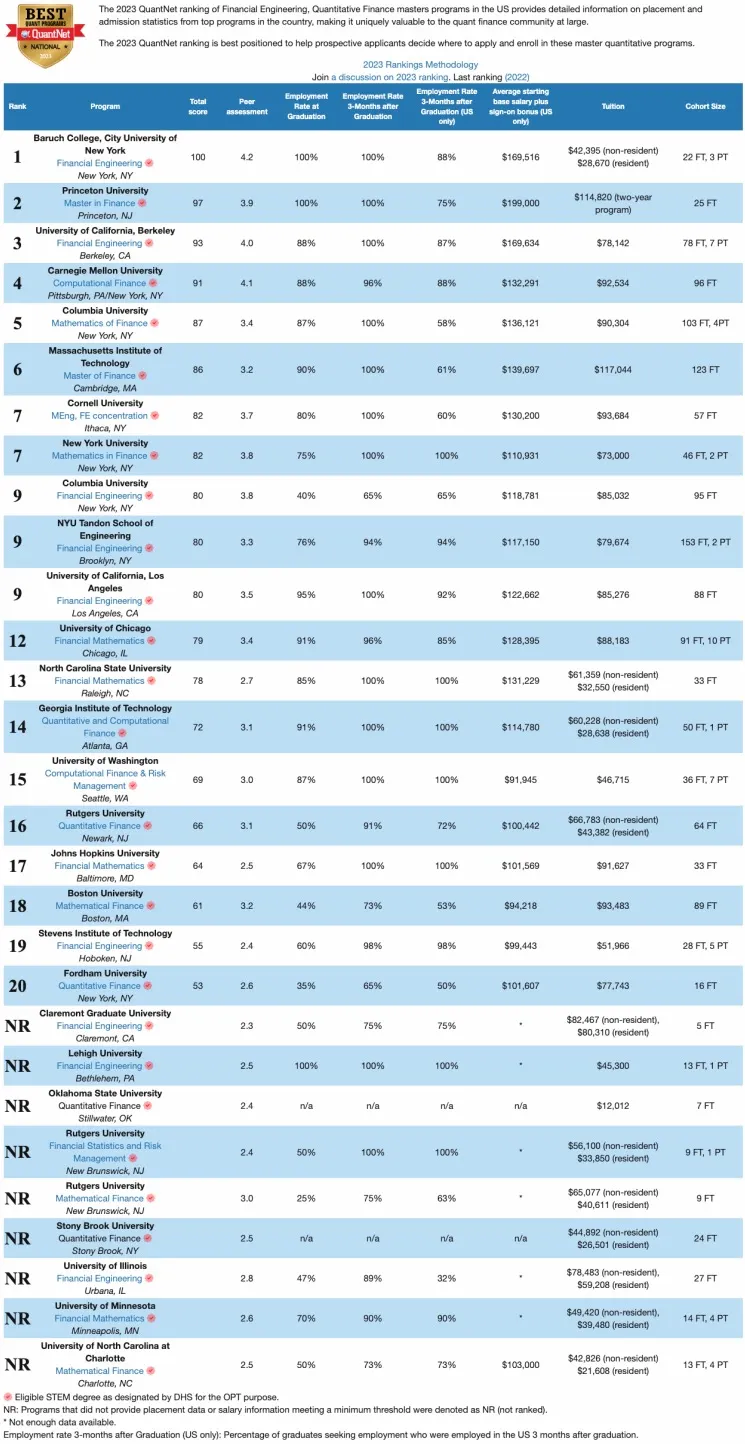
Baruch College’s Financial Engineering master’s program continues to hold the top spot this year. Princeton’s Master in Finance moved up one rank to second, surpassing third- and fourth-ranked UCB and CMU. Columbia’s Mathematics of Finance surged past its Financial Engineering counterpart to break into the Top 5, while Columbia Financial Engineering dropped from last year’s 5th to 9th this year.
New programs added this year:
Oklahoma State University – Quantitative Finance
Rutgers University – Financial Statistics and Risk Management
Overall, due to an adjustment in the employment ranking indicator to US Only, the rankings have seen considerable changes this year.
Columbia University – MS in Financial Engineering
Next, let’s take a closer look at a specific financial engineering program:
Located in Manhattan, New York, Columbia University, an Ivy League institution, is a dream school for many students.
It sits in the world’s financial hub, offering abundant internship opportunities and convenient access to interviews; its overall ranking is among the top 10 nationally, and the financial engineering program is top 3 in the US—whether seeking employment in the US or back home, this experience is a résumé booster. Columbia is also a target school for big names like JPMorgan, with a stream of investment banks and securities firms holding exclusive info sessions on campus each year, giving students the chance to interact with recruiters. Moreover, Columbia has its own job board, mock interviews, résumé reviews, alumni networking, and other career services that provide rich professional resources and industry insights for graduates.
Columbia’s Financial Engineering program is under the Department of Industrial Engineering and Operations Research (IEOR) in the School of Engineering. In addition to the MSFE, IEOR offers three other master’s programs:
MS in Business Analytics
MS in Industrial Engineering
MS in Operations Research
.png)
The Columbia Financial Engineering program provides coursework covering financial theory, engineering methods, mathematical tools, and programming. It is a full-time program requiring 36 credits for graduation.
The program starts in the fall (August enrollment), and students can arrange to complete their courses in June, August, or December of the following year. All courses are 3 credits, so you need to complete 12 courses.
The MFE program offers 7 concentrations; students may choose one based on their undergraduate background and future research interests:
1. Asset Management
2. Computation & Programming
3. Computational Finance/Trading Systems
4. Derivatives
5. Finance & Economics
6. Financial Technology
7. Machine Learning for Financial Engineering
.png)
In the first and second semesters, students must complete at least 24 credits of core courses; additionally, students can choose from electives offered by the IEOR department, Columbia Business School, and the Graduate School of Arts and Sciences.
From the curriculum design, the program leans more theoretical, with fewer hands-on practical courses. Admission standards: judging from past admission data, Columbia’s financial engineering program highly values background fit. Applicants need to come from engineering, mathematics, computer science, statistics, economics, finance, or other quantitative fields. Among these, a strong math background is extremely critical for admission. It is recommended that prospective applicants earn high scores in relevant undergraduate courses (calculus, linear algebra, probability and statistics, stochastic processes, etc.) to strengthen their application.
Additionally, programming skills are very important. Students should, during critical periods like sophomore and junior years, work hard to improve their technical skills and become proficient in at least one programming language such as Python, R, C++, MATLAB, Java, etc. These skills should also be demonstrated in academic projects, so that admissions officers can see practical experience.
The MSFE program receives hundreds of applicants each year and admits only around 10 students, resulting in an acceptance rate of roughly 4%. Competition is fierce, and the admission difficulty rivals that of PhD programs.
Career Development in Financial Engineering
We can refer to the 2023 QuantNet Financial Engineering Rankings and post-graduation earnings, along with specific career possibilities as follows—
Investment Banks (Securities Firms): renowned international investment banks like Goldman Sachs, Citi, Morgan Stanley, JPMorgan; domestic Chinese investment banks such as CICC, Industrial Securities, Guotai Junan, CITIC Securities. Roles mainly involve Investment Banking Division (IBD), Sales & Trading, Research, etc.
Big Four Accounting Firms & Consulting: MFE graduates can join Big Four firms PwC, Deloitte, KPMG, EY and strategy consulting firms like McKinsey, BCG, Bain, Roland Berger, working as corporate strategy consultants. Compared to investment banks, these are relatively easier to enter.
Funds, Trusts, Private Equity & Venture Capital: mainly analyst roles; the industry has high barriers, and analysts gain significant value after several years of development.
Insurance Companies: primarily engaged in actuarial and risk management roles, these are high-paying positions within the sector.
Fortune 500 Corporations: responsible for corporate finance functions including accounting, capital management, cost control, and internal controls.
.png)
Finally, here are some MFE admissions offers for your reference:
.png)

————————————————
If you’re interested in pursuing a Master’s in Financial Engineering or graduate study abroad, feel free to scan the QR code below to start a one-on-one consultation right away~
.png)