
Canada has long been a top destination for students planning to study abroad, but the difficulty of getting into a Canadian master's program is well known. So just how hard is it to apply for a Canadian master's degree? What are the benefits of studying in Canada, and what should you keep in mind when applying for a Canadian master's program?
Why Canadian Master's Programs Are the Hardest to Get Into Worldwide
- Canadian universities admit a large number of undergraduates, operating on a "wide entry, strict exit" principle. Even though exit is strict, there are naturally many Canadian bachelor's graduates.
- Many of these graduates prefer to apply for Canadian master's programs for various reasons—familiarity with the environment, strong social networks, immigration aspirations, or a desire to stay in their comfort zone. However, master's enrollment is far smaller than undergraduate, leading to intense competition.
- There are only three highly ranked Canadian universities. Not to mention locally esteemed schools like Waterloo, McMaster, or Western, only U of T, McGill, and UBC fall within the QS top 100.
- QS rankings are, of course, a key factor for students and parents planning to return home after graduation, making U of T and UBC especially popular. Beyond rankings, academic atmosphere, geographic location, and economic development also play major roles.
- McGill focuses heavily on research, with a relatively traditional campus and academic environment. Located in Montreal, its economy and job market lag behind Vancouver and Toronto, which pushes most applicants to concentrate on the remaining two schools.
- Strict GPA requirements: many programs (not just the top three) explicitly state that applicants must have a GPA of 3.3+ before their materials will even be processed. This immediately eliminates students with lower GPAs.
Of course, 3.3+ is just the minimum threshold. The GPAs of those who actually receive offers... well, you can imagine how competitive it is.

Advice for Students and Parents Considering Canadian Master's Programs
- Students with excellent GPAs and overall profiles may consider applying only to Canada.
- Students with immigration intentions who are open to lower-ranked institutions may also apply only to Canada.
- Students with above-average grades should consider a mixed application strategy, such as Canada and the U.S.
- Students with less competitive grades should focus on other countries and only apply to one or two Canadian schools as ambitious targets.
The suggestion that only top students apply exclusively to Canada is partly explained above, and also because most Canadian schools allow applications to only one or two programs, reducing options and increasing risk.
What Are the Benefits of Studying in Canada?
1. Canada offers high-quality education with strong global recognition and prestige.
2. Canadian tuition fees are lower compared to other English-speaking destinations like the UK and the US.
3. The Canadian government supports education investment; it provides loans, and schools offer scholarships.
4. Canada's study visa policy is relatively lenient, typically granting validity up to graduation.
5. Canada is an inclusive, non-discriminatory society that embraces multiculturalism.
6. Canada is more stable and safe, with generally good public security.
7. Canada’s proximity to the US means that after studying in Canada, you also have the option to develop your career in the United States, giving you an extra choice.
8. As a nation built on immigration, Canada has attractive immigration policies, which are particularly favorable for those who wish to stay in North America.
9. Student satisfaction rates in Canada are very high. According to the Canadian Bureau for International Education, 95% of international students recommend Canada as a top study destination.
10. Many Canadian institutions offer co-op programs, which provide valuable work experience that can support immigration applications.
11. Canada has an excellent social welfare system. Medical insurance is relatively affordable, and once you have a work permit, you can also register for pension and unemployment insurance. Having children makes you eligible for child benefits.
12. Canada boasts stunning natural scenery: cherry blossoms in spring, seaside strolls in summer, vibrant maple leaves in autumn, and snowy landscapes in winter.
13. Food safety in Canada is rigorously maintained.
In light of all these advantages, more and more students and parents are making Canada their study-abroad destination of choice.

Latest Trends for Master's Studies in Canada
First, the number of applicants to Canadian master's programs will continue to rise. A master's degree is increasingly seen as the standard academic threshold by many companies and industries. Taking UBC, one of Canada's top three universities, as an example: the University of British Columbia Annual Enrolment Report 2021/22 shows that master's admissions on the Vancouver campus increased by 3% in 2022, but applications surged by 29%, causing admit rates to drop by 4 to 20 percentage points year over year.
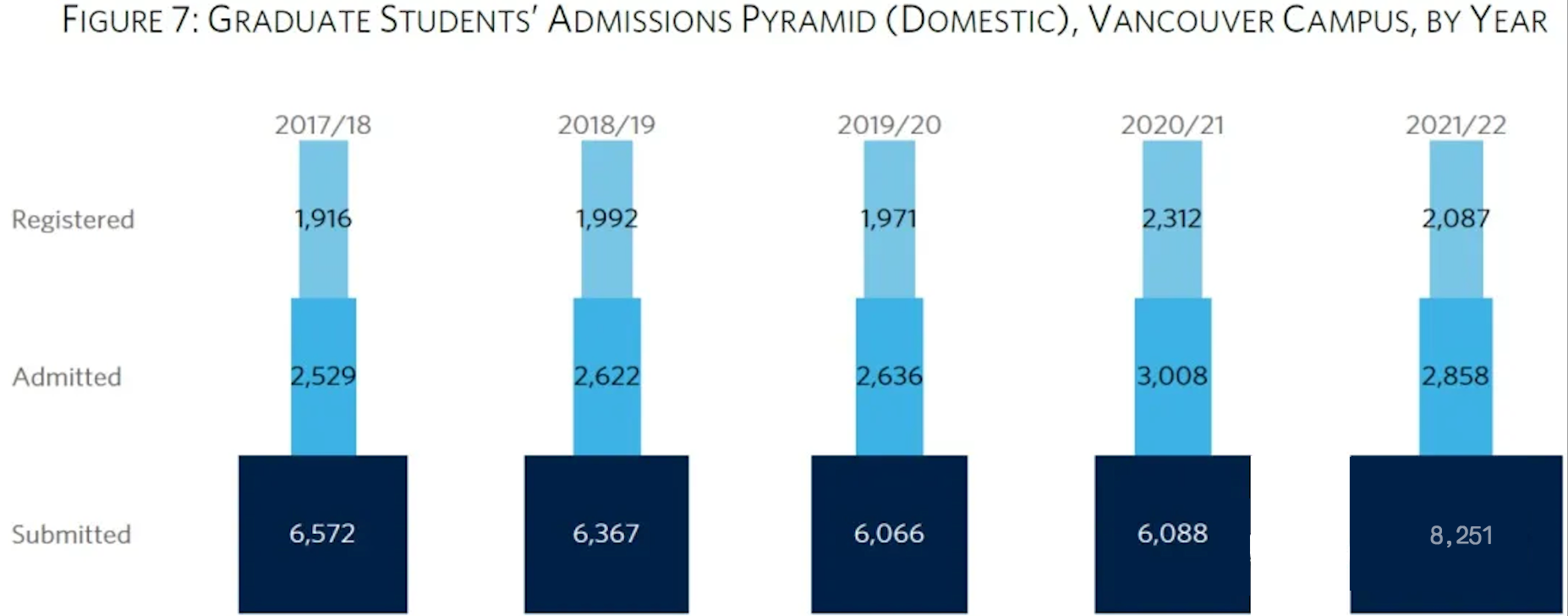
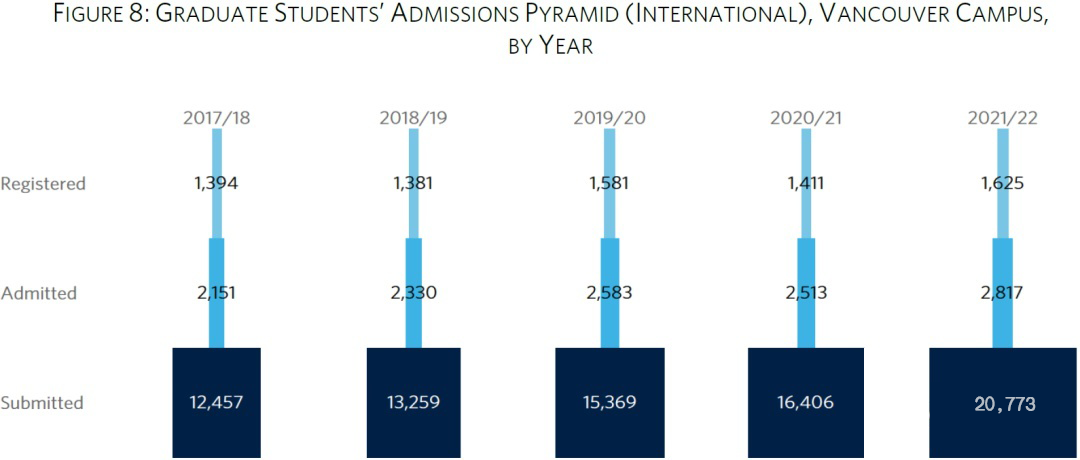
The two charts above show master's application data for domestic and international students at UBC's Vancouver campus, respectively.
As these figures illustrate, competition for top Canadian universities is fierce. In summary, graduate studies in Canada are characterized by a small number of institutions, limited program offerings, and relatively small cohort sizes. If you plan to apply, be sure to prepare thoroughly in advance. Early planning and preparation will give you more options and greater flexibility.
Here are some offer letters from top Canadian universities:


If you're interested in studying in Canada for your master's, feel free to scan the QR code below and start a one-on-one consultation today!
.png)