Columbia University's Master of Science in Enterprise Risk Management (ERM) has always been a popular choice for graduate business applications in the U.S.
Columbia's ERM program has only one application round, using a rolling-like admissions model (the 23Fall round is shown below)
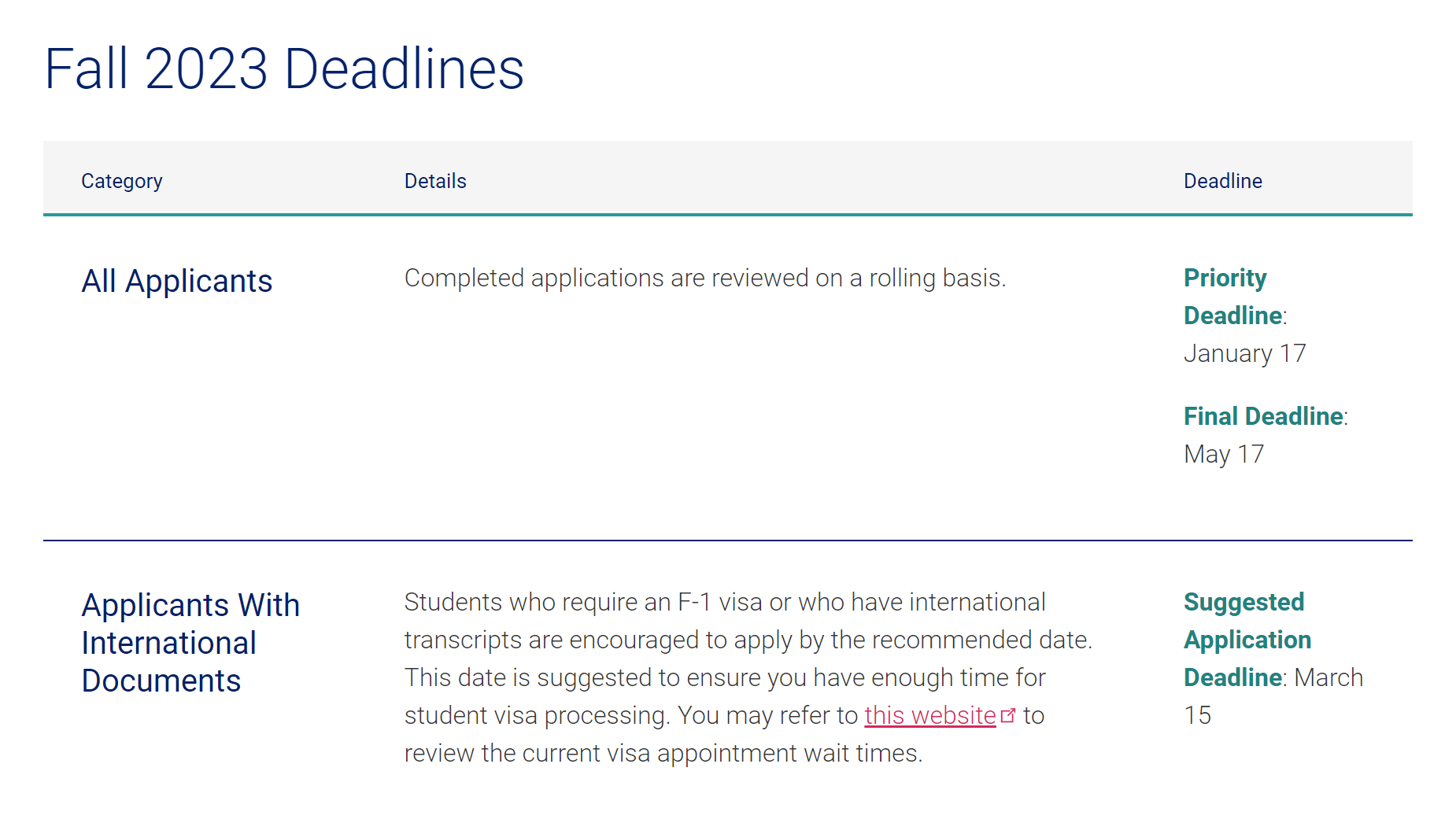
However, based on past data, Columbia ERM admissions numbers are not evenly distributed.
Taking 22Fall as an example, before February the admission bar was extremely high; rejections with GPAs of 3.6 and 3.7 were common, while a 3.8 was normal for admission. This made many students wonder, is Columbia going crazy?
But starting in March, particularly with offers issued in April and May, Columbia ERM's bar returned to its "normal level". For overseas university graduates, the GPA was around 3.3, and for domestic Chinese university graduates, it was between 3.4 and 3.6.
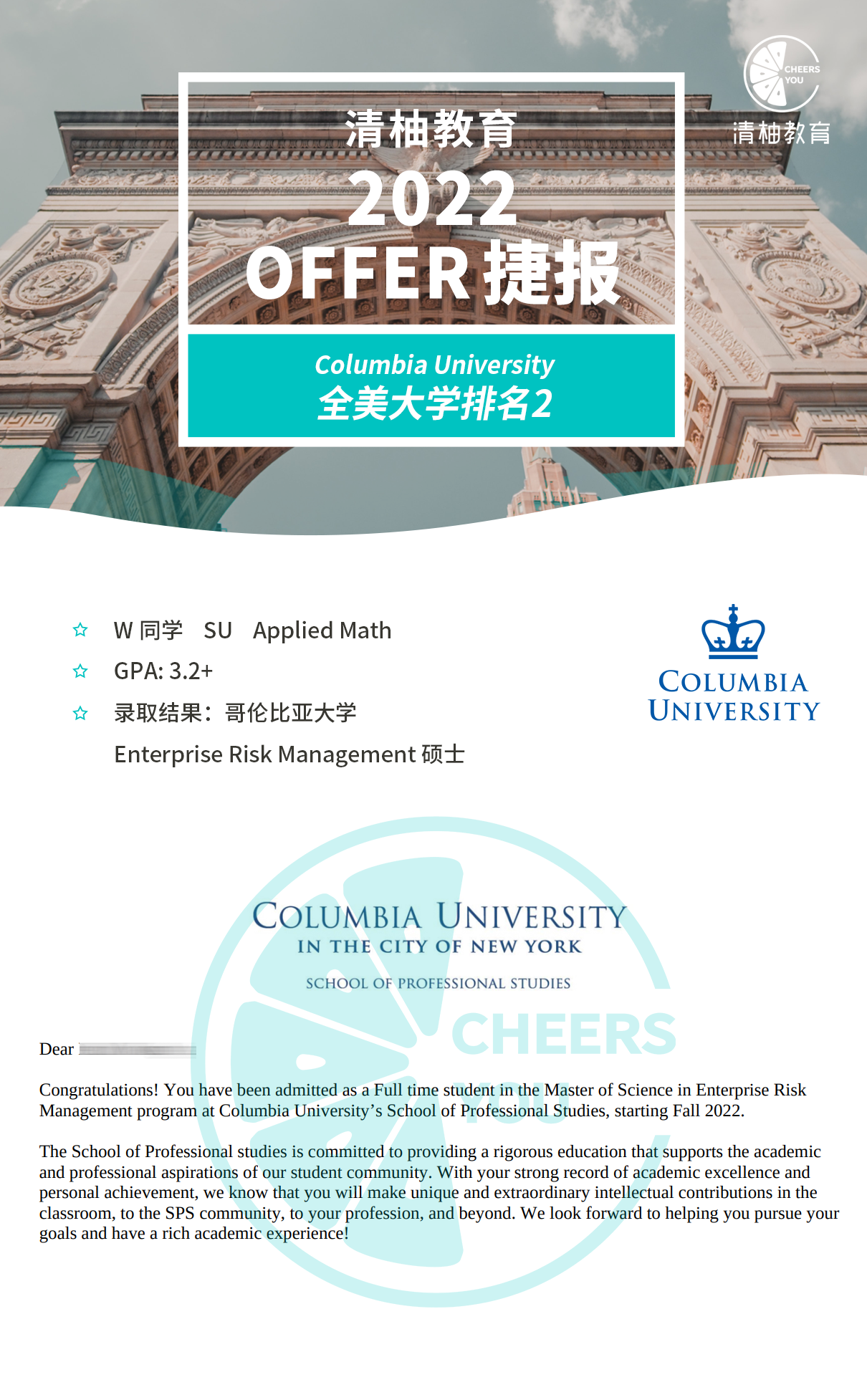
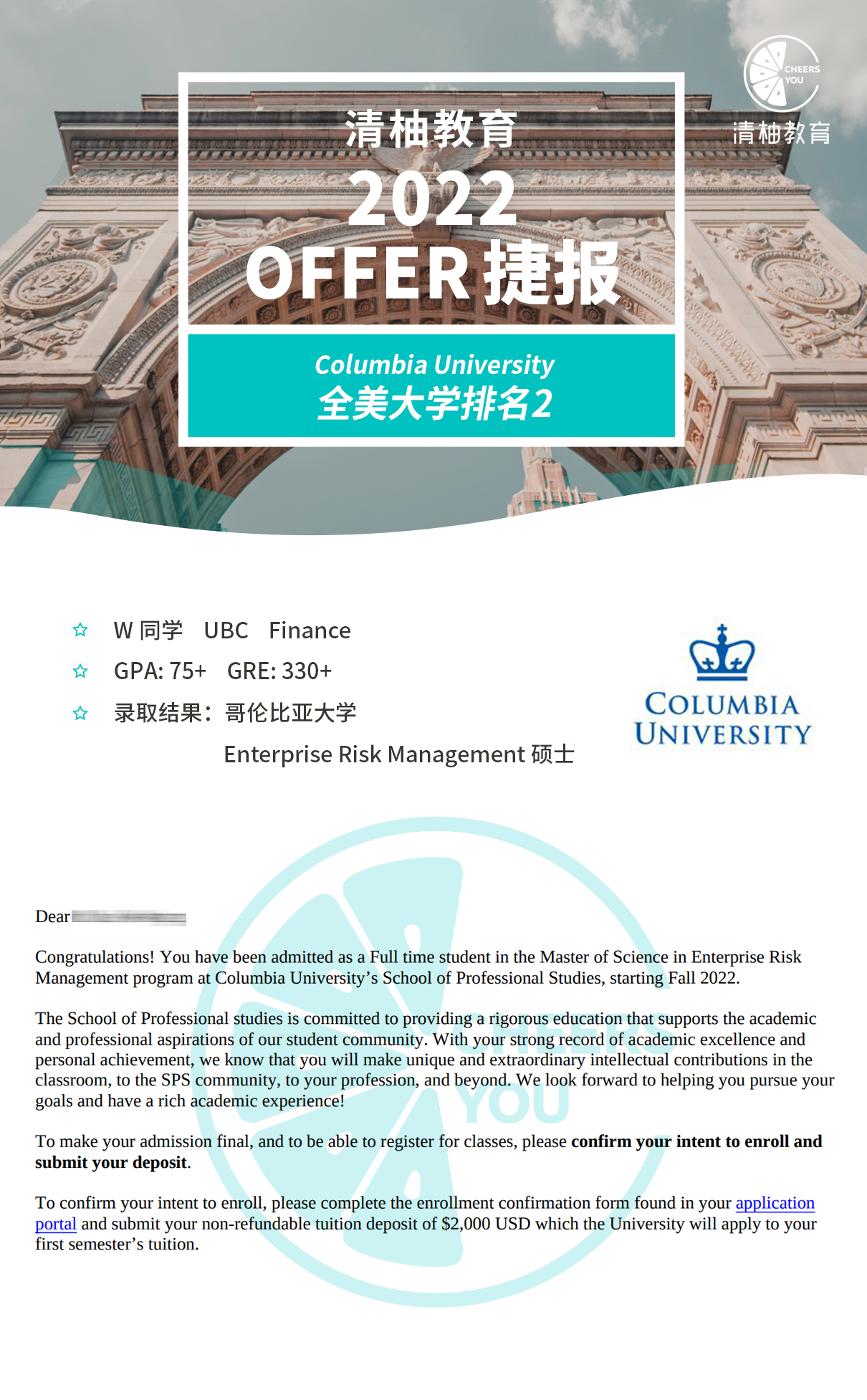
Today, we've compiled some backgrounds of students admitted to Columbia ERM after April, focusing on low GPAs, for your reference~
Chinese 211 Univ / Finance & Econ / GPA 3.4+ / GRE 320+ / TOEFL 100+
Chinese Non-Top Univ / Math / GPA 3.4+ / GRE 325+ / IELTS 7+
Australian G8 / Econ / GPA 70+ / GRE 325+
Top 3 Canadian Univ / Econ / GPA 3.2+ / GRE 325+
Top 3 Canadian Univ / MGMT / GPA 3.4+ / GRE 320+
Top 3 Canadian Univ / Finance / GPA 75+ / GRE 325+
US Univ / BE / GPA 3.2+ / no test scores
Top 50 US Univ / Math / GPA 3.2+ / no test scores
US Univ / Accounting / GPA 2.9+ / GRE 315+
Top 50 US Univ / Econ / GPA 3.1+ / GRE 325+
Top 100 US Univ / Econ / GPA 3.2+ / no test scores
Top 80 US Univ / Finance / GPA 3.2+ / no test scores
Program Introduction:
Columbia University's Master of Science in Enterprise Risk Management is designed for risk professionals to design, implement, and execute ERM programs and improve decision-making efficiency. The program provides students with advanced risk management capabilities. Its core curriculum equips students with integrated skills in using enterprise risk management tools and techniques.
The ERM program's curriculum is divided into core courses and electives.
Core courses include:
Value-Based Enterprise Risk Management
Traditional Risk and ERM Practice
External Stakeholder Requirement
Introduction to Finance
Managing Human Behavior in the Organization
Strategic Communications for Risk Professionals
Capstone
Electives are divided into Risk Electives (choose two), ERM Electives, and Business Electives.
Risk Electives:
Strategic Risk Management
Operational Risk Management
Financial Risk Management
Insurance Risk Management
ERM Electives:
Introduction to Quantitative Risk Management
Company Failure
Systemic Risk
ERM Modeling
Information Technology Risk Management
Enterprise Information Security: Threats & Defense
Bayesian Data Analysis
ERM Internship
Coding for Risk Management
Credit Risk Management
Business Electives:
Financial Accounting
Judging from the curriculum design, the courses are rich and closely integrated with practice. There is also a wide range of electives for students to choose from, which can help them develop better toward their career direction. According to the experience of enrolled students, the quantitative background of the program may be slightly weak. If you want to stay in the U.S., students can make up for this by taking electives in computer science, business analytics, financial engineering, etc.
Additionally, students can take foundational and specialized courses from other schools, such as computer science. Currently, up to two ERM required courses can be waived and replaced by two courses from other schools, but this requires discussion with the student's Academic Advisor.