

Cornell University's Master of Public Health (MPH) program is housed within the College of Veterinary Medicine, which is the second-ranked veterinary school in the United States.
The Ivy League prestige paired with disciplinary strengths has made Cornell's MPH program a sought-after choice in the field of public health.
For this reason, CheersYou(清柚教育) has compiled the following admission cases for the Cornell MPH program for your reference:
U.S. Undergrad Top80/Biochemistry/GPA3.7+/GRE320+
U.S. Undergrad Top50/Medical Anthropology/GPA3.3+/GRE not submitted
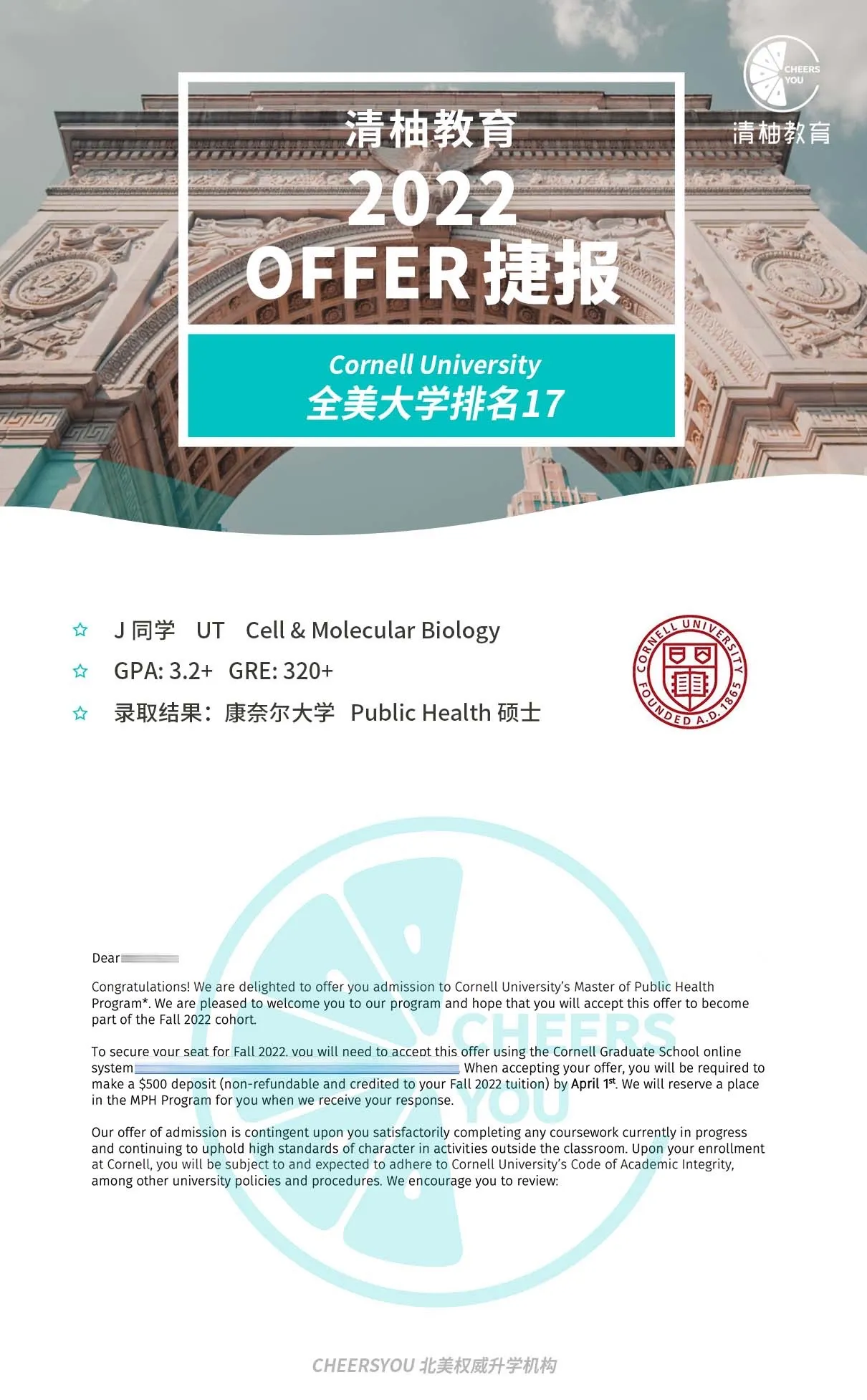
Canadian Undergrad Top3/Cell&Molecular Biology/GPA3.1+/GRE315+
Canadian Undergrad Top3/Food, Nutrition and Health/GPA80+/GRE325+
U.S. Undergrad Top40/Biology Science/GPA3.5+/GRE not submitted
U.S. Undergrad Top60/Dietetics/GPA3.6+/GRE not submitted
It's evident that the admissions bar for this program is not extremely high, but the relevance of the undergraduate background is heavily weighted.
Program Introduction:
Cornell's MPH program offers two concentrations: Food Systems & Health and Infectious Disease Epidemiology.
Food Systems & Health: In this concentration, students learn to analyze and characterize food systems from production to consumption, ensuring rigorous control from the source to the final consumer to guarantee safety. They study and evaluate food system interventions to improve nutrition, food security, and public health, implementing interventions for practitioners to enhance their awareness of food safety and public health. Students investigate and communicate food safety risks throughout the food system, analyze current public health nutrition issues and policies, and compare policy options. By analyzing current food safety problems, they develop corresponding strategies and disseminate this information to consumers, raising public safety awareness.
Infectious Disease Epidemiology: In this concentration, students compare and contrast infectious disease prevention and control strategies and systems; learn critical approaches to infectious disease diagnosis and detection systems; evaluate different epidemiological and statistical methods and assessment techniques used in infectious disease events, research, and programs; and integrate general principles of infectious disease epidemiology and biology to interpret infectious disease events and programs.
For more application details, feel free to add the QR code below for a consultation~
.png)