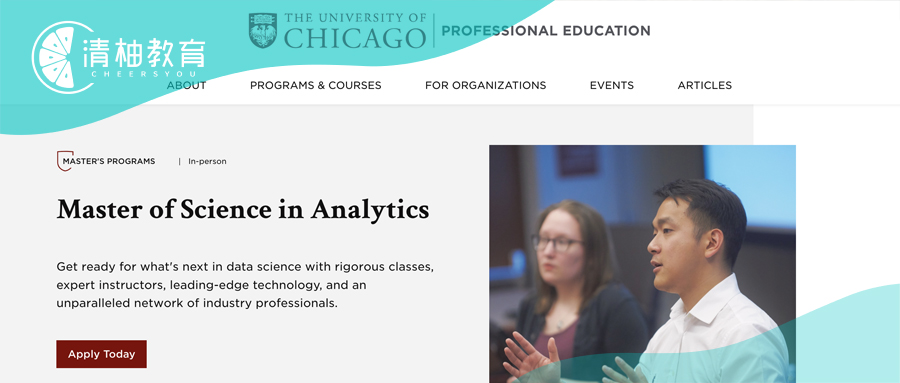
The University of Chicago's Analytics program was originally housed under the Professional Education School, often referred to as the continuing education school. However, it is now taught by the Data Science Institute (DSI) under the Physical Sciences Division, meaning it is theoretically moving away from the continuing education framework. What exactly is the Master of Science in Analytics at UChicago like? Today, we'll give you a detailed introduction!
.png?x-oss-process=style/opt-webp)
University of Chicago Master of Science in Analytics
The program offers two tracks: full-time and part-time. The full-time track spans 5 quarters, including 12 courses and a capstone project. The part-time track takes 2–3 years; we mention it because the program has traditionally had a majority of part-time students.
Curriculum:
Core courses include:
Time Series Analysis, Statistical Analysis, Data Mining, Machine Learning and Predictive Analytics, and Linear and Nonlinear Models, for a total of five. Additionally, students choose one from the data engineering track: Data Engineering Platforms for Analytics and Big Data Platforms, and one from the leadership courses, making a total of 7 core courses.
Elective courses are relatively limited and less flexible:
They include business-oriented courses such as Financial Analytics, Marketing Analytics, and Credit and Insurance Analytics, as well as more technical courses like Data Visualization Techniques, Bayesian Methods, Advanced Machine Learning and Artificial Intelligence, and Real-Time Intelligent Systems.
.png?x-oss-process=style/opt-webp)
All courses are taught in small classes of at most 20–30 students. Additionally, non-credit workshops and short courses, such as Hadoop Workshop, Linux Workshop, R Workshop, and Deep Learning and Image Recognition, are available to help students better master the credit courses.
Admission Requirements:
- GPA: 3.8+
- GRE: 325+
- Language Proficiency: TOEFL 105+ / IELTS 7+
.png?x-oss-process=style/opt-webp)
Applicant Background:
The program values work experience, but this does not mean that fresh graduates without two or more years of experience cannot apply. However, the requirements for fresh graduates are higher; the official website specifically lists the conditions for fresh applicants and those with at least two years of work experience. Prerequisites: Applicants should have completed Calculus I and Calculus II at the undergraduate level. The program also offers foundational courses in programming, statistics, and linear algebra for students lacking the relevant background.
Career Outcomes:
The UChicago MScA program is primarily career-oriented, so its career services are quite comprehensive. Graduates find employment across various industries, including at companies such as McKinsey, Amazon, and Deloitte. There are two major job fairs each year: one is a university-wide graduate career fair held at the Hyde Park Campus, and the other is specifically for Analytics students, with highly targeted positions typically directly related to data analytics.
.png?x-oss-process=style/opt-webp)
According to official data, 75% of students secure employment upon graduation, 30% of employers offer tuition assistance, students see a 33% salary increase from prior work, and graduates experience a 52% salary boost, with the final employment rate reaching 100%. Graduates work in industries like finance, marketing, IT, and consulting; while job titles vary, most are analytics-related. Moreover, this program is a STEM-designated program, making it a highly worthwhile choice for students seeking to stay and work in the U.S.
In summary, the UChicago Analytics curriculum is quite practical. The majority of admitted students have two years of work experience, though exceptionally strong fresh graduates are also accepted; over 80% of students have more than three years of work experience. Some students are indeed concerned about safety in Chicago. However, in terms of career resources—
1. It is a STEM program.
2. The prestigious University of Chicago offers excellent alumni and career resources.
Thus, students can make their choices based on their future development and goals. This year, Anne (a consultant) had a student who received an offer from the Analytics program:
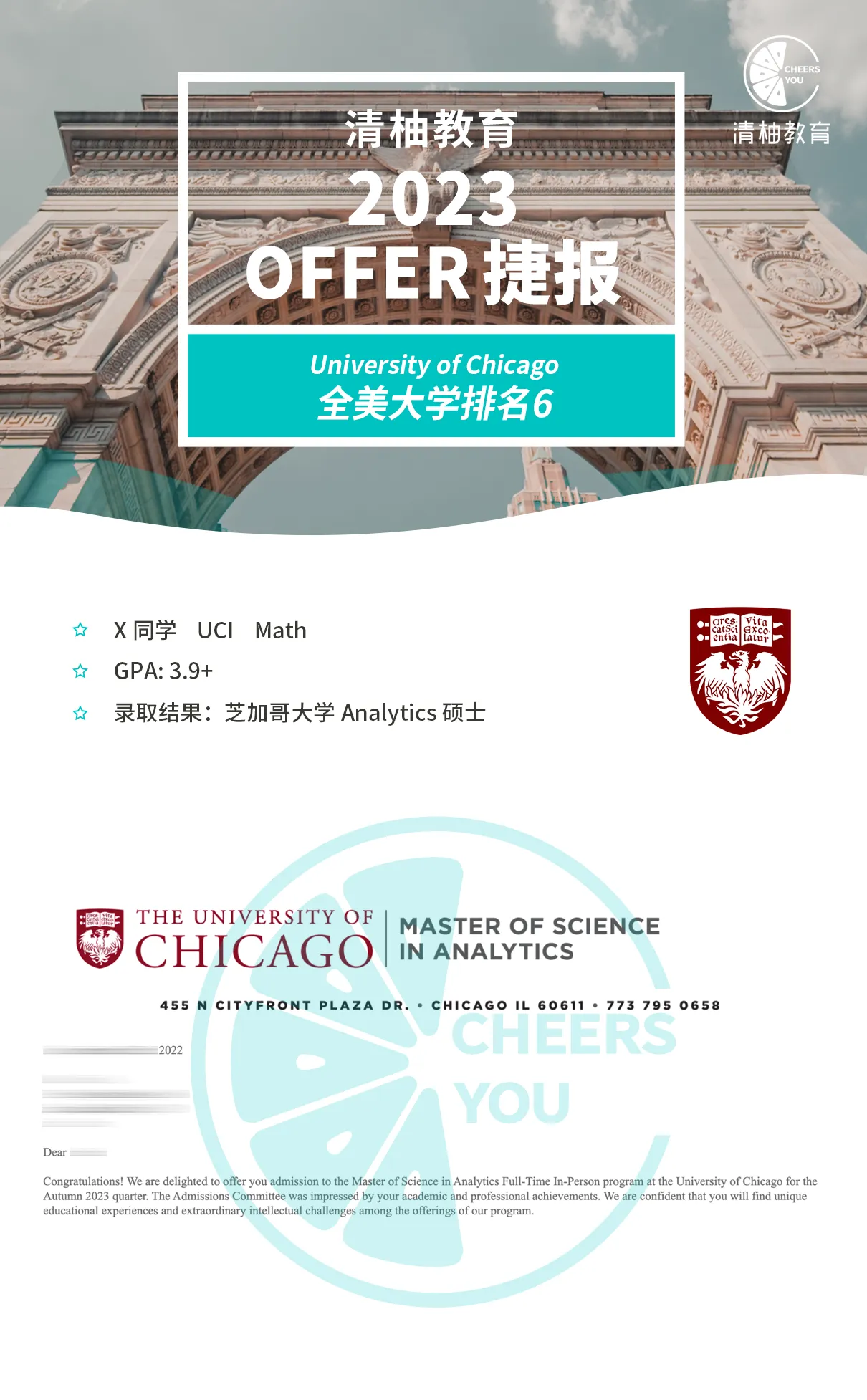
That's Anne's interpretation and analysis of the University of Chicago's Master of Science in Analytics. Students interested or with study-abroad questions are welcome to consult us!
.png?x-oss-process=style/opt-webp)