Nowadays, when choosing a major for studying in the UK, more and more students are opting for a Master's in Public Policy (MPP) or a Master's in Public Administration (MPA). Below is a detailed introduction to MPP and MPA graduate programs at some UK universities, the differences between MPP/MPA master's programs in the UK and the US, the distinctions and curriculum and application requirements of MPP (Master of Public Policy) and MPA (Master of Public Administration), and recommended MPP/MPA programs at top UK universities.
Differences Between UK and US MPP/MPA Master's Programs
Since the establishment of the welfare state in the 1940s, the UK has seen rapid development in the field of public policy. Public policy and management involves the application of social science theories such as political science, sociology, psychology, economics, and management to better address social issues.
However, compared to the US, the UK's humanities place more emphasis on theoretical research, and throughout the history of policy development, British scholars have won the Nobel Prize more frequently. So both the UK and the US have strengths, with different emphases. Students can choose based on their preferences and career development inclinations.

Differences Between MPP (Master of Public Policy) and MPA (Master of Public Administration)
MPA (Master of Public Administration) primarily focuses on learning administrative management and execution, while MPP (Master of Public Policy) focuses on policy analysis, research, and formulation.
MPA involves more management disciplines related to organization, administration, and human resources, and places greater emphasis on cultivating students' professional ethics. MPP covers a wide range of knowledge and academic fields, including economics, computer science, macroeconomics, and other courses designed to cultivate students' ability to analyze, evaluate, and research policy issues and social hot topics.
Most UK universities offer MPA/MPP programs, generally within the Faculty of Humanities and Social Sciences, though some are housed in business schools. These programs are highly interdisciplinary, with a diverse student body and rich curriculum. They typically do not have strict undergraduate major requirements, focusing more on applicants' work experience, internships, and personal skills, making them very friendly to cross-disciplinary applicants.
Which Students Are Suitable for Switching to MPP/MPA
Here are some scenarios of students suitable for switching to MPP/MPA:
1. Students with business backgrounds who accept interdisciplinary studies can later transition to the consulting industry.
2. Students from humanities and social sciences who wish to engage with business but find the high thresholds of business majors unrealistic—this cross-disciplinary public affairs track is a great entry point.
3. STEM students wanting to switch to a more humanities-oriented discipline, though rare, can apply given their strong quantitative backgrounds.
4. Students aiming to switch to media studies in the UK—since UK media programs are extremely popular and top programs prefer applicants with extensive practical experience, when competitive positioning is lacking, they can consider the public affairs direction, leading to careers in PR or media companies.

Recommended MPA/MPP Programs at Top UK Universities
University College London (UCL)
MSc Public Policy
This is a one-year program that is highly inclusive and boasts a diverse student body, comprising not only recent graduates but also those with substantial work experience. With participants from varied backgrounds, alumni resources are also abundant.

Curriculum:
The program covers many different disciplines, including political science, economics, law, public management, and public health. It consists of 180 credits, including core modules (90 credits) that impart key substantive methodological concepts and skills, and a dissertation (60 credits).
Core modules cover topics such as policymaking processes, agenda setting, policy implementation and evaluation, public management, regulation, economics, and research methods. Students also take 30 credits of elective modules, which may include voluntary sector policy, health policy and reform, energy and climate policy, parliament, political parties and policymaking, and international trade policy.
Moreover, UCL's MPP program offers each methodology course at both advanced and introductory levels, allowing students to choose based on their own situations. For those with weaker foundations, the introductory level is more suitable, and after deeper study, they can naturally move on to advanced content.
Overall, UCL's curriculum is challenging and rigorous, testing students' critical thinking applied in economics, reading speed, research skills, etc.
The University of Manchester
MSc International Development: Public Policy and Management
Manchester's PPM program not only covers fundamental public policy knowledge and skills but also emphasizes the development direction of public policy in an international context. The program goes beyond theoretical instruction by providing real-world examples of policy formulation and implementation in the public sector, enabling students to better understand the operational processes of public policy and its institutions, and honing their ability to apply theoretical knowledge to real cases.

Curriculum:
Two of the three core courses are related to economics, including data analysis and financial analysis, indicating that Manchester's PPM program focuses on the economic aspects of public policy. Elective courses are more macro-oriented, covering international management, international political economy, trade globalization, etc.
The program requires a total of 120 credits in taught content plus a 12,000-15,000 word dissertation. Courses include public sector reform and management, research skills for economic development (quantitative methods), economic analysis of the public sector, global political economy, trade theory and development, etc.
Application Requirements:
Manchester's PPM admits according to the School of Environment, Education and Development's list; domestic Chinese undergraduates on the list are recommended to have a GPA of 83+ to apply.
It does not strictly restrict applicants' backgrounds, but preference is given to those with sociology-related backgrounds.
IELTS 7 (6.5), TOEFL 100 (25).
The London School of Economics and Political Science (LSE)
Master of Public Administration (MPA)
LSE's MPA is one of the few two-year master's programs in the UK. The School of Public Policy is a founding member of the elite international public policy network. Located in London, LSE offers abundant job opportunities and resources such as career fairs, career advisors, alumni networks, etc., which need no further elaboration.

During the program, students will research and analyze a public policy problem faced by a real public or private organization, including cases from Boston Consulting Group, OECD, UNESCO, and the Gates Foundation.
The program emphasizes economics, econometrics, and political science. Students can pursue the general MPA, or request one of the following specializations in the degree title: Economic Policy, International Development, Inequality and Poverty, Social Impact, International Political Economy. In the first year, students take three compulsory courses: Micro and Macro Economics for Public Policy, Political Science and Public Policy, and Quantitative Methods and Policy Analysis. The second year involves a Capstone project and elective courses in a chosen specialization.
Application Requirements:
No work experience is mandatory, but preferably at least one year of work experience.
IELTS 7 (Reading 7, Listening/Writing/Speaking 6.5), TOEFL 100 (Reading 25, Writing 24, Listening/Speaking 22).
Recommended average score of 88+ for Chinese undergraduates from 985/211 universities to apply.
Application Characteristics:
As employment-oriented programs, MPP/MPA programs, besides requiring undergraduate GPA and other standardized test scores, more importantly hope to see applicants with internship or full-time work experience in the public sector, NGOs/NPOs, or campus experiences such as Model United Nations. Although MPP/MPA programs are open to cross-disciplinary applicants, historical data shows that applicants with undergraduate backgrounds in public administration, political science, business, economics, etc., have higher admission rates. Some UK programs also require applicants to have taken macro/microeconomics or mathematical statistics courses at the undergraduate level, or to demonstrate such skills through internship or work experience.
Additionally, proficiency in computer languages such as R, Python, C++, and data analysis tools like SPSS can greatly enhance an applicant's competitiveness. Of course, MPP and MPA also have their own emphases: MPP focuses on policy analysis, formulation, evaluation, and problem-solving ability, so it often has prerequisite requirements in economics, mathematics, statistics, etc.; MPA, on the other hand, focuses on team leadership, management practice, policy implementation, and problem handling, so it considers applicants' internship or work experience more in admissions.
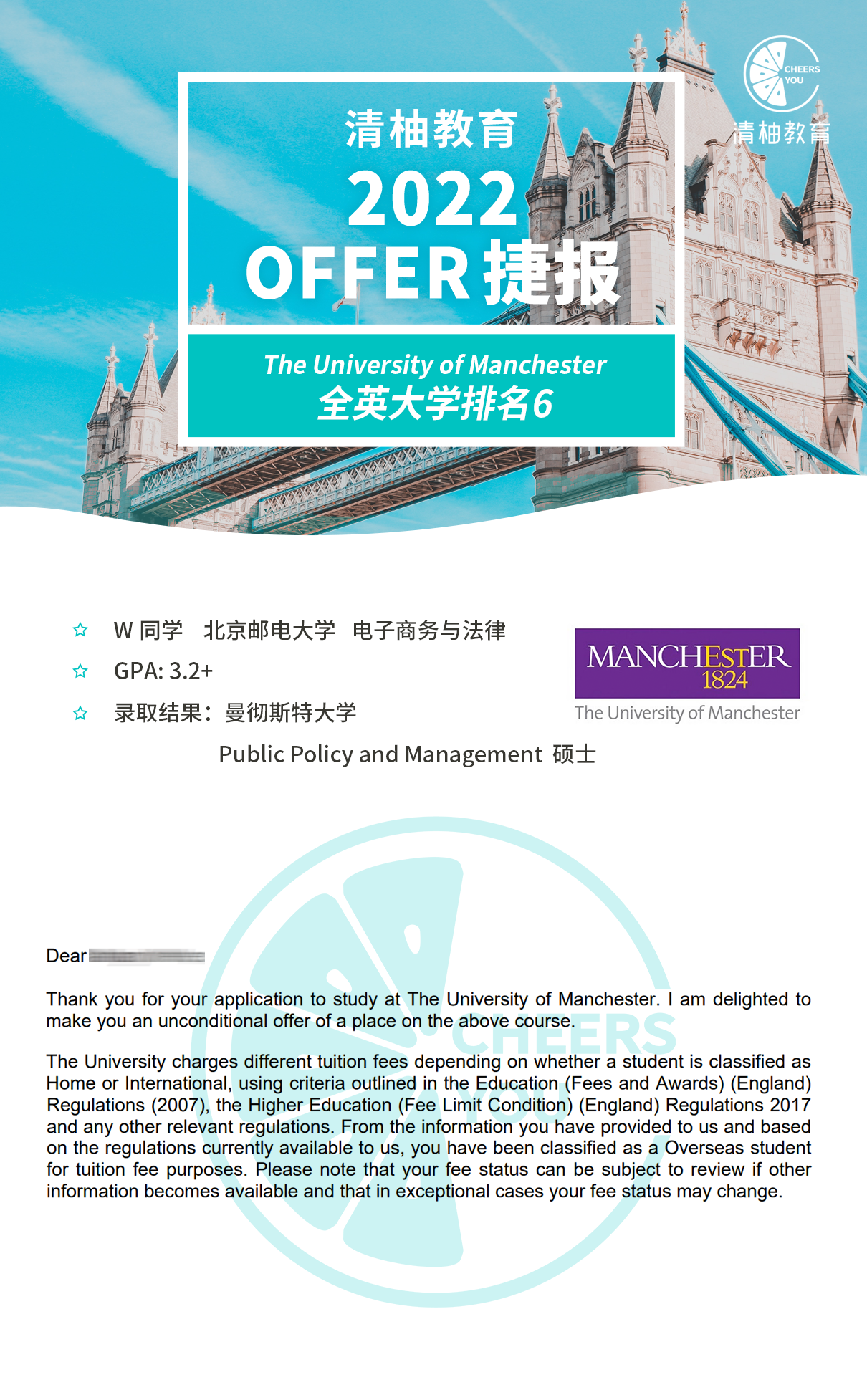
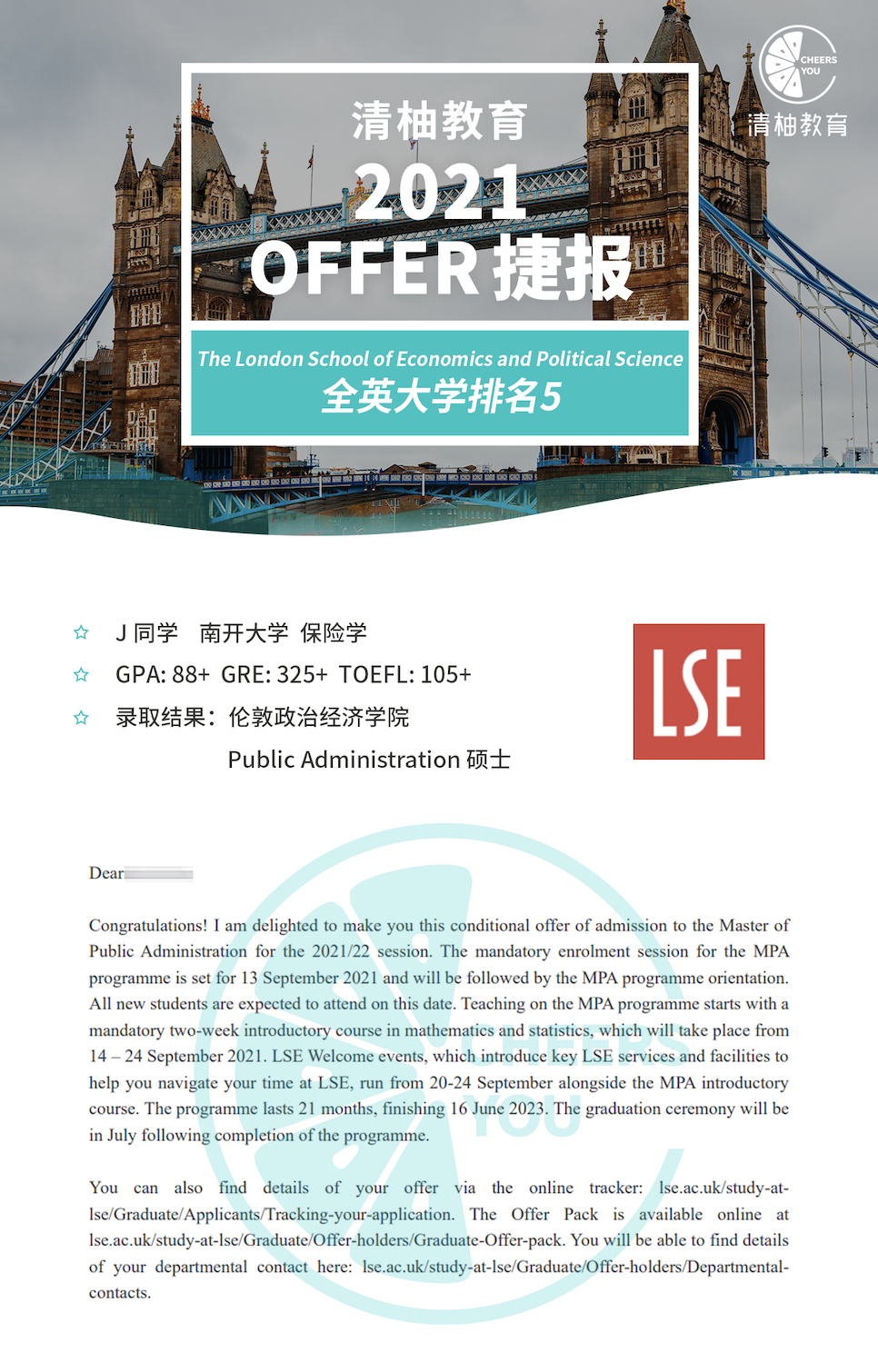
Below are some MPP/MPA offer examples from top UK universities~
If you are interested in pursuing an MPP/MPA master's program in the UK, please scan the QR code below to immediately start a one-on-one admissions consultation~
.jpg?x-oss-process=style/opt-webp)