Applied mathematics focuses on the mutual application of mathematics and other disciplines. Many undergraduate mathematics majors also choose to apply for graduate programs in Applied Mathematics, and Columbia University's Applied Mathematics program is a popular choice. Columbia's Applied Mathematics department is particularly well-known for environmental and climate analysis, largely because many professors are meteorologists, and similar news can be found on the department's website. So what should be noted when applying to Columbia's Applied Mathematics program? Here is a detailed analysis and application advice for the Columbia Applied Mathematics program.
Columbia Applied Mathematics
.png?x-oss-process=style/opt-webp)
Curriculum:
Columbia's curriculum requires students to choose 5 core courses and 5 elective courses. The core courses are relatively theoretical and very friendly to students with an undergraduate background in mathematics. However, there are also challenging courses, such as APMA E4300: Numerical Methods and APMA E4302: Computational Methods, which involve programming languages like Python and C, Fortran, or similar compiled languages. Elective courses are more flexible and application-oriented, allowing choices from computer science and IE/OR courses, such as Algorithm Analysis, Financial Engineering, Industrial Economics, Game Theory Models, and analytical courses.
.png?x-oss-process=style/opt-webp)
Admission Requirements:
- GPA: 3.7+
- GRE: 325+
- Language Proficiency: IELTS 7.5+ / TOEFL 105+
.png?x-oss-process=style/opt-webp)
Background Requirements:
The program requires applicants to have foundational knowledge in calculus, linear algebra, elementary differential equations, probability, statistics, and programming languages. Advanced calculus and mathematical analysis knowledge, including measure theory, is recommended but not mandatory. Additionally, courses in probability theory, introduction to statistical theory, and principles of mathematical analysis are suggested. Therefore, the program has very strict math background requirements. Of course, related research/internship experience, participation in national/global mathematics competitions, and awards in modeling contests are highly advantageous.
Career Prospects:
Many students think that a math degree only leads to teaching or research, with a narrow career scope. That is not the case. With the rapid development of computing, tech companies need software engineers with a math background for database development. Economics often requires professional math for analysis, and many applied math courses are designed based on economics examples. Therefore, math graduates have broad career prospects in IT, finance, and more.
-
Actuary
Both domestically and internationally, actuaries attract attention with high employment rates and salaries. To become a qualified actuary, one needs a solid math foundation, the ability to use modern mathematical methods and data to analyze and predict future trends, and keen insight and ability to handle various controllable risks. A strong math background enables quick entry into this field.
-
Banking and Securities
In finance, mathematics is used to build and statistically analyze models for risk assets (such as stocks, bonds, commodities), to establish and calculate pricing theories for derivatives, and to research optimal investment portfolios. Math-background professionals can fill roles such as insurance actuaries, business consultants, financial analysts, and securities analysts.
-
IT Industry
When improving software speed and efficiency, math experts often exhibit stronger innovation than typical computer science students. To become a qualified software talent, a solid math foundation and rigorous logical thinking are indispensable—logical thinking itself stems from deep math knowledge. For a programmer, developing mathematical thinking is harder than learning to code, so many companies recruit students from math backgrounds, even if they lack programming skills, because they value mathematical thinking and logic. They can take on roles like data analyst and software developer.
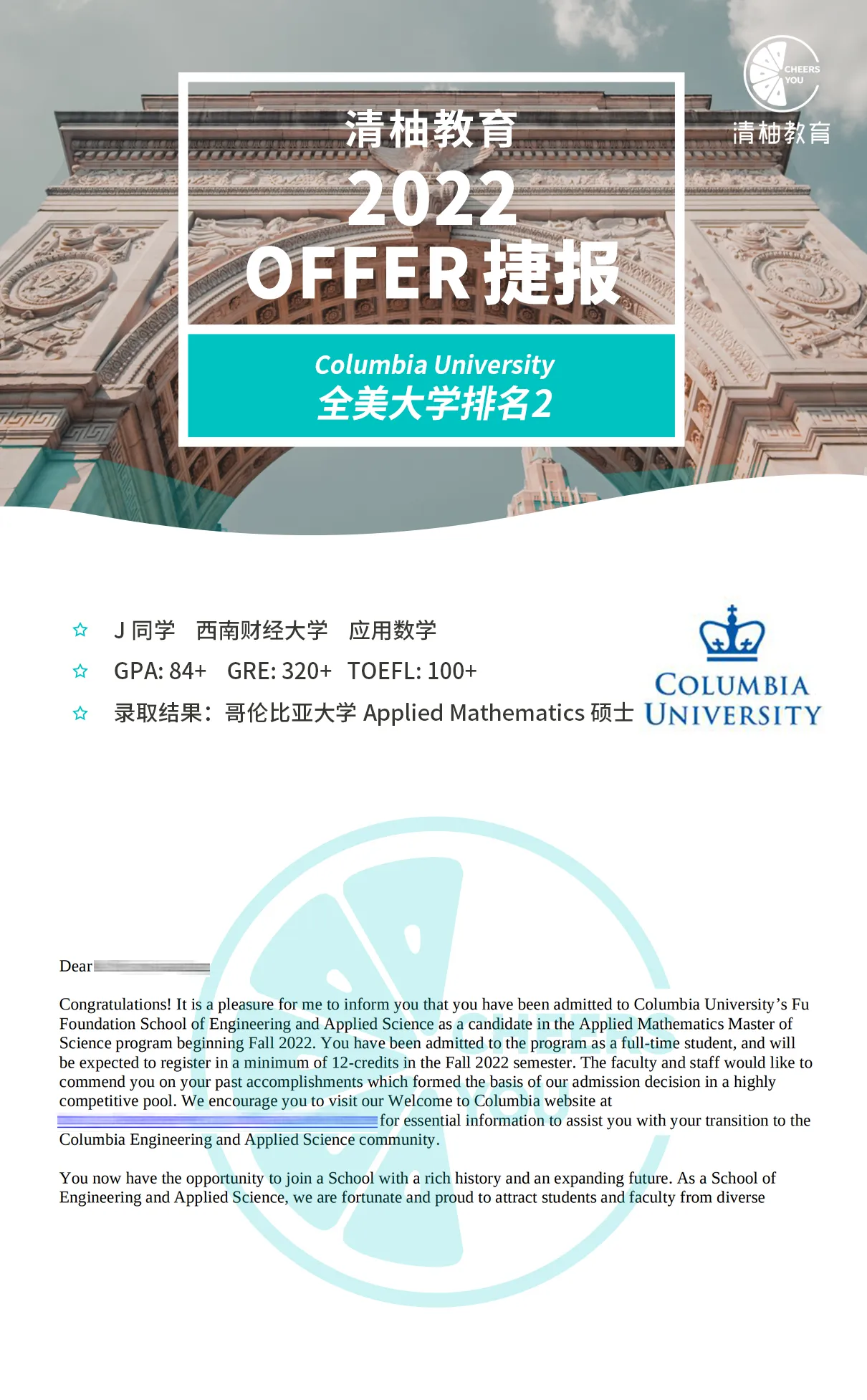
This year, Teacher Anne has also helped some students receive offers from Columbia's Applied Mathematics program:
.png?x-oss-process=style/opt-webp)
Above is an introduction to Columbia's Applied Mathematics program. Scan the QR code below to start a one-on-one study abroad consultation right away~
.png?x-oss-process=style/opt-webp)