
The Master of Public Administration (MPA) is actually one of the top choices for many liberal arts students studying abroad! MPA-related programs have very few restrictions on applicant backgrounds. Whether you study management, economics, statistics, history, sociology, or education, you can consider them. Therefore, the application difficulty is relatively mild. If you have an outstanding background and some relevant work experience, you have a great chance of getting into an Ivy League MPA program. Speaking of Ivy League MPA-related programs, we must mention the two popular ones: Cornell University's MPA and the University of Pennsylvania's IMPA. So, what are the differences between them? What are the application requirements? CheersYou(清柚教育) provides a detailed analysis for everyone~
Cornell University vs. University of Pennsylvania
First, let's look at the differences between Cornell University and the University of Pennsylvania themselves.
Looking purely at rankings, Penn (US News #8) is definitely ahead of Cornell (US News #17), which means employer recognition when returning home may be higher. However, the experience of living abroad varies from person to person.
Moreover, Cornell University's main campus is located in the small town of Ithaca in the northwestern part of New York State (about a four-hour drive from New York City). Compared to the typically crowded universities in the northeastern United States, Ithaca boasts beautiful lake and mountain scenery, presenting a grand and spacious atmosphere.
.png?x-oss-process=style/opt-webp)
Penn is located in Philadelphia, the cradle of the United States and the sixth-largest city in the country. It is the third-largest economic hub on the East Coast after New York and Washington, D.C., and also a historic city. However, safety in certain areas of Philadelphia is not particularly good, so if you plan to study and live in Philadelphia, do not be lax about safety issues.
.png?x-oss-process=style/opt-webp)
In summary, if you want to experience beautiful rustic scenery, quietly engage in academic pursuits, and do not mind missing out on big city bustle, Cornell is definitely a good choice. Otherwise, Penn might be the preferred option.
Penn IMPA vs. Cornell MPA
University of Pennsylvania IMPA
This Upenn program is part of Liberal and Professional Studies (LPS), which is housed under the School of Arts and Sciences, one of Penn's twelve schools. To explain briefly: the School of Arts and Sciences has three divisions, each with its own academic objectives—CAS is responsible for undergraduate education, the Graduate Division handles research-oriented master’s and doctoral degrees, and LPS is in charge of lifelong education. In other words, LPS focuses on bringing the Ivy League heritage to people of all ages, educating through a combination of general knowledge and practice-oriented career skills. So, LPS is not equivalent to the SPS schools some American universities have. It is similar to the SCALE school at NUS: Penn places many professionally oriented degrees under LPS for management and admissions, but the faculty and degree conferral come from the respective schools and Arts and Sciences.
.png?x-oss-process=style/opt-webp)
Furthermore, the final diploma only shows the Penn degree, with no indication of the college. It is also worth noting that each student in this program is assigned an academic and career advisor who meets with them regularly. Extracurricular experiences include meetings with prominent leaders from government, business, academia, philanthropy, media, and other sectors, as well as various networking and social events.
Admission Requirements:
GRE is not required (but a score of 325+ is more competitive); IELTS 7, TOEFL 100. The school explicitly states a preference for applicants with the following four backgrounds—
- Outstanding academic records in any undergraduate or graduate field of study (including liberal arts or business).
- Evidence of a willingness to help others through extracurricular activities, internships, or work experience.
- A desire to pursue a successful career as an effective and ethical leader in institutional settings (nonprofit, corporate, or government).
- Proficiency in English and any one or more of the following three languages: Mandarin, Hindi, or Swahili.
Curriculum:
The program is one year long, costs approximately $64,324, and requires the completion of ten courses.
.png?x-oss-process=style/opt-webp)
These include:
- Three Intellectual Framework courses—covering research on issues of human well-being, cross-sector collaboration and interdisciplinary thinking, and competitive theories and concepts of leadership effectiveness;
- Four Interdisciplinary Foundation courses—Economic Reasoning (I-MPA 6020), Quantitative Reasoning (I-MPA 6030), Ethical Reasoning (I-MPA 6060), and Program Evaluation (I-MPA 6070);
- Three advanced courses—completed through individual, small-group, and whole-class formats, covering topics such as personal leadership learning, analysis of India’s energy needs and economic development challenges, and global aging and China’s pension crisis.
Given space constraints, we won’t go into more details. If interested, check the official website link: https://www.lps.upenn.edu/degree-programs/impa
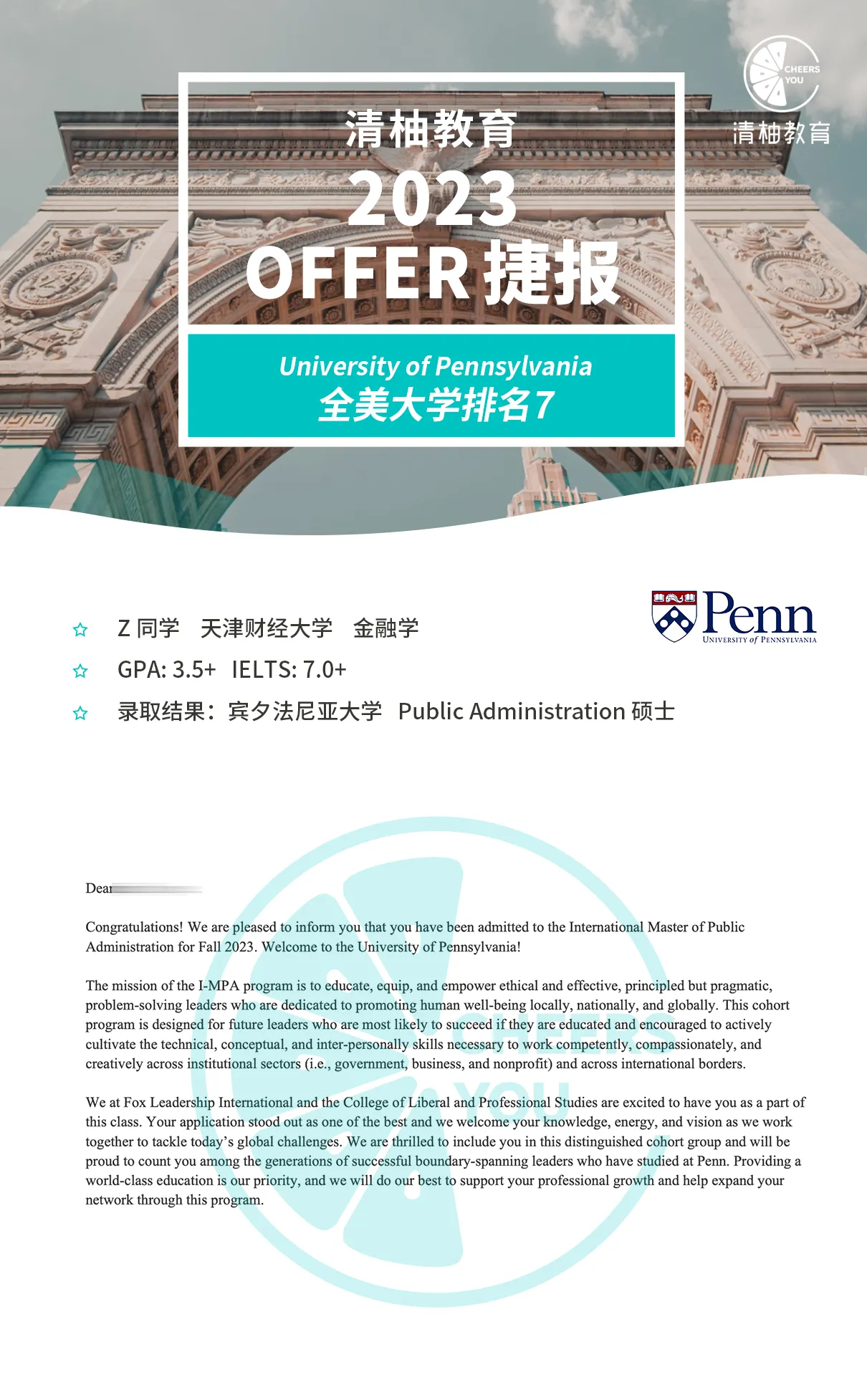
Cornell University MPA
This program belongs to the Cornell Institute for Public Affairs (CIPA), established under the Brooks School of Public Policy. It aims to prepare students for management and leadership roles in the public service sector. Cornell’s MPA focuses on building skills in management, economics and finance, and quantitative analysis.
.png?x-oss-process=style/opt-webp)
Admission Requirements:
IELTS 7.5 (minimum 7 in each section), TOEFL 100, GRE is not mandatory. We won’t expand on specific essay requirements here. If you have questions, feel free to contact us privately.
Curriculum:
Cornell’s MPA program is two years long and offers eight concentrations to choose from: Economic and Financial Policy; Environmental Policy; Government, Politics, and Policy Studies; Human Rights and Social Justice; International Development Studies; Public and Nonprofit Management; Science, Technology, and Infrastructure Policy; Social Policy. This means students can delve deeply into their areas of interest. I especially recommend taking an employment-oriented approach, since policies in finance, technology, education, and other sectors differ greatly. Using graduate coursework to directly link to the industries and positions of future employment is a solid foundation for strengthening competitiveness.
.png?x-oss-process=style/opt-webp)
Besides nine core courses, each concentration offers dozens of elective courses. Again, due to space, we won’t go into details. If interested, check the official website: https://publicpolicy.cornell.edu/studying-at-brooks/masters-programs/cipa/
.png?x-oss-process=style/opt-webp)
Career Development:
Most graduates go on to work in public, corporate, and nonprofit sectors, with the first two accounting for a larger share. Examples include analysts at the New York City Housing and Economic Development Working Group, researchers at the U.S. Bureau of Labor Statistics, consultants at the World Bank, and positions in the Ministry of Foreign Affairs.
That concludes our analysis of these two programs. Additionally, we’d like to recommend some related programs. Anne has helped many students secure offers from these programs, such as:
- Columbia -- Nonprofit Management
- Chicago -- MPP
- USC -- MPP
- NWU -- Public Policy and Administration
For more application details, add the QR code below to learn and consult~
.png?x-oss-process=style/opt-webp)