
The National University of Singapore (NUS), a world-class top university and the highest-ranked institution in the Asia-Pacific region, has always been a popular choice for study-abroad candidates. But what are the requirements for applying to NUS? Do 985/211 students really have a higher admission rate? What kind of students does NUS admit? Today, CheersYou(清柚教育) advisor will give you a detailed analysis.
First, let’s briefly introduce NUS. Since 2019, NUS has consistently held the 11th position in world university rankings, making it a truly world-class top institution.
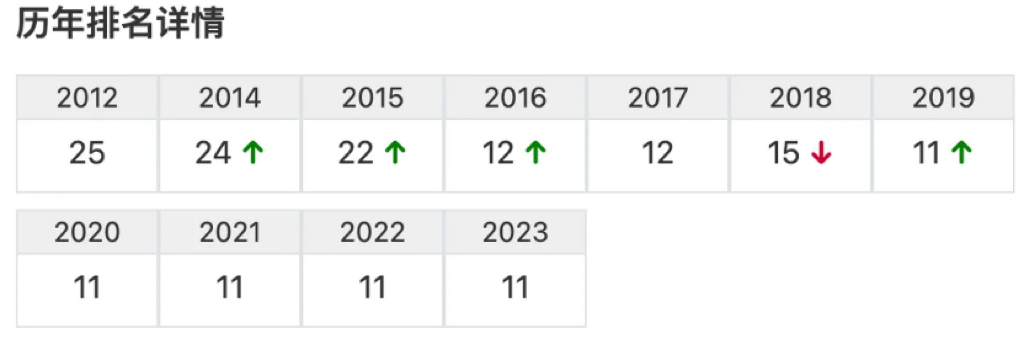
Moreover, beyond its rankings, NUS has 38 programs ranked among the world’s top 50, spanning engineering, social policy, business, computer science, education, and many other fields.
Therefore, whether it’s for the university’s prestige or program choices, NUS is the top pick for many students. Additionally, after the pandemic, the number of students choosing to study abroad has been increasing, and many are adopting multi-country application strategies to boost their chances. This rising tide lifts all boats, and NUS naturally becomes more rigorous in its applicant review.
“Students with high GPAs above 3.7 from overseas universities use NUS and NTU as safety schools; students from domestic or joint-venture institutions with GPAs of 3.5–3.6, who want to stay close to home, live in a safe city, and have a good school ranking gradient, use NUS and NTU as reach/main choices.”
As applicants’ backgrounds become stronger, admission requirements will certainly rise accordingly.
So what kind of students does NUS actually admit? Let’s first look at a few offers received by CheersYou(清柚教育) students as reference.
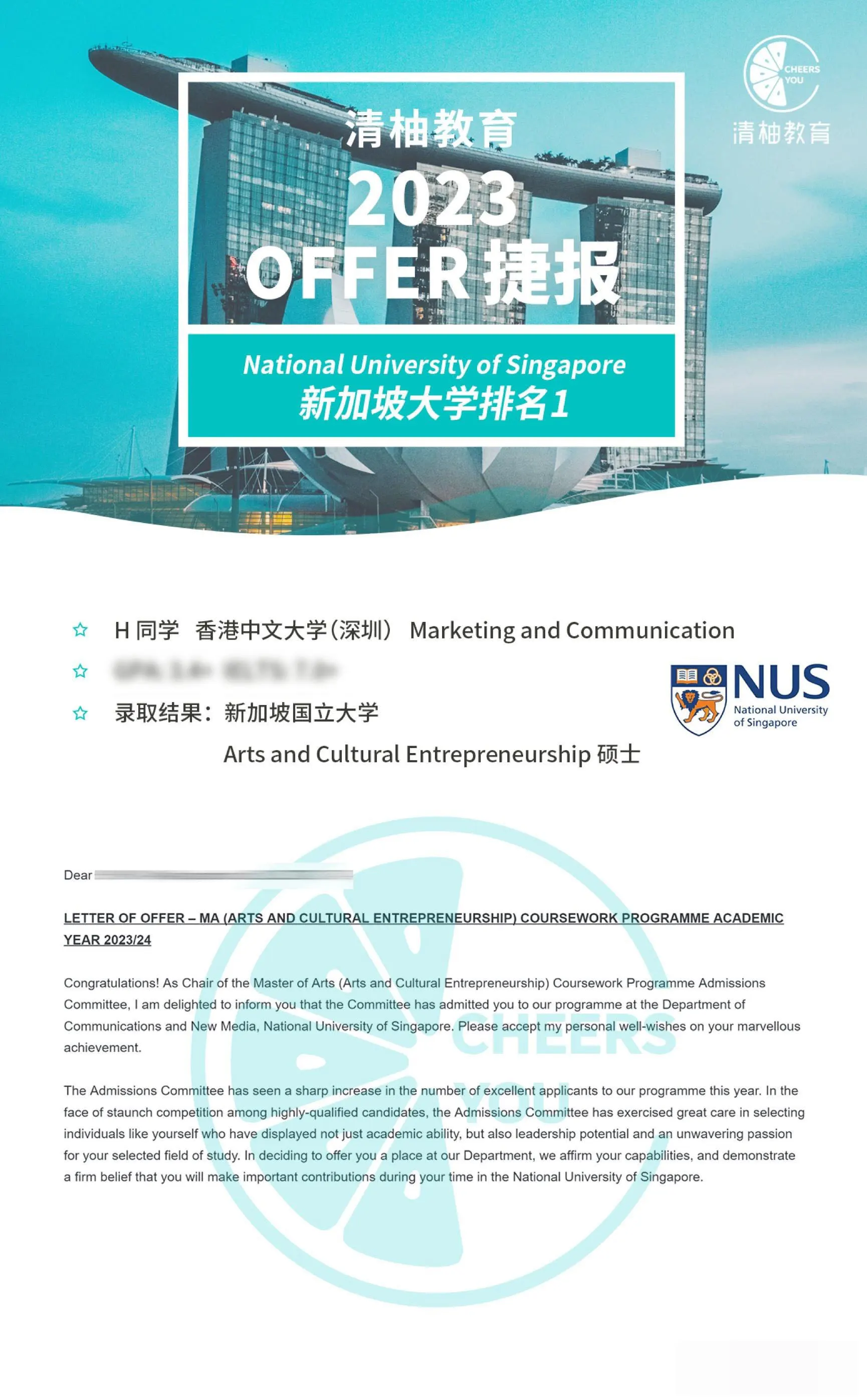
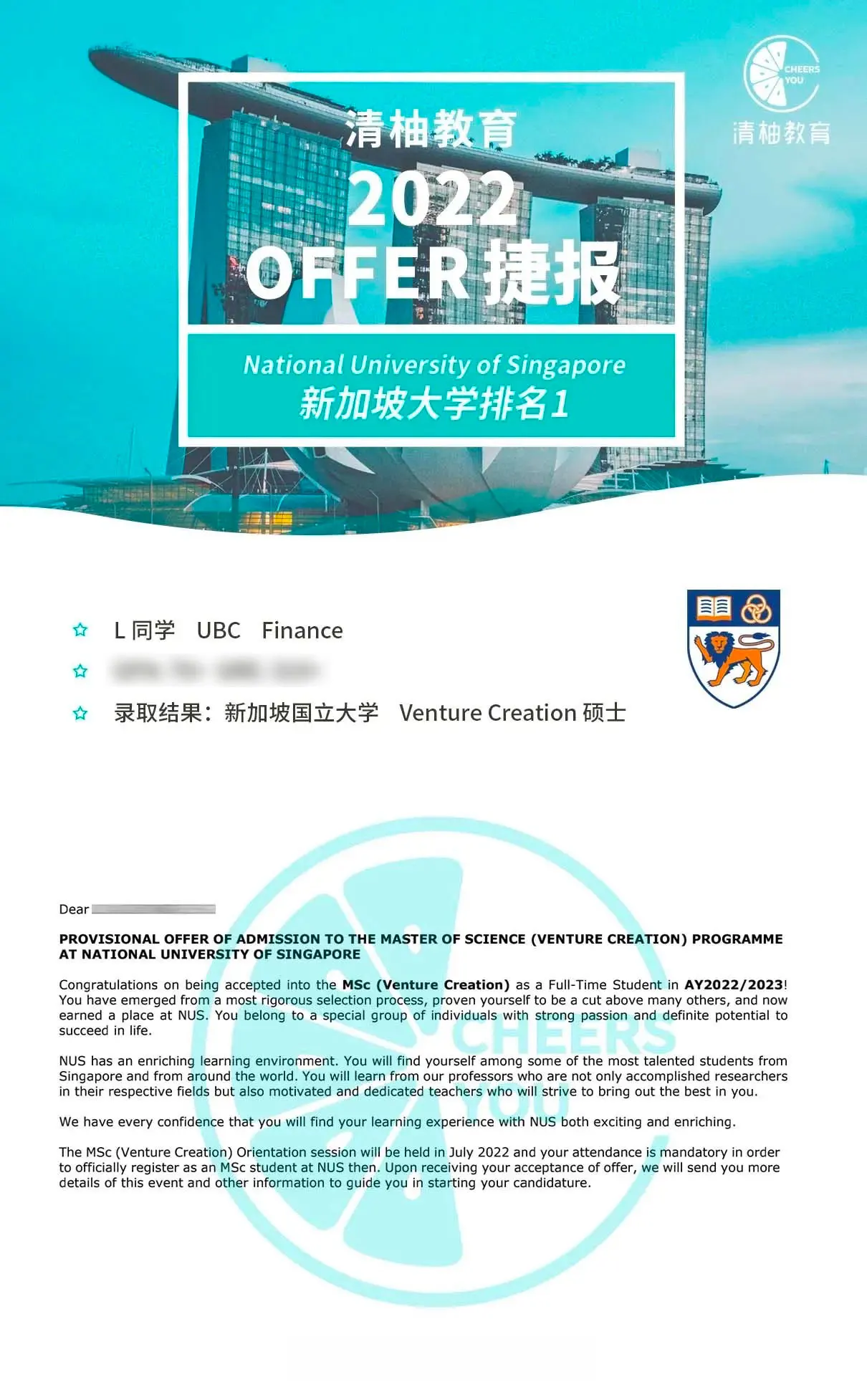
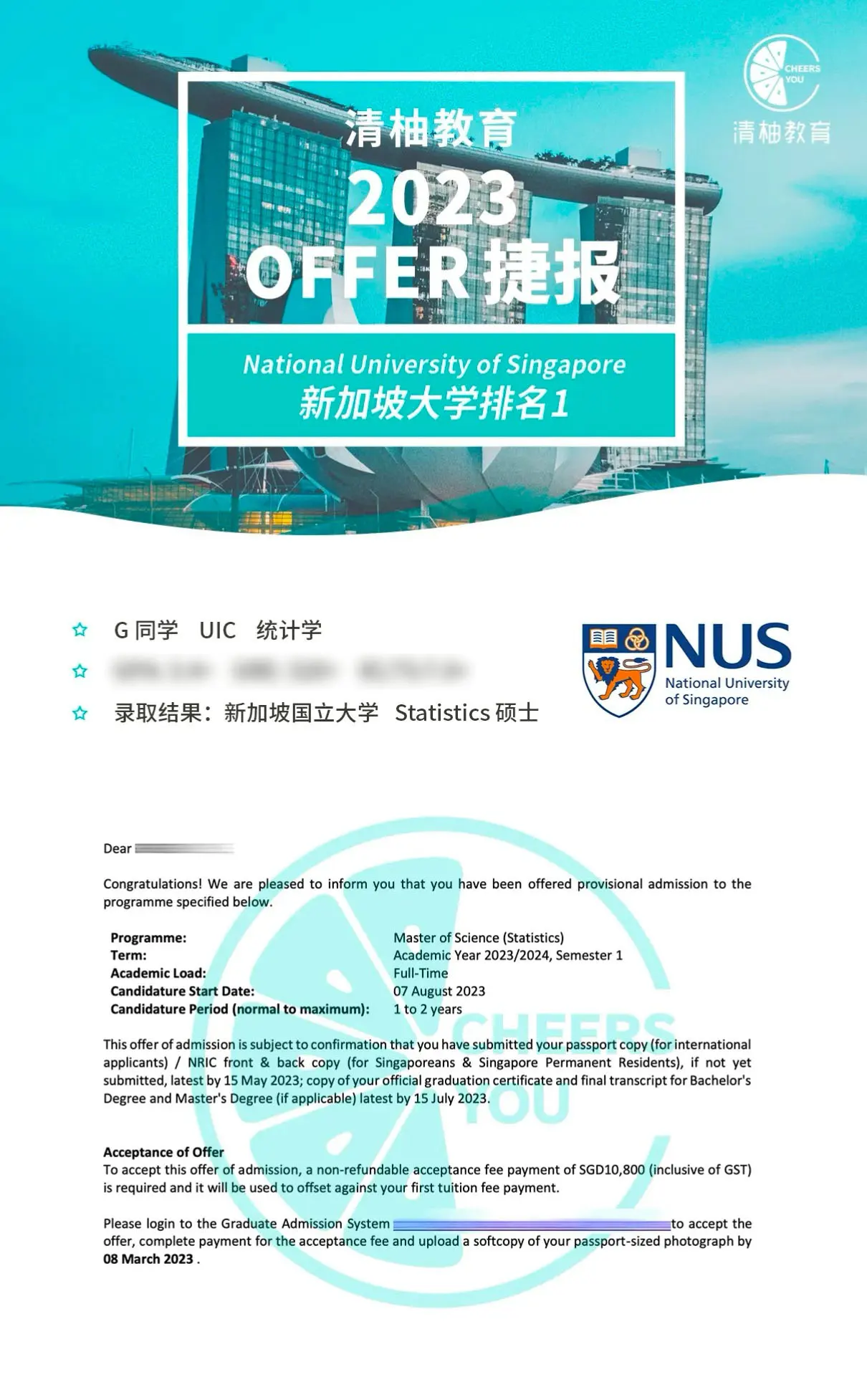
Like the UK, Singapore places considerable weight on applicants’ undergraduate institution backgrounds, which is clearly evident from the admission backgrounds of the offers above. Therefore, students from overseas, joint-venture, and 985/211 institutions do have a certain advantage in initial conditions, but there is no explicit rule that only those from prestigious backgrounds can receive offers. Today, CheersYou(清柚教育) advisor has summarized some other application characteristics of offer holders. If you are not currently enrolled in a 985/211 or other prestigious university, excelling in the following areas can make overtaking on the curve possible.
1. Three-Dimensional Scores
(Based on the offers received by CheersYou(清柚教育) students in the 23Fall cycle)
- IELTS needs to reach 7 / TOEFL needs to reach 100
- GPA at least 3.3 or above
- In highly competitive programs like finance, business analytics, and computer science, GRE scores are also very important. Especially for students with a GPA between 3.3 and 3.5, a GRE score of 325 or even 330+ can compensate for a less stellar GPA.

When applying to the “New Two” (NUS and NTU), you need to have a complete language test score. Some programs strongly recommend submitting GRE/GMAT scores, so it is advised that students who want to apply to NUS start understanding the application requirements and preparing for exams as early as freshman or sophomore year.
2. How to Supplement Your Background
- Prerequisite Course Supplement
For example, if you want to apply for a Business Analytics program, the school will look at your quantitative background. You should take as many mathematics, statistics, and computer science courses as possible during your undergraduate studies, participate in academic research projects that utilize statistical analysis and modeling skills such as SPSS, EViews, MATLAB, and learn at least one programming language like R, Python, MATLAB, or SQL.
- Accumulate High-Caliber Internship/Research Experience
No matter which school you want to apply to, having internship or research experience strongly related to your target program will definitely be a huge plus. It is recommended to start internships during the summer or winter breaks of your sophomore year. Taking NUS BA admission outcomes as an example, previous offer holders’ resumes show that many had full-time work experience, while fresh applicants typically have 2–3 internships during their undergraduate years. Among them, many have 1–2 data analysis or data processing internships, such as data analysis roles in securities firms, consulting, internet, or data analytics companies, market analysis positions in Fortune 500 companies, or data analysis roles in other industries. These types of internship experiences are highly valuable. By using strengths to compensate for weaknesses, the likelihood of a successful application greatly increases.
3. About the Personal Statement
The personal statement is the only warm and personal element among all application materials. Through it, you can let the admissions officer feel your personality. Many students underestimate its importance, but when all other data is similar, the role of the personal statement becomes especially critical. Moreover, if the statement is poorly written, you may be rejected early in the review process, so preparing a good personal statement is also very important.
4. About the Interview
As the final step in the NUS graduate application process, 60% of students are rejected due to poor interview performance… The importance of the interview needs no further explanation from me; you can say the interview is the last dash before securing an offer. Every year, CheersYou(清柚教育) compiles the latest interview experiences for various programs and arranges mock interviews with professional foreign mentors to ensure that students can give their best performance during the actual interview!
5. Apply as Early as Possible!!!
“The early bird gets the worm” applies to graduate applications as well! For the 23Fall cycle, regular programs opened online applications in October-November, but some programs offered early application rounds. For example, the Faculty of Science (such as the Master of Economics program) started applications on May 16th. Admissions officers review applications in the order they are received, and popular programs receive tens of thousands of submissions, so being reviewed earlier is definitely advantageous. Therefore, do not wait until the deadline; you should apply as early as possible!
Although NUS graduate applications are highly competitive, by excelling in the above areas, even without a prestigious academic background, you can still have a chance to secure an offer. If you have other questions about studying abroad or want to learn more about school information, application requirements, or admission trends, scan the QR code below to start a one-on-one consultation~