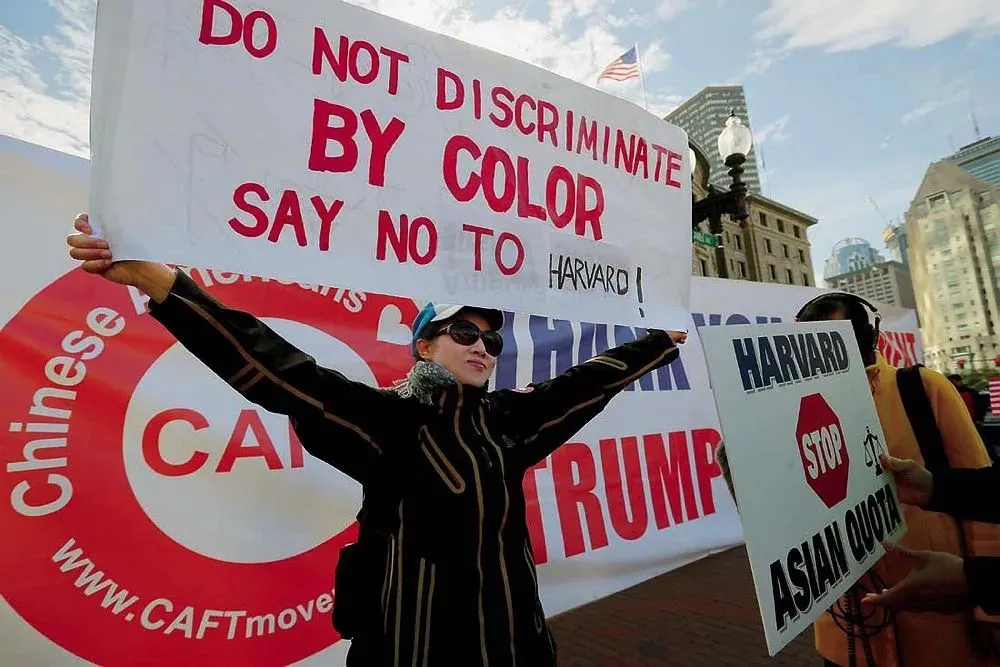
Just now, the U.S. Supreme Court issued a historic ruling:
Colleges cannot consider 'race' as a factor in admissions.
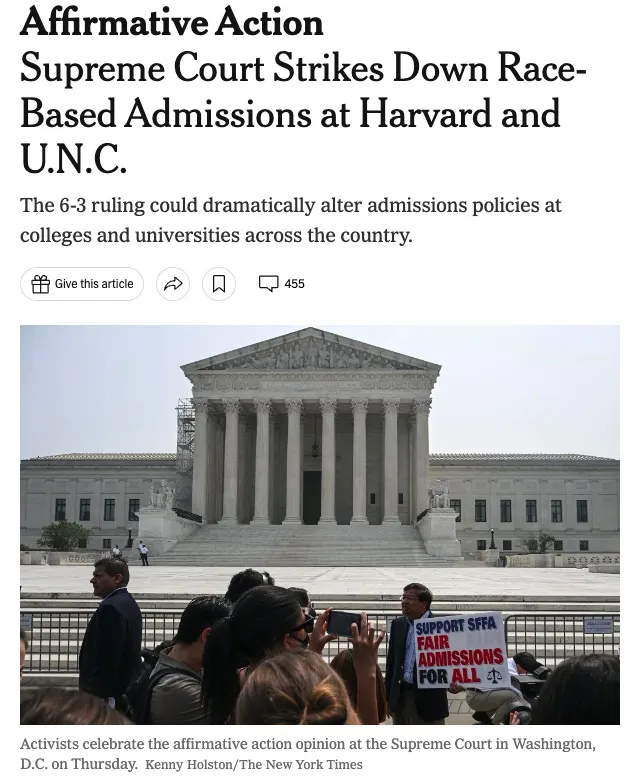
This ruling declares that the admissions policies of Harvard University and the University of North Carolina at Chapel Hill, which consider race, are unconstitutional, and confirms that the long-standing practice of affirmative action at U.S. colleges is incorrect.
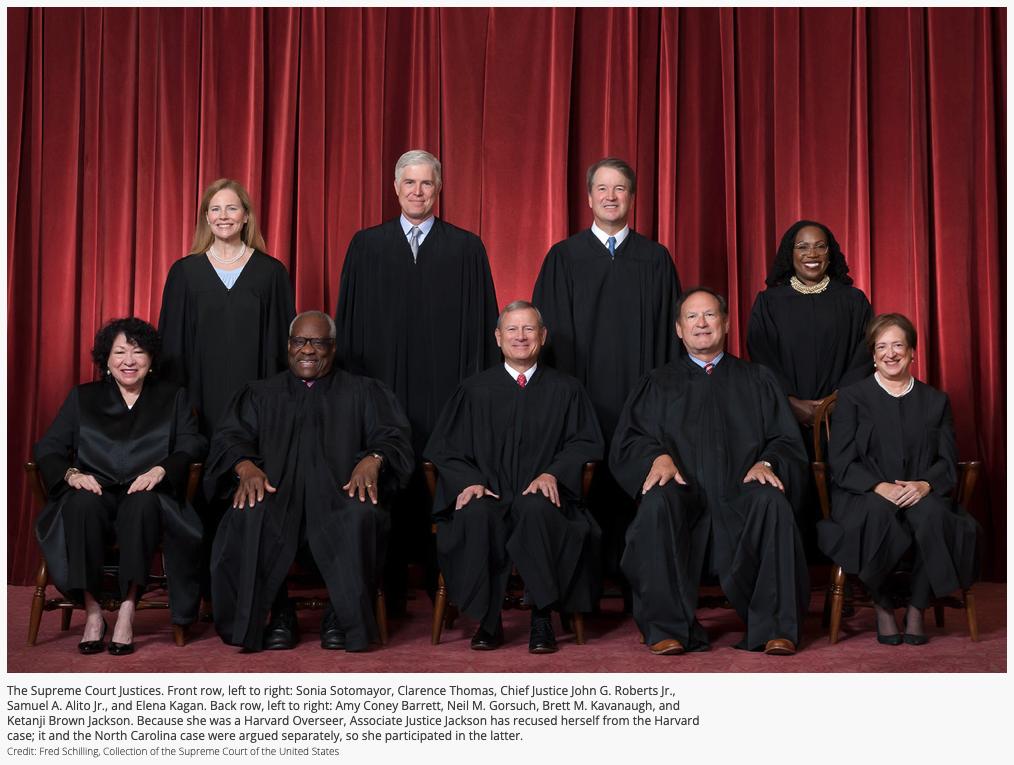
The Supreme Court ruled 6-3 that UNC’s admissions process was unconstitutional and 6-2 that Harvard’s was as well.
.png)
In the majority opinion, Chief Justice of the U.S. Supreme Court wrote: 'Eliminating racial discrimination means eliminating all of it. Schools must consider students’ individual experiences, not race.' He added that Harvard and UNC’s affirmative action programs 'unavoidably use race in a negative manner, involve racial stereotyping, and lack meaningful end points.'
This landmark decision overturns more than 40 years of precedent that favored Black and Latino students in higher education admissions. In the future, college campuses can expect more White and Asian students.
Public Opinion Remains Divided
Of course, society remains divided over this ruling.
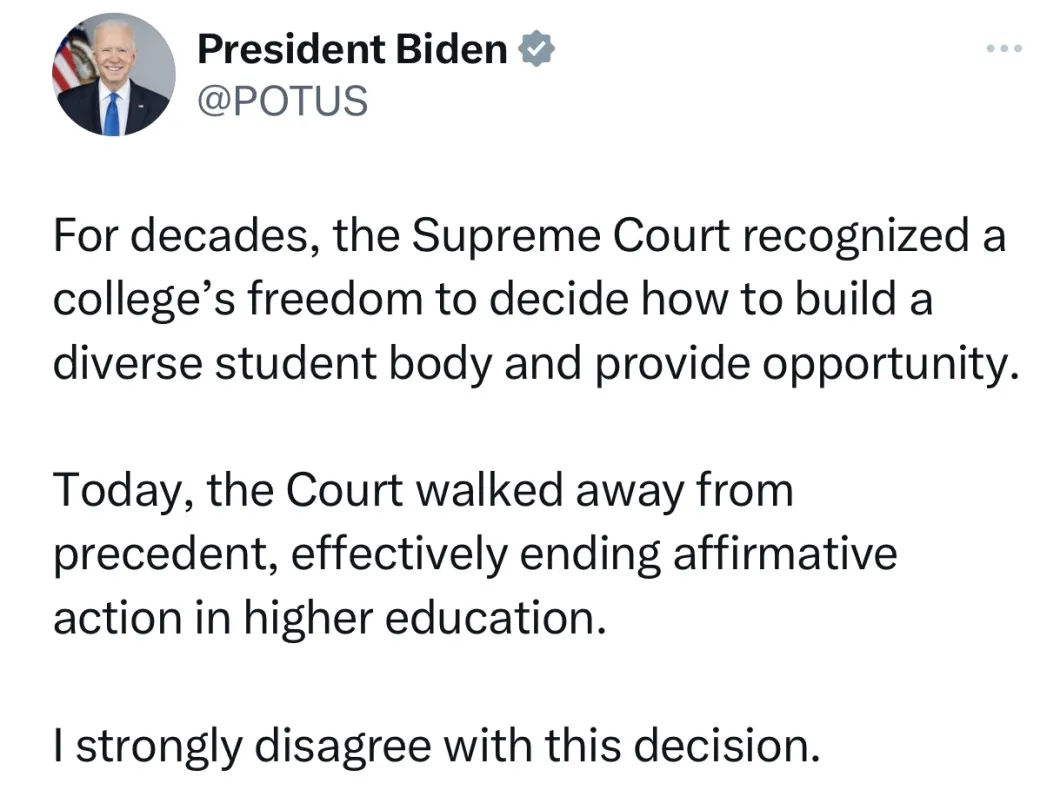
President Biden expressed his opposition, 'strongly disagreeing with the Supreme Court’s decision,' and stated, 'Colleges and our entire country are stronger when they reflect greater racial diversity.'
In the dissenting opinion, the dissenting justices wrote that 'the use of racial quotas in affirmative action promotes equal opportunity in higher education.' However, they argue that the court’s action 'obstructs and overturns decades of precedent and significant progress that had been made.'
The Speaker of the House approved of the Supreme Court’s latest decision, saying, 'Now students will be able to compete based on equal standards and individual merit.'
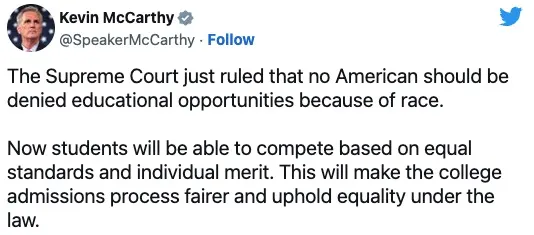
Many supportive netizens also chimed in: This is the best decision the Supreme Court has made in 50 years.

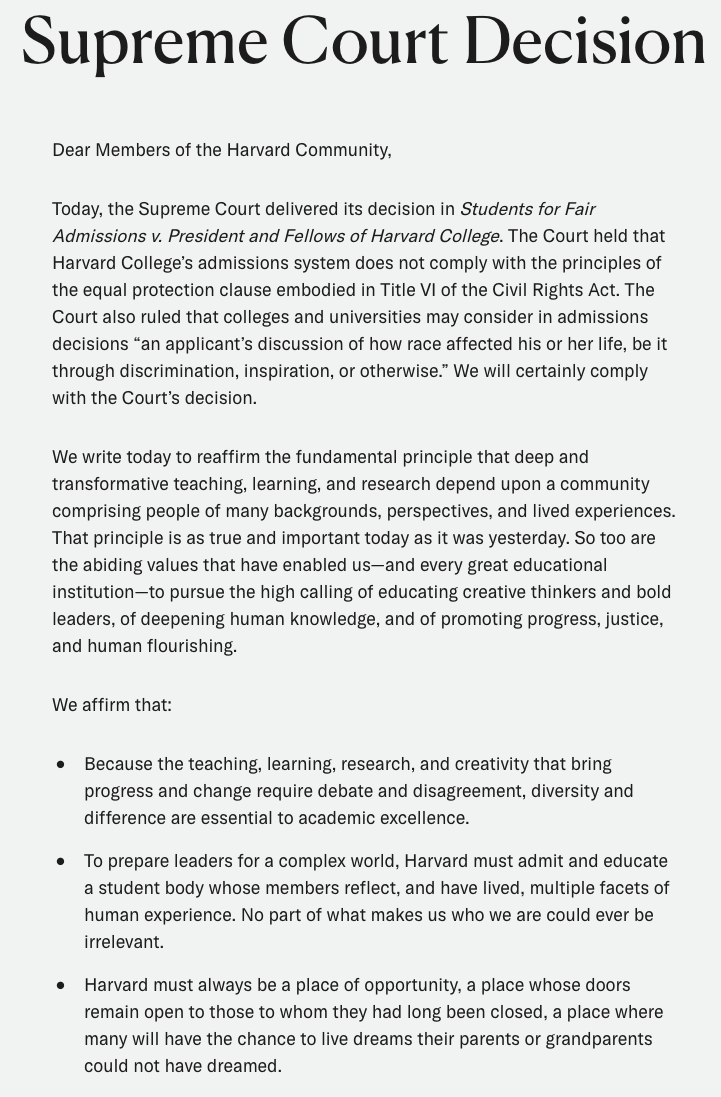
Harvard University issued a statement saying it will 'determine how to uphold the university’s core values in light of the court’s new precedent,' emphasizing that this ruling could have unpredictable consequences given the varying admissions policies of selective institutions.
As for whether Harvard will continue to maintain preferential policies for, say, children of alumni and donors or certain types of athletes in future admissions, many media outlets are watching closely.
The Contentious History of Affirmative Action in U.S. College Admissions
Affirmative Action in U.S. college admissions, also called 'positive affirmative measures,' refers to policies designed to prevent discrimination against minority or disadvantaged groups based on 'race, religion, sex, or national origin.' By providing these groups with preferential treatment, the aim is to remedy discrimination and achieve equity.
According to data from Ballotpedia, about 20% of public universities consider race in admissions.
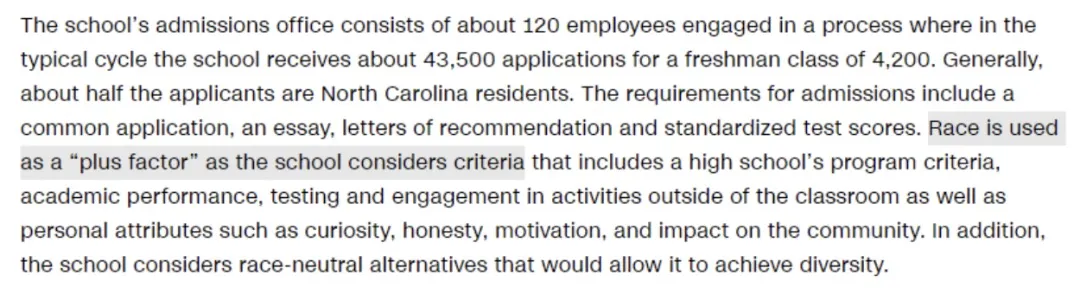
Multiple institutions, including Harvard and UNC, have stated that considering race as one factor in a holistic review of applicants is necessary to promote campus diversity. UNC even uses 'race' as a bonus point in admissions:
In recent years, however, challenges to affirmative action have grown.
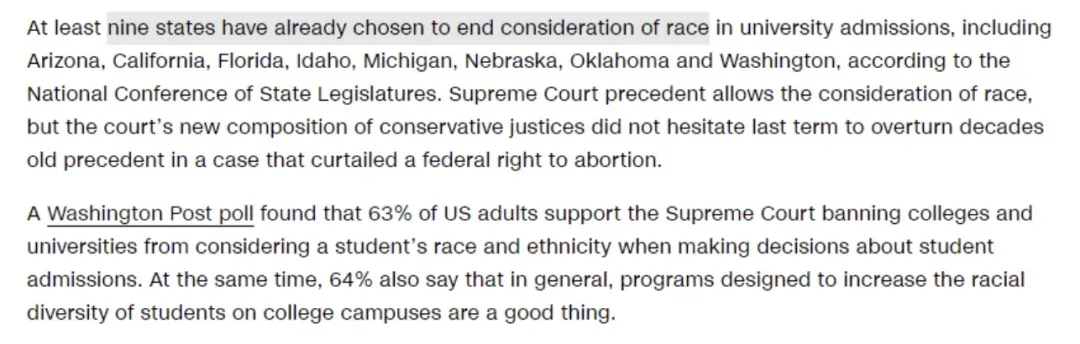
A Washington Post poll shows that 63% of Americans support the Supreme Court banning the consideration of race in college admissions. Currently, public universities in at least nine U.S. states, including California, Florida, Michigan, and Washington, no longer consider race in admissions.
The civil rights group Students for Fair Admissions (SFFA) is the force behind the lawsuits against Harvard and UNC for alleged discrimination against Asian American applicants.
The Chinese-American student who recently made headlines in study-abroad circles for being rejected by six elite universities despite a 1590 SAT score is also a member of the organization.
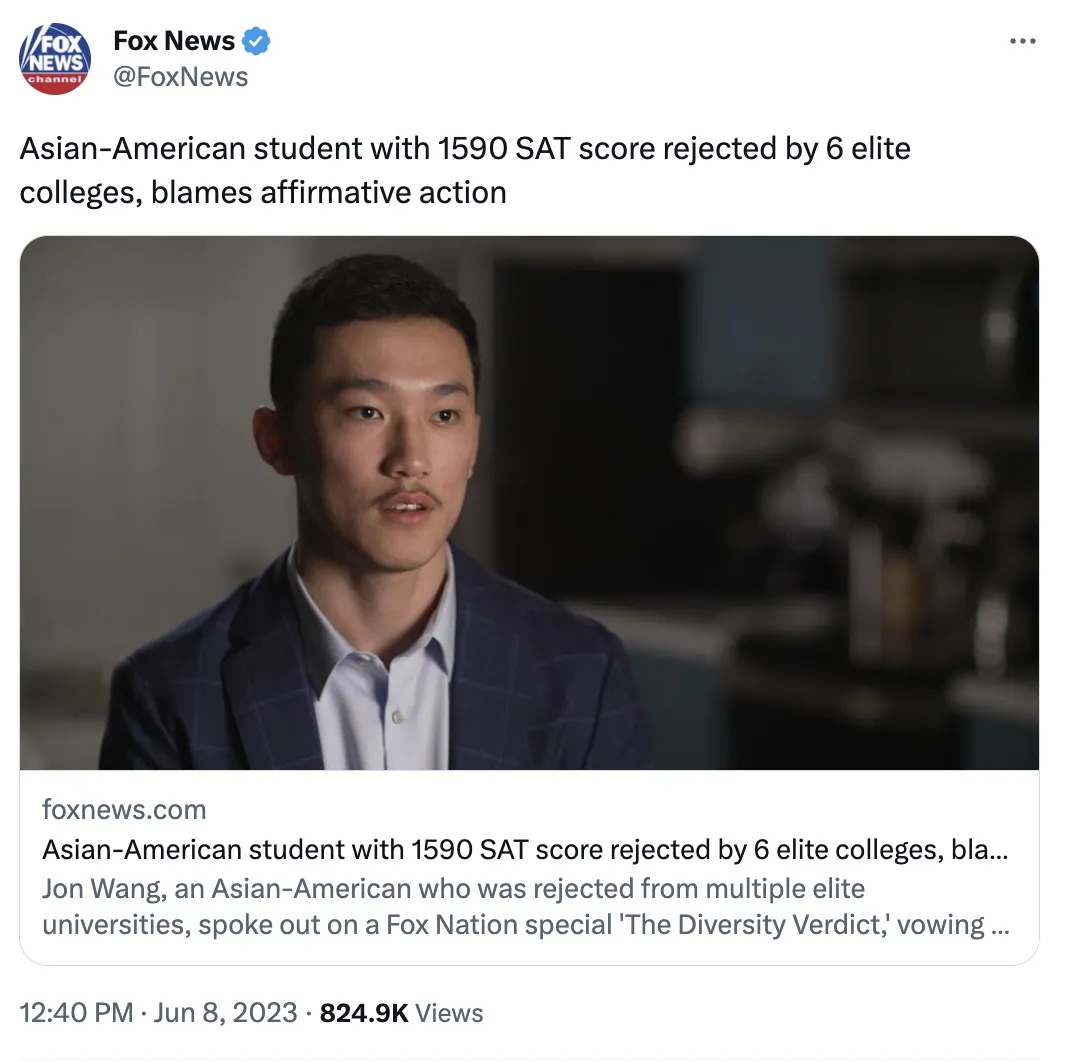
The tug-of-war between SFFA and Harvard has lasted nearly a decade. As far back as 2014, SFFA sued Harvard, alleging that over the years the school had admitted other racial groups over more qualified Asian applicants.
SFFA accused Harvard of 'discriminating against Asian Americans,' violating Title VI of the Civil Rights Act. Their complaint against UNC centered on the school’s unwillingness to adopt 'race-neutral alternatives.'

This case, arguably the most sensational in American education, began in the Supreme Court late last year and today culminated in the ruling that race-conscious admissions are unconstitutional.
Educational Equity: A Long Road Ahead
This historic ruling will force the entire U.S. higher education system to redefine admissions standards. How American universities can truly balance fairness and diversity in admissions will continue to face many challenges in the future.
The fight for educational equity for Asian Americans is long and arduous, but with the advocacy of groups like SFFA and the Supreme Court’s ruling, there will be new opportunities along the road to equality.
As the status of the Asian community rises in the future, this will also benefit Chinese international students.