The Master of Public Policy (MPP) program at the University of Chicago, housed in the Harris School of Public Policy, is a two-year graduate degree. The MPP program has long been highly regarded and, in terms of both reputation and career prospects, is a dream choice for domestic graduate students. It stands as a paragon of public affairs education in the U.S., cultivating students' abilities to formulate, analyze, and implement public policy in fields such as politics, economics, society, and the environment.
Many prospective graduate students are interested in the MPP program. Today, a CheersYou(清柚教育) advisor will provide a comprehensive analysis of the student experience. If you have other questions, feel free to scan the QR code below for a one-on-one consultation~

Program Overview:
MPP is a program that values diversity and respects freedom of speech. The core curriculum spans various disciplines and fields, including economics, sociology, political science, statistics, econometrics, political economy, organizational theory, and program evaluation, making it ideal for students seeking a multidisciplinary approach to public policy studies. Throughout the learning process, great emphasis is placed on cultivating critical thinking and analytical skills. Electives allow exploration of specific academic interests and areas, complemented by internships and independent research that supplement the required coursework.
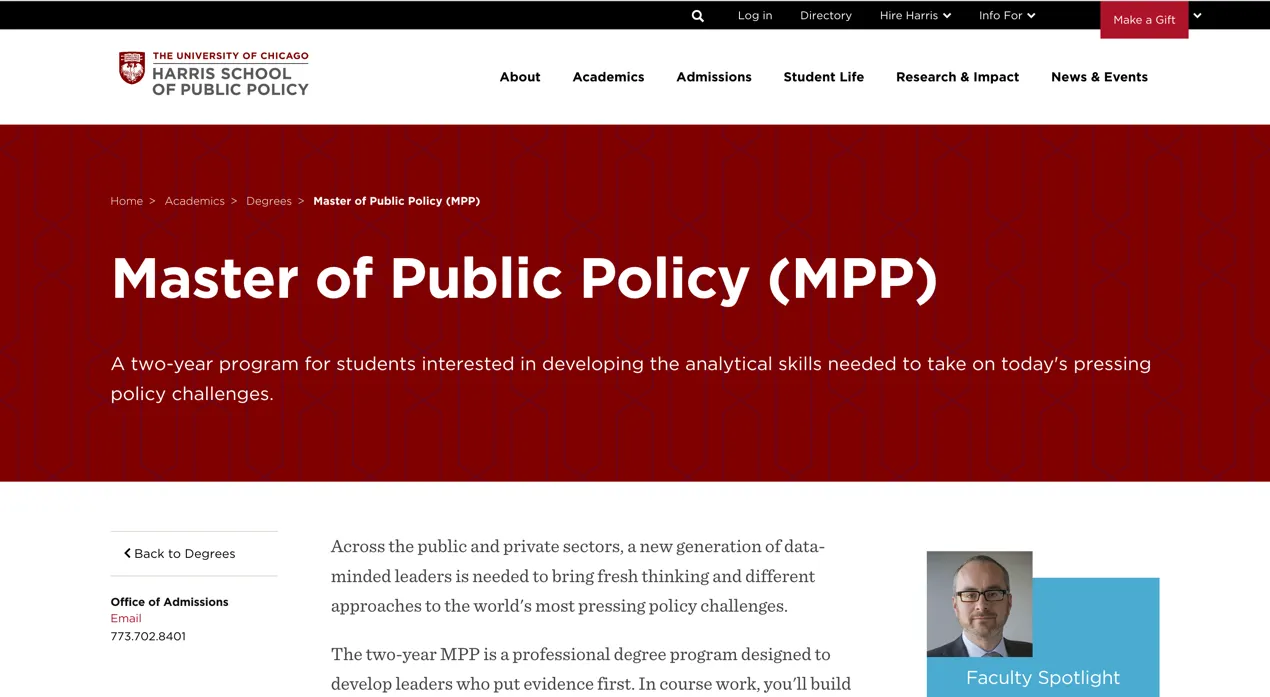
Official program link:
https://harris.uchicago.edu/academics/degrees/master-public-policy-mpp
Curriculum:
The program requires completion of 18 courses, of which 12 must be taken within Harris. Six are core requirements covering microeconomics, statistics, policy formulation, politics, etc., and the remaining six are electives. The other six courses can be taken in other schools. Chinese students typically show strong interest in economics and finance, so they may choose relevant courses at the Booth School of Business.
Detailed Curriculum:
- 18 graduate courses (1800 units of credit), including at least 12 Public Policy (PPHA) courses
- 6 core courses that lay the foundation for critical analysis, reflecting Harris's belief that mastering quantitative and analytical skills empowers students to become effective public policy leaders
- Analytical Politics I:
- PPHA 30800 Analytical Politics I: Strategic Foundations, or
- PPHA 41501 - PhD Game Theory (requires instructor approval and based on seat availability)
- Analytical Politics II:
- PPHA 31610 Analytical Politics II: Political Institutions
- Statistics Sequence I:
- PPHA 31002 Statistics for Data Analysis I, or
- PPHA 31202 Advanced Statistics for Data Analysis I, or
- Any course in the PhD Econometrics sequence (requires instructor approval and based on seat availability): PPHA 42000 or PPHA 42100 or PPHA 42200
- Statistics Sequence II:
- PPHA 31102 Statistics for Data Analysis II: Regression, or
- PPHA 31302 Advanced Statistics for Data Analysis II, or
- Any course in the PhD Econometrics sequence (requires instructor approval and based on seat availability): PPHA 42000 or PPHA 42100 or PPHA 42200
- Microeconomics Sequence I:
- PPHA 32300 Principles of Microeconomics and Public Policy I, or
- PPHA 32310 Advanced Microeconomics for Public Policy I, or
- PPHA 44100 Principles of Microeconomics and Public Policy I (PhD sequence - requires instructor approval and based on seat availability)
- Microeconomics Sequence II:
- PPHA 32400 Principles of Microeconomics and Public Policy II, or
- PPHA 32410 Advanced Microeconomics for Public Policy II, or
- PPHA 44200 Principles of Microeconomics and Public Policy II (PhD sequence - requires instructor approval and based on seat availability)
- Analytical Politics I:
- Elective Options
- MPP students can explore special academic interests and areas, and engage in internships and independent research to supplement the required coursework.
- Students may choose to focus on a public policy area, enroll in courses across university departments and schools, and leverage experiential opportunities to apply classroom knowledge to real-world issues.
Application Requirements
- Resume
- Motivation Statement (300 words explaining your reasons for applying)
- Transcripts
- 2 Letters of Recommendation
- GRE: Required, unless meeting specific conditions such as being a University of Chicago undergraduate or having taken college-level calculus.
- TOEFL/IELTS: TOEFL minimum 95, or IELTS overall 7 with minimum 7 in each component
- $100 Application Fee
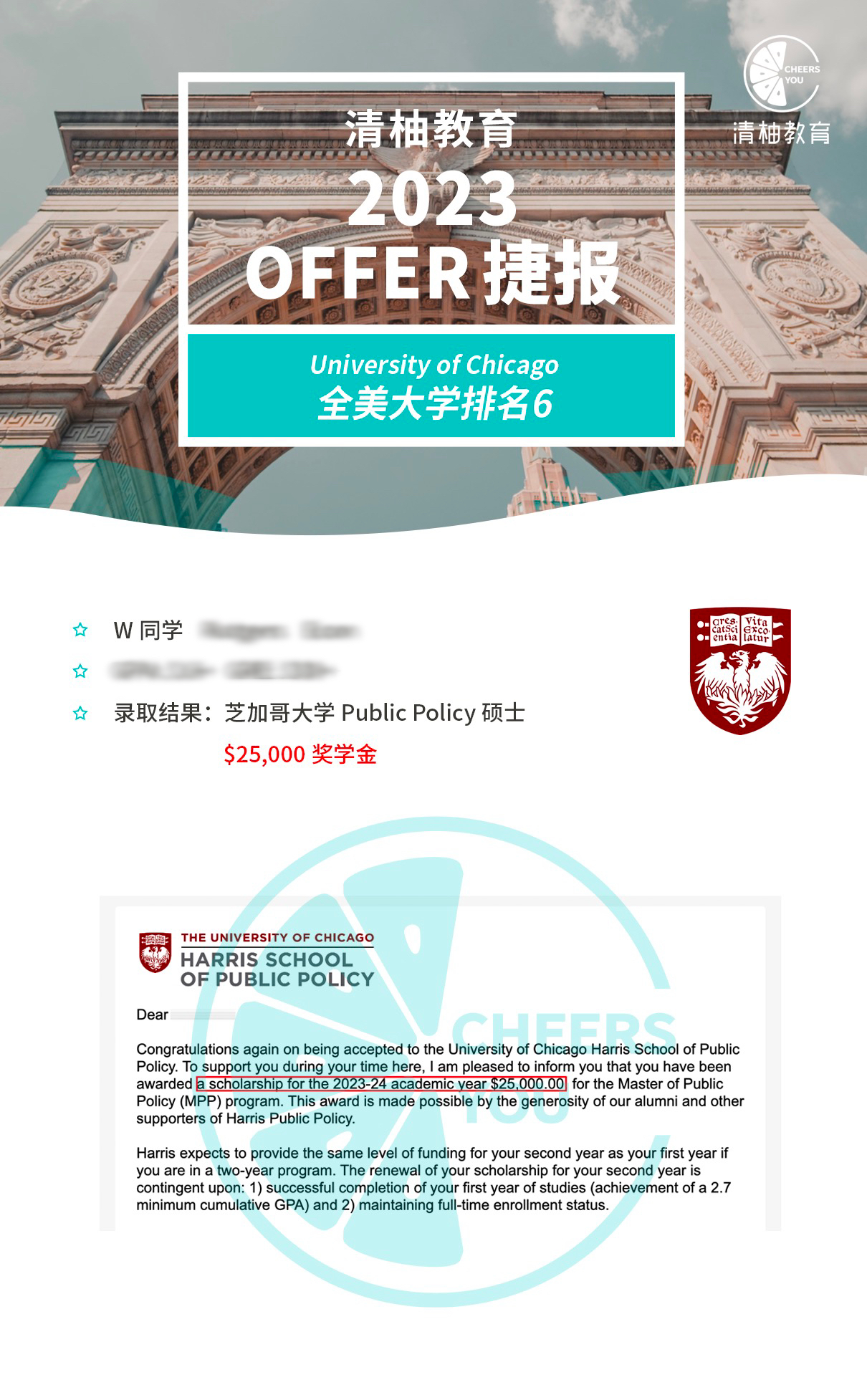
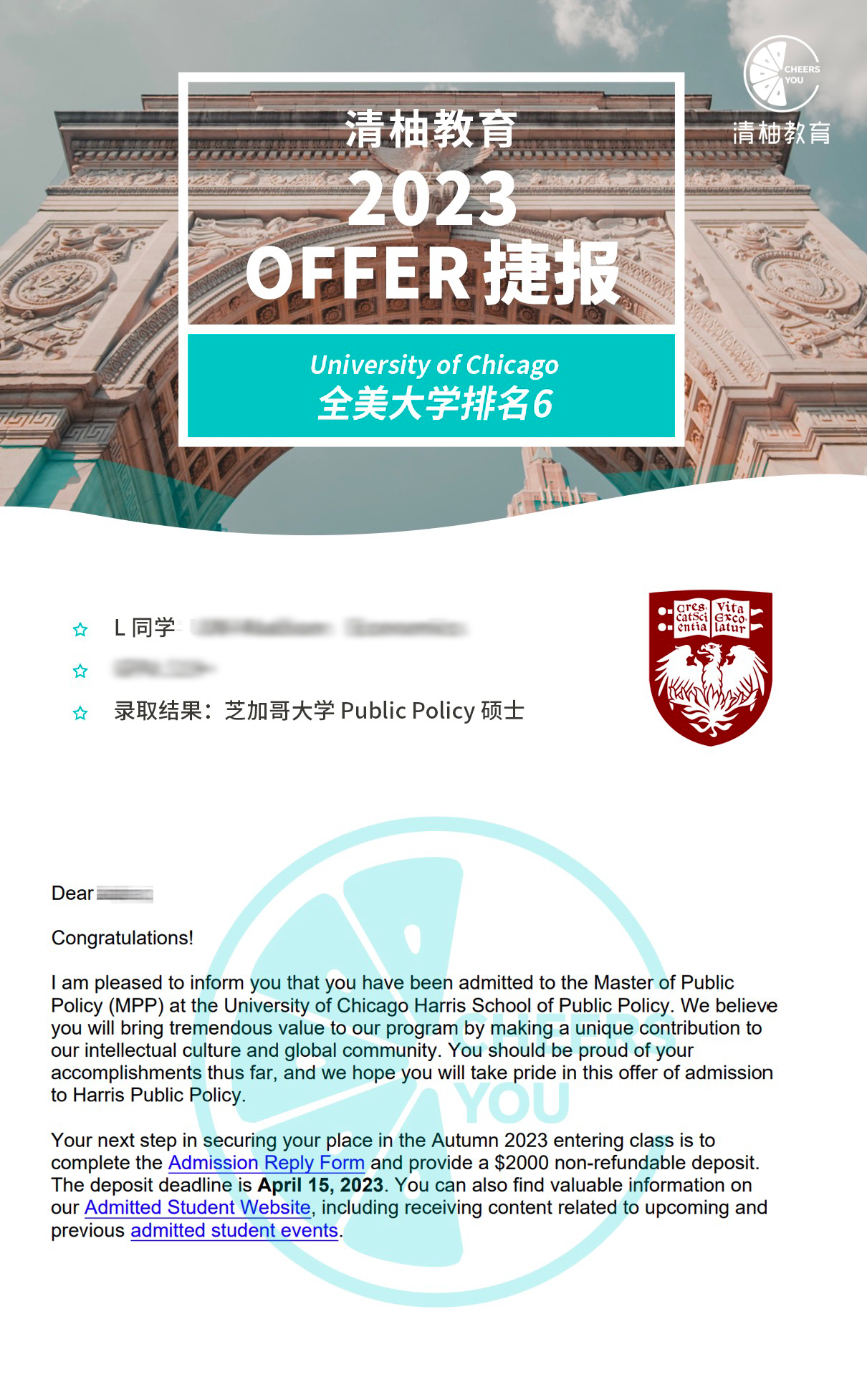
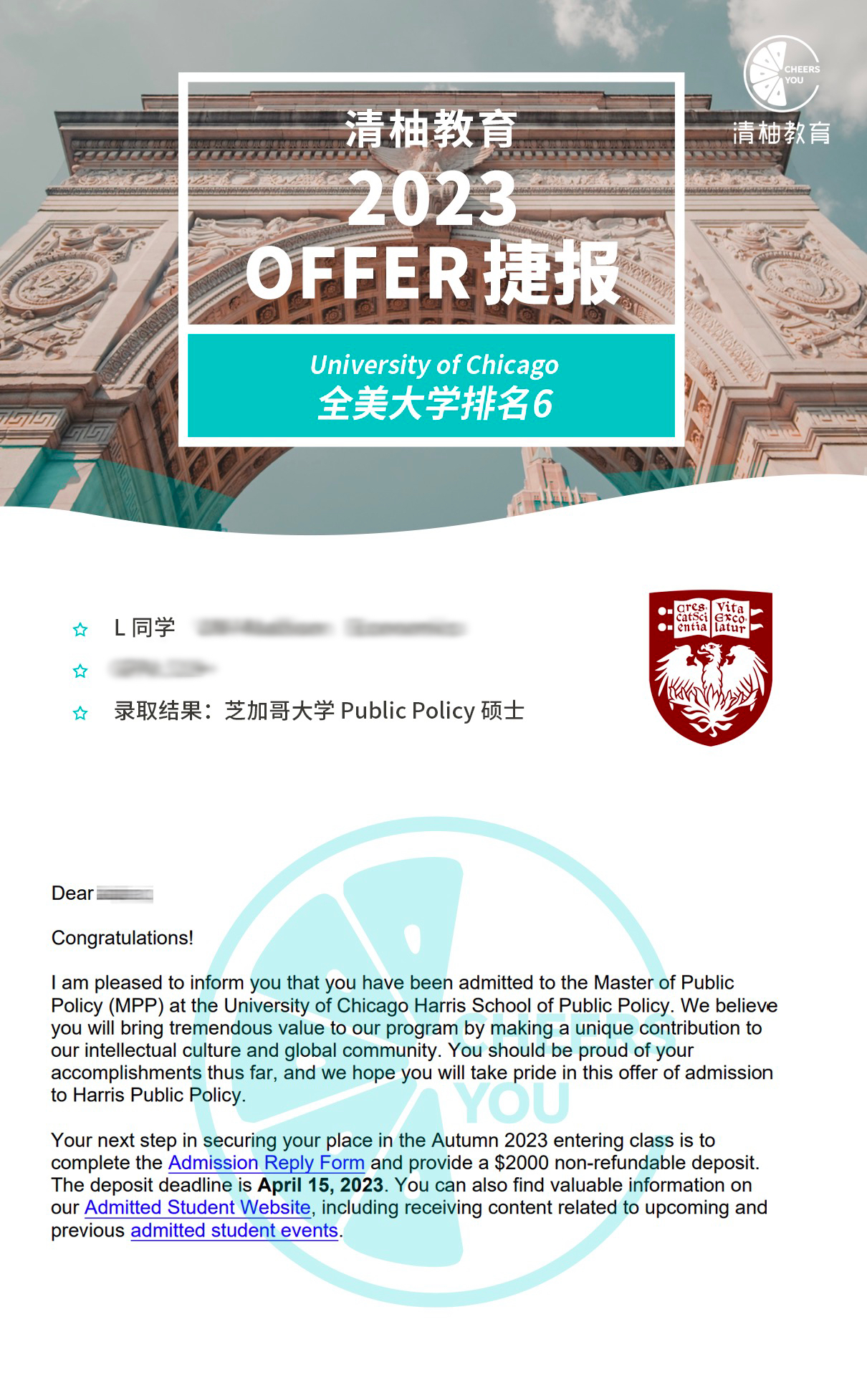
Here are a few examples of our admitted students for reference:
Program Highlights
The curriculum is relatively flexible, with many research areas including economic policy, public finance, healthcare, campaign management, etc.
Since Harris itself is a professional school, there are often numerous activities for students to participate in. For instance, in terms of networking, there is a regular weekly happy hour where everyone can chat and make new friends from diverse backgrounds. Every day at noon, each classroom hosts seminars or info sessions for discussions on hot topics. Financial companies also frequently come to give presentations, which is very friendly for students who want to work in the U.S. after graduation.
Career Services
The career center staff are very responsible, pushing you from the start to continuously polish your resume, cover letter, etc. Harris also often invites alumni who are already employed to come back and have face-to-face conversations with current students, providing many internal referral opportunities.
There is also a mentorship matching program: Based on students' needs, alumni are paired with current students, offering two face-to-face meetings per quarter.
Employment Outcomes
The overall employment direction roughly splits among government agencies, non-profit/NGO/international organizations, and private sector companies like consulting and investment banking—with roughly equal distribution among these three. 94% of graduates receive job offers within six months, and over 200 employers choose to hire from the University of Chicago, including major firms such as Accenture, China Galaxy Securities, Citigroup, CITIC Securities, Deloitte, Goldman Sachs, and others.
Campus Life
Location
Although Chicago is a big city, the campus is located in the South Side, a predominantly Black neighborhood, so safety around campus is not very high, requiring extra vigilance for personal safety.
Climate
Chicago's latitude is similar to Northeast China. The coldest temperatures can drop to -20 to -30 degrees Celsius. Also, Chicago is known as the Windy City, so it's very windy—be mentally prepared.
Food and Housing
There are not many Chinese restaurants near campus, but the school is just a ten-minute drive from Chicago's Chinatown. Renting an apartment is also quite affordable.
Transportation
Public transportation is quite convenient, with metro, bus, and Uber all being good options. However, the school is some distance from the airport—about a 40-minute drive under smooth traffic. Parking near residential areas is expensive, up to $200 per month, but parking on the street for free is an alternative.
Campus Activities
The school has many student clubs with corresponding rich activities, often organizing trips to the aquarium, football games, etc. Parties and sports events are plentiful, and you can participate as you wish.
Facilities
University of Chicago's campus facilities are better than those in China, and the library is fantastic! Campus safety measures are also well-implemented; there is a police officer at every intersection at night, and if any unsafe incident occurs on campus, the school notifies all students via email.
For more graduate application questions, feel free to scan the QR code below to add a CheersYou(清柚教育) advisor for a consultation~