Recently, the Forbes 2023 America's Top Colleges annual list was released.
Princeton University topped the 2023 rankings, with Yale, Stanford, and MIT following closely. Public universities in California continued to show strength, with the University of California, Berkeley placing fifth.
Rounding out the top ten are Columbia University, UCLA, the University of Pennsylvania, Harvard University, and Williams College.
A college education is one of the most important investments in a person's life, and recent economic turbulence has intensified that investment. The Forbes ranking places greater emphasis on student educational outcomes and institutional return on investment, aiming to better reflect which schools truly help students achieve the "American Dream."
Let's take a look at this year's latest rankings~
Forbes Ranking Methodology
Forbes considers a wide range of institutions in its ranking, including doctoral research universities, master's universities and colleges, bachelor's degree colleges, as well as colleges offering specialized programs in engineering, business, and the arts.
Forbes believes that an excellent university should not only have top-notch teaching, but also affordable tuition, a debt burden manageable for everyone, and generous post-graduation salaries.
This year's specific ranking indicators and weights are as follows:
1. Alumni Salary 20%
2. Student Debt 15%
3. Return on Investment 15%
4. Graduation Rate 15%
5. Forbes American Leaders List 15%
6. Retention Rate 10%
7. Academic Success 10%
Forbes also stated in a press release: "If students graduate on time, earn high incomes, have low debt, and go on to have successful careers, the school will receive a higher ranking accordingly."
Additionally, it is important to assess what kind of students a school educates and whether it makes quality education accessible to students from low-income families.
Highlights from the Forbes Rankings
Princeton claimed the top spot this year, rising three places from last year. Its graduates' ten-year median salary of $177,300 ranks first nationally, and only 4% of students take on student loan debt to attend college—demonstrating outstanding performance across all metrics.
Public universities also performed exceptionally well on this year's list. UC Berkeley, UCLA, UC San Diego, the University of Michigan–Ann Arbor, and UC Santa Barbara all made the top 25.
According to the report, 18 public universities made the top 50, showing that public institutions are not inferior to private ones in terms of educational return on investment.
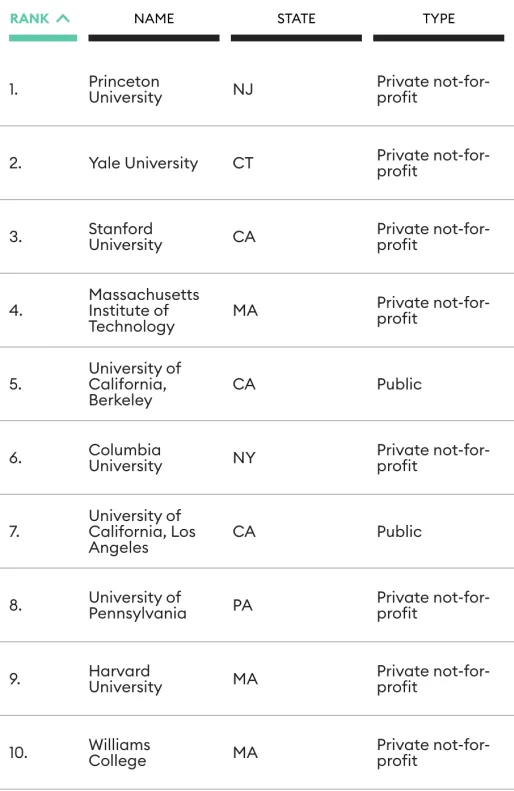
The Ivy League saw varied shifts in rankings. Compared to last year, the University of Pennsylvania rose two spots to 8th; Harvard climbed six places from 15th to return to the top ten (#9); and Brown also rebounded, from 19th to 15th.
Reasonable tuition, higher financial aid accessibility, and broader student diversity are key factors for performing well in the Forbes ranking.
The University of California system, for example, ranks highly in Forbes because it admits Pell Grant recipients, retains them through graduation, and delivers higher return on investment for these students.
Summary of Ranking Changes and Full List
Compared to 2022, schools with significant ranking improvements include:
Princeton University: from 4th to 1st
Yale University: from 8th to 2nd
Harvard University: from 15th to 9th
Cornell University: from 16th to 12th
UC Santa Barbara: from 39th to 24th
……
Schools with notable ranking drops include:
MIT: from 1st to 4th
Williams College: from 7th to 10th
Duke University: from 9th to 17th
Northwestern University: from 11th to 18th
Rice University: from 12th to 22nd
……
Full Top 100 Rankings

Forbes' America's Top Colleges list provides a useful reference from a return-on-investment perspective, but it is clear that the ranking downplays factors such as academic reputation and student-faculty quality, which many value in a university.
Rankings should still be taken as reference only. Rankings themselves should not be the sole basis for college applications.
When choosing a U.S. university, students should consider all factors of a school comprehensively, and make a rational, personalized choice based on their own background and aspirations.
.png)