After the GRE reform, many students have reported that the math questions have become more difficult! Moreover, the margin for error has shrunk, so missing just one question may keep you from a perfect score!

In fact, GRE Math covers a wide range of content, and during your prep you must solidify the fundamentals of every topic. When reviewing math, do your best to be comprehensive. Many students feel they already have a solid math foundation, so they skim over the math review, only to realize after seeing their scores that they lost critical points.
.jpg?x-oss-process=style/opt-webp)
Therefore, the reason many students don’t score high on GRE Math is not a lack of math ability, but rather not mastering the pace of solving questions. Improving your speed is closely tied to how familiar you are with the tested concepts.
Today, we’re going to summarize the high-frequency GRE Math topics and formulas for you, helping those of you currently grinding through practice problems to organize all areas of math knowledge!
Summary of High-Frequency Topics
1. Geometry
Various trigonometric identities, sum, difference, double-angle, half-angle formulas; sum-to-product and product-to-sum; plane analytic geometry.
2. Mathematical Analysis
Concepts of limit and continuity; single-variable calculus (derivative rules, integral rules, differentials); multivariable calculus and its applications; curve and surface integrals; introduction to field theory. Gauss-Seidel iteration method, interpolation methods, and other basic algorithms.
3. Formula
Differential equations, basic concepts, basic solution methods for various types of equations.
4. Algebra
Linear algebra and elementary algebra, Eisenstein’s criterion, determinants, vector spaces, methods for solving systems of multivariable equations, characteristic polynomials and eigenvectors, linear transformations and orthogonal transformations, metric spaces. Abstract algebra, basic concepts and operations of group theory and ring/field theory.
5. Discrete Mathematics
Propositional logic, introductory graph theory (basic concepts, representations, adjacency and incidence matrices, basic theorems such as V+F-E=2), set theory (note the concept of partial order).
6. Functions
Real variable functions, countability, measurability, integrability; metric spaces, inner products, etc.
Basic concepts of complex variable functions, analyticity (concept of conjugate harmonic functions), Cauchy integral theorem, Taylor & Laurent expansions (key topic), conformal mappings (less emphasized), residue theorem (key topic).
7. Probability and Statistics
Classical probability models, univariate probability distribution models, normal approximation to the binomial distribution.

Math Formula Compilation



Now let’s bring you a GRE Math formula compilation. Be sure to memorize these formulas well—they can save you a lot of time on test day!
Geometry
Algebra
Number Properties
How to Get It for Free
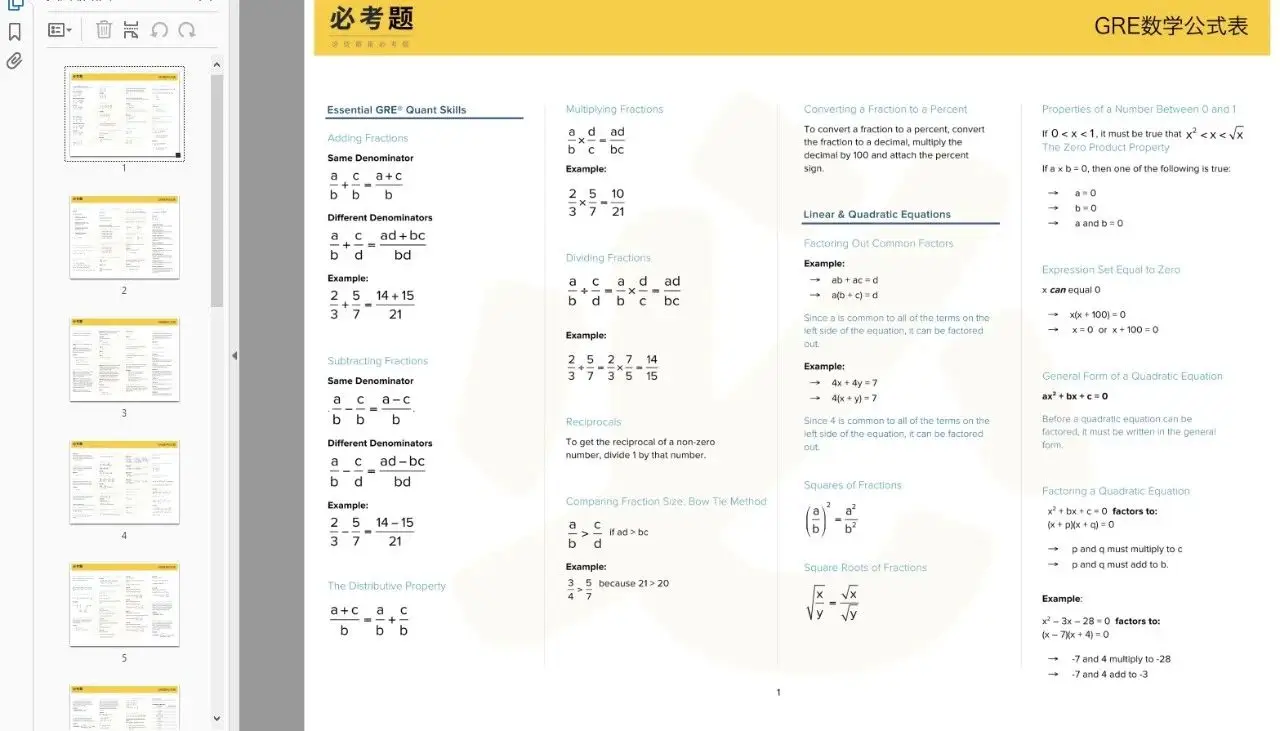
👇 Get the complete PDF version for free now 👇
Contact a CheersYou(清柚教育) teacher or scan the code,
Reply with the keyword 【Math Formulas】
Get your free copy now!

The point of being familiar with formulas is that when you read a question, you should immediately translate it in your mind into the relevant concept and formula, so you can speed up your problem-solving without slowly translating word by word in your head and slowing down. During your review, be sure to thoroughly cover every topic explicitly mentioned in the OG. The most common topics on the GRE are: arithmetic, algebra, geometry, and data analysis. Each broad topic contains several core subtopics. In the early stage of review, you need to systematically go through the Math Review section to identify and fill any gaps. This is the only way to flexibly handle all the concepts.
We hope this ultra-practical GRE Math topic summary effectively helps you. We also wish all of you who are currently preparing for the exam smooth sailing toward your target scores and successful admission to your dream schools!