
How exactly is the GRE scored after the reform?!!
.jpeg)
So far, ETS has not publicly disclosed detailed GRE scoring rules. Since the GRE is an adaptive test, the system determines the difficulty of the next section based on your performance in the current section.
Moreover, scoring incorporates question difficulty and response time, making it difficult to pinpoint exactly how many correct answers yield a specific score. We can only rely on data to make rough estimates.
Based on extensive post-reform GRE scores and diagnostic reports, we have summarized the approximate scoring rules, clarifying once and for all how your GRE score is calculated after the reform!
GRE Score Structure After the Reform
Each GRE administration generally includes the following sections:
- Verbal (two sections)
- Quantitative (two sections)
- Writing (one Issue essay)
Verbal and Quantitative are entirely multiple-choice and automatically scored by computer, so you can see your scores immediately after the test. The maximum is 170, with a baseline of 130. Even if you answer everything incorrectly, you will still receive a 130. However, if you do not answer any questions, the report will show No Score (NS).
The Writing section is scored by both human raters and a computer program. Scores range from 0 to 6, with a baseline of 0.
GRE Adaptive Mechanism After the Reform
In the actual GRE, the difficulty of the second section depends on your accuracy in the first section. So, first, we need to determine the specific correlation between the two.
Based on analysis of most students' score data, we speculate the adaptive mechanism after the reform works as follows:
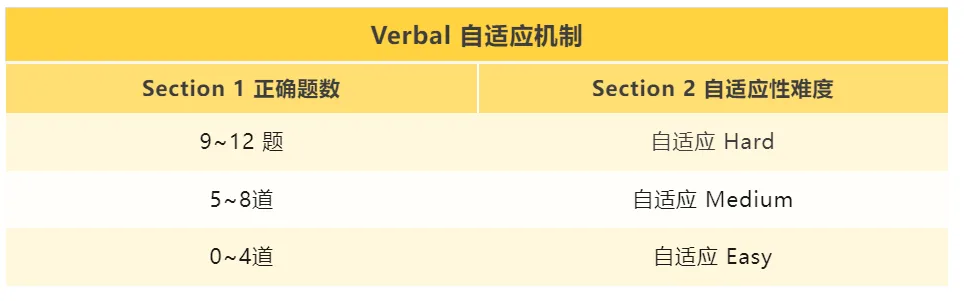
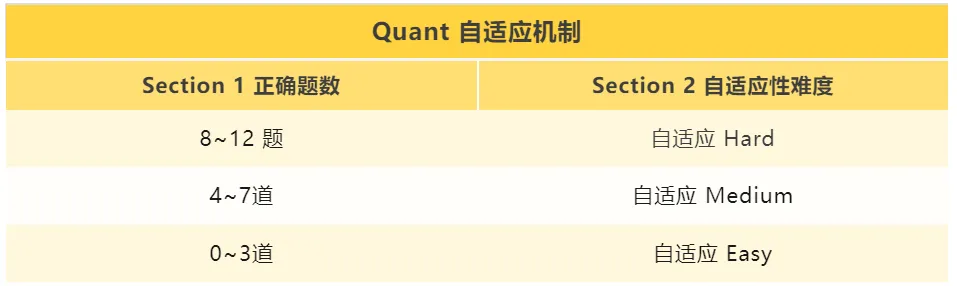
GRE scoring is complex because it is based not only on the number of correct and incorrect answers but also on question difficulty and response time. Therefore, the data in the tables are for reference only; actual scores depend on the difficulty coefficients of the questions you answered correctly.
GRE Scoring Formulas After the Reform
Although ETS has not published an official scoring formula, based on the GRE score diagnostic reports we have collected and previous experience, we have roughly derived the following scoring formulas:
Verbal
① If you answer 9 or more questions correctly in Section 1 (i.e., 0–3 wrong) and Section 2 is an adaptive Hard section:
Deduction ≈ Number of questions wrong − 1
For example: If you miss 2 questions in Section 1 and 4 in Section 2, your score is likely 163 = 170 − 6 − 1.
② If you answer 5–8 questions correctly in Section 1 (i.e., 4–7 wrong) and Section 2 is an adaptive Medium section:
Deduction ≈ Number of questions wrong − 4
For example: If you miss 6 questions in Section 1 and 5 in Section 2, your score is likely 155 = 170 − 11 − 4.

Note: The above data are for reference only. Actual test scores should be evaluated in conjunction with specific question difficulty.
Quantitative
Most Chinese students can answer 8 or more questions correctly in the first section, so the second section typically becomes Hard.
Therefore, assuming the second section is Hard, the Quantitative scoring formula is:
① For each question with a difficulty coefficient of 4 or 5 that is missed, deduct 1 point.
② For each question with a difficulty coefficient of 2 or 3 that is missed, deduct an average of 2 points.
For example: If you miss one difficulty-4 question in Section 1, and in Section 2 miss one difficulty-4 and one difficulty-5 question, your score is likely 167 = 170 − 1*3.

Note: The above data are for reference only. Actual test scores should be evaluated in conjunction with specific question difficulty.
Analytical Writing
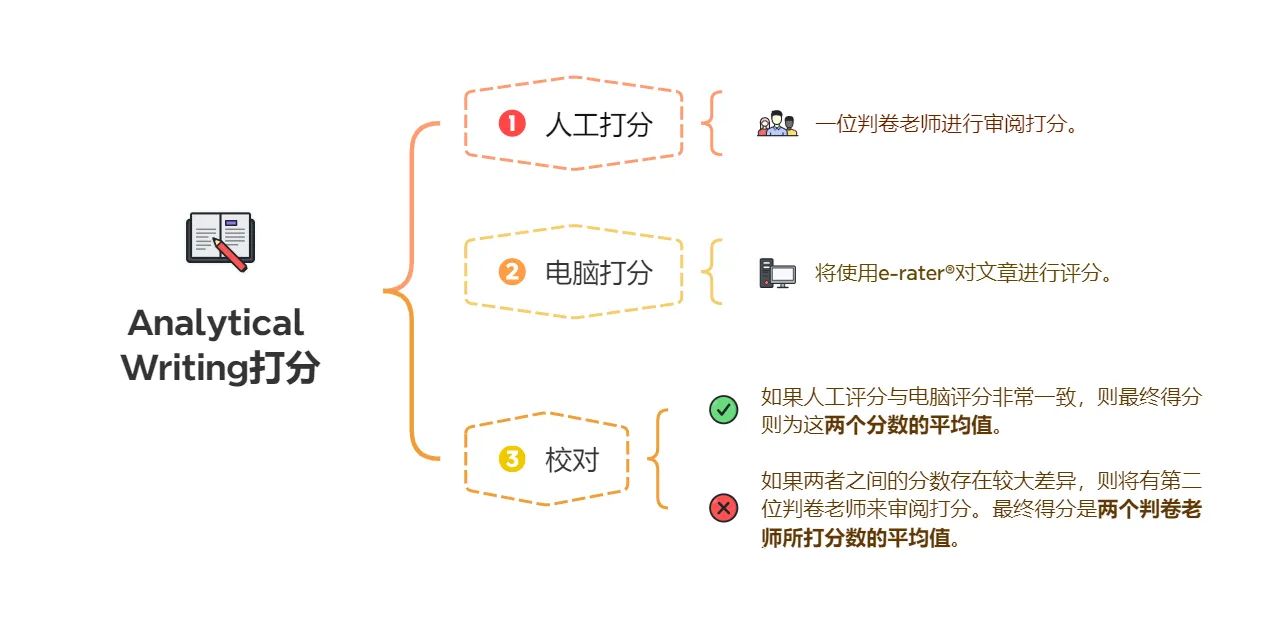
The Analytical Writing scoring process involves three steps.
Step 1: Human scoring
First, a trained and carefully selected rater reviews and scores the essay.
Step 2: Computer scoring
Then, the e-rater® engine—a computer program developed by ETS that identifies essay features and assesses writing proficiency—scores the essay.
Step 3: Verification
If the human score and the computer score are very close, the final score is the average of the two.
If there is a significant discrepancy, a second human rater scores the essay, and the final score is the average of the two human scores.
ETS also explicitly lists the criteria that essays at each score level must meet:
Issue Score 6 Criteria
- articulates a clear and insightful position on the issue in accordance with the assigned task
- develops the position fully with compelling reasons and/or persuasive examples
- sustains a well-focused, well-organized analysis, connecting ideas logically
- conveys ideas fluently and precisely, using effective vocabulary and sentence variety
- demonstrates superior facility with the conventions of standard written English (i.e., grammar, usage and mechanics), but may have minor errors
Issue Score 5 Criteria
- presents a clear and well-considered position on the issue in accordance with the assigned task
- develops the position with logically sound reasons and/or well-chosen examples
- is focused and generally well organized, connecting ideas appropriately
- conveys ideas clearly and well, using appropriate vocabulary and sentence variety
- demonstrates facility with the conventions of standard written English, but may have minor errors
Issue Score 4 Criteria
- presents a clear position on the issue in accordance with the assigned task
- develops the position with relevant reasons and/or examples
- is adequately focused and organized
- demonstrates sufficient control of language to express ideas with acceptable clarity
- generally demonstrates control of the conventions of standard written English, but may have some errors
Issue Score 3 Criteria
- is vague or limited in addressing the specific task directions and in presenting or developing a position on the issue or both
- is weak in the use of relevant reasons or examples or relies largely on unsupported claims
- is limited in focus and/or organization
- has problems in language and sentence structure that result in a lack of clarity
- contains occasional major errors or frequent minor errors in grammar, usage or mechanics that can interfere with meaning
Issue Score 2 Criteria
- is unclear or seriously limited in addressing the specific task directions and in presenting or developing a position on the issue or both
- provides few, if any, relevant reasons or examples in support of its claims
- is poorly focused and/or poorly organized
- has serious problems in language and sentence structure that frequently interfere with meaning
- contains serious errors in grammar, usage or mechanics that frequently obscure meaning
Issue Score 1 Criteria
- provides little or no evidence of understanding the issue
- provides little or no evidence of the ability to develop an organized response (e.g., is disorganized and/or extremely brief)
- has severe problems in language and sentence structure that persistently interfere with meaning
- contains pervasive errors in grammar, usage or mechanics that result in incoherence
GRE Score Requirements
Different fields have different GRE score expectations. For humanities, top-tier programs generally require scores of 330+ and place a premium on Verbal and Writing. For STEM fields, GRE scores typically range from 320 to 330, with an emphasis on Quantitative.
ETS also offers official post-reform GRE practice tests called PowerPrep, which includes five sets of authentic practice questions (two free and three paid). POWERPREP simulates the actual test environment and can give a relatively accurate prediction of your GRE score.
For test-takers who completed their primary and secondary education in China, the Quantitative section usually yields strong scores, but Chinese test-takers’ average Verbal scores are noticeably lower, so extra focus on Verbal practice is essential.
.jpeg)
Clearing up confusion about GRE scoring rules can help you prepare more strategically.
At the same time, you should not overlook any section of the GRE. With a deep understanding of the test and thorough, dedicated preparation, you can aim for a satisfying score and an offer from your dream school!