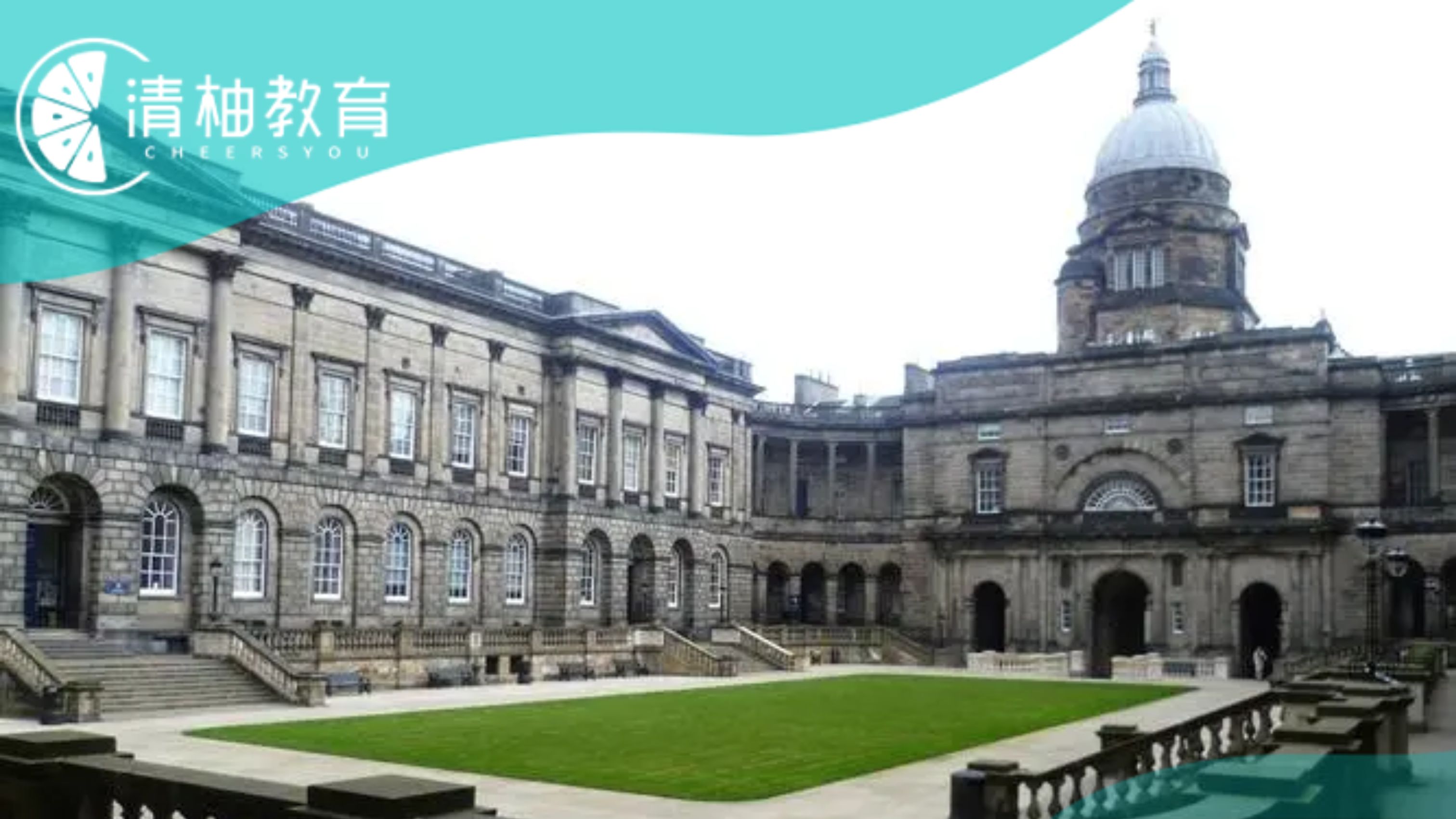
The University of Edinburgh has launched a new MSc Counselling Studies program for the 24Fall application cycle. It is a one-year full-time postgraduate course offered by the renowned School of Philosophy, Psychology and Language Sciences. The program aims to provide students with in-depth theoretical knowledge and practical skills in counselling, cultivating them into professional counsellors. As a historic university, Edinburgh holds a distinguished reputation in academia, and students will have the opportunity to access the latest research and industry trends. For more questions, you can also scan the QR code below for one-on-one consultation.

1. Program Introduction
The School of Health in Social Science at the University of Edinburgh (School of Health in Social Science) is a major center for research from an integrated perspective of health and social sciences, encompassing nursing, clinical psychology, counselling and psychotherapy, and applied social science research. Within it, the MSc Counselling Studies offers advanced academic study of counselling and related practices that extend beyond psychotherapy. It positions counselling practice within the field of social science research, providing a foundation for further study for non-professional counselling students, or supplementing a critical reflective perspective for practitioners with professional qualifications. It is an academic program focused on advanced counselling and psychotherapy. The program combines theory and practice, emphasizing non-directive relational approaches such as psychodynamic and person-centered frameworks. The curriculum aims to develop students' professional skills while encouraging them to critically reflect on counselling practice and theory.
The program is suitable for students who wish to pursue in-depth study in counselling and psychotherapy, especially those aiming to work in mental health, education, and social services. Graduates can apply their knowledge in various settings, including counselling agencies, schools, and healthcare facilities.
This program is highly inclusive and does not restrict applicants' academic backgrounds, as long as they can demonstrate strong motivation for studying counselling, relevant experience, and a certain level of understanding and reflection on counselling. However, note that this is not a professional counselling training course. If you have one to two years of work experience and wish to obtain a professionally accredited counselling postgraduate degree in the UK, you can apply for Edinburgh's two-year full-time (or four-year part-time) Master of Counselling (Interpersonal Dialogue).
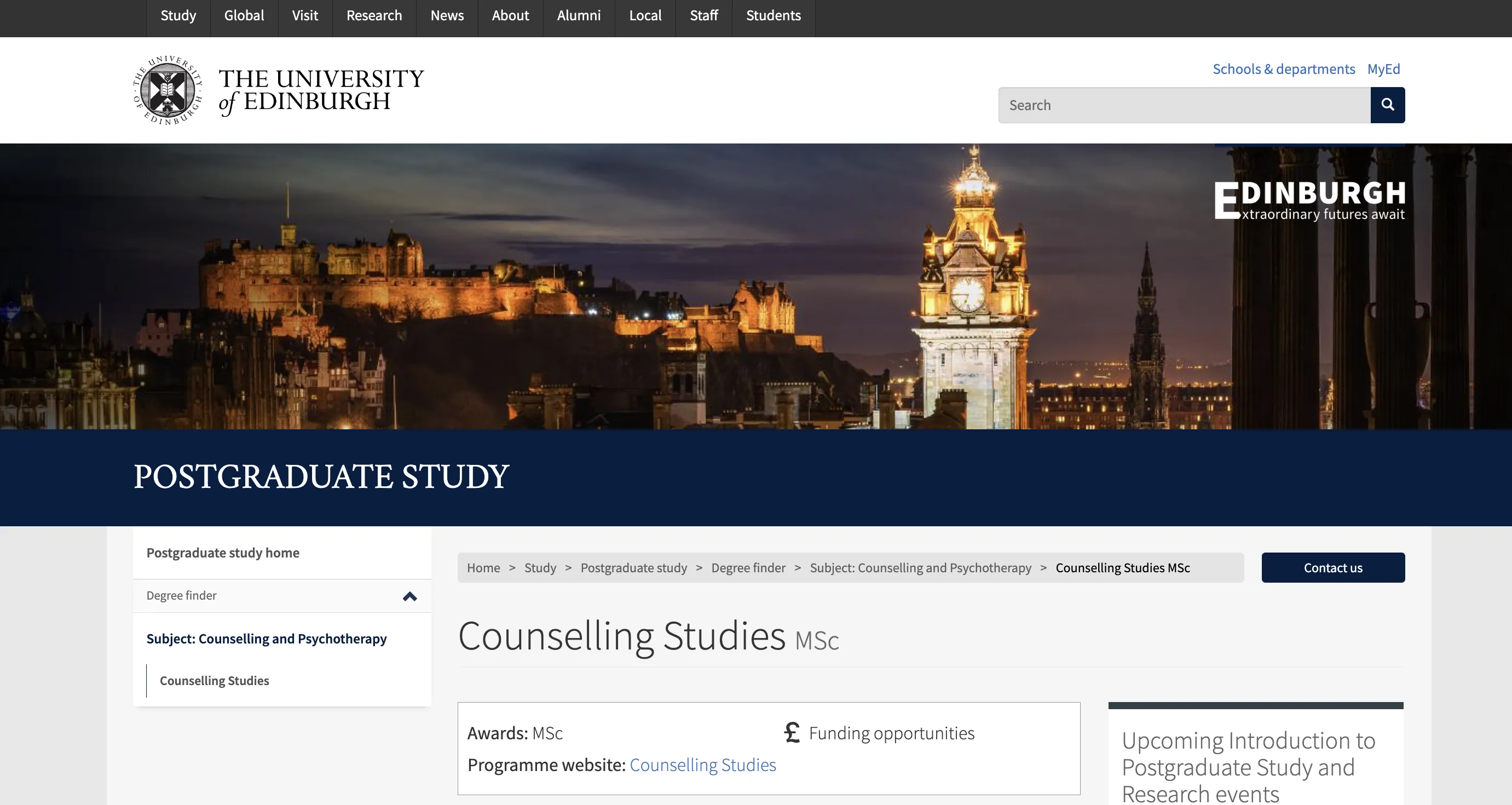
Official website: https://www.ed.ac.uk/studying/postgraduate/degrees/index.php?r=site/view...
2. Curriculum
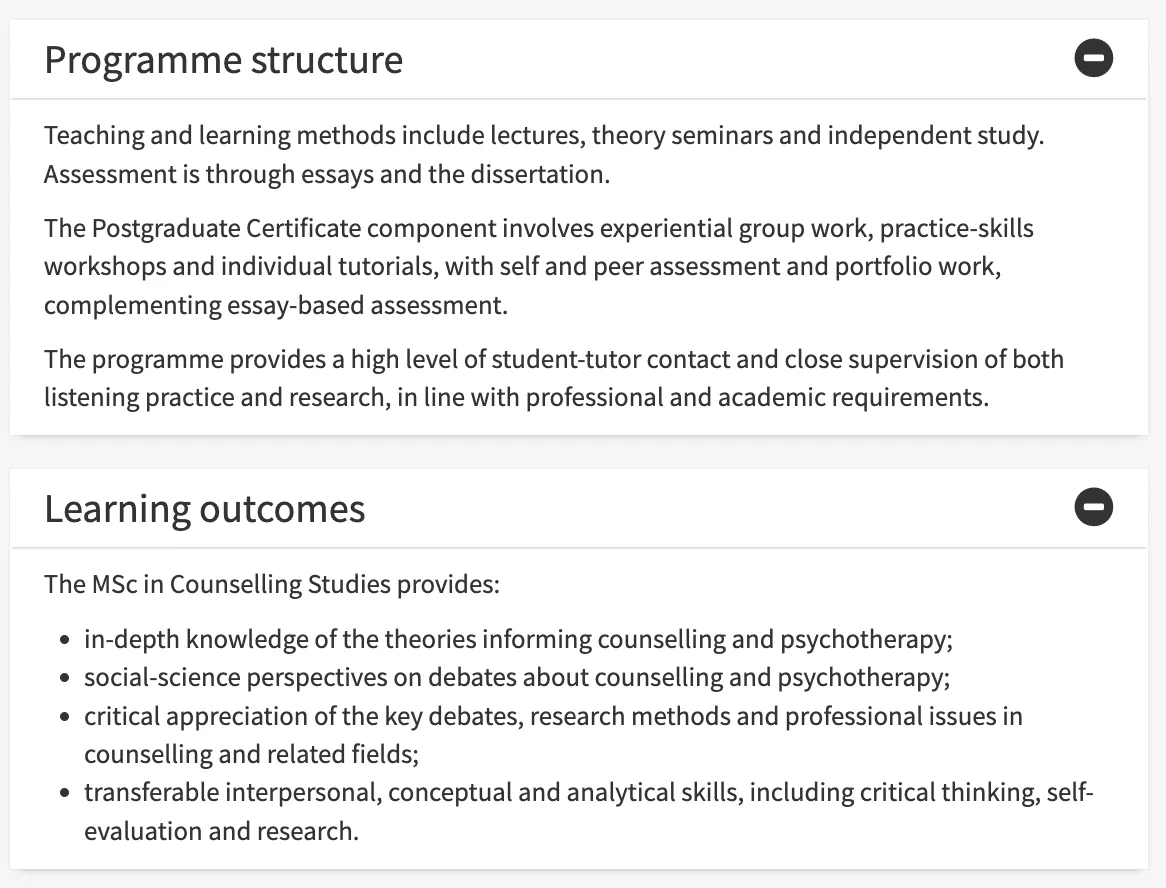
Core courses: Students will study core courses in counselling theory, counselling skills and processes, research methods, etc., laying a solid foundation for subsequent practice and research.
Elective courses: Students can choose elective courses based on their interests and career plans, such as family counselling, psychological assessment, etc., to broaden their knowledge and skills.
Internship and practice: Students will participate in internship projects, practicing in professional counselling agencies or schools, applying theoretical knowledge to actual counselling.
Thesis: Students need to complete a dissertation, demonstrating their academic ability and critical thinking in counselling research.
3. Application Requirements
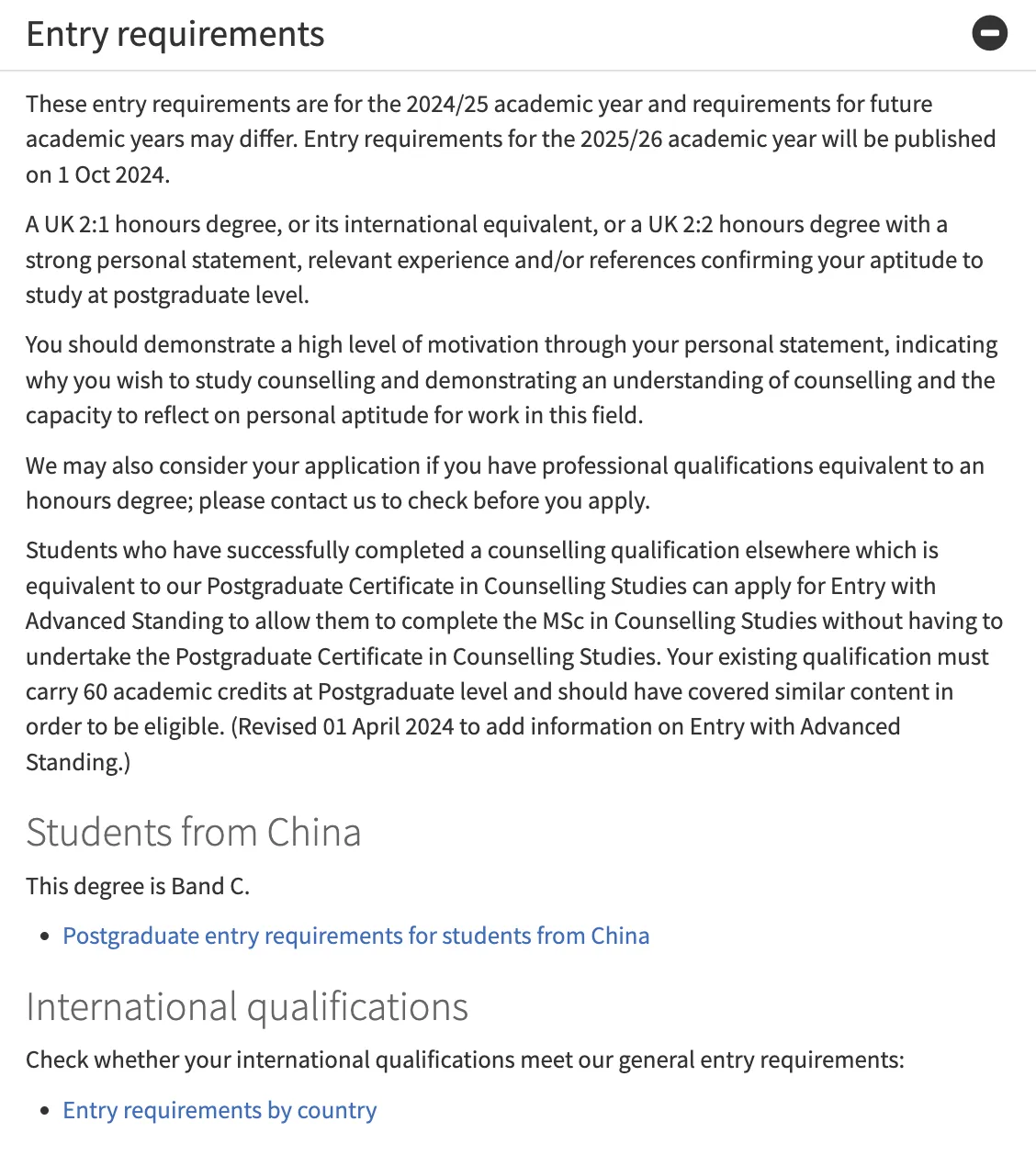
Academic background: Applicants are usually required to have a bachelor's degree in psychology or a related field, or possess a certain background in psychology.
Language proficiency: Non-native English speakers need to provide proof of English proficiency, such as TOEFL or IELTS scores, to meet the university's language requirements.
Work experience: Although not mandatory, applicants with relevant work experience will have an advantage.
Recommendation letters: Applicants need to submit two recommendation letters, preferably from previous instructors or work supervisors, to attest to their academic ability and professional competence.
Personal statement: Applicants need to submit a personal statement, explaining their interest in counselling research, career plans, and reasons for choosing the University of Edinburgh.
4. Career Development Prospects
The program offers graduates a wide range of career opportunities. Graduates can work in counselling agencies, schools, hospitals, and other settings, or choose to pursue further studies or research in related fields. Additionally, the program provides graduates with abundant career development resources, such as career development lectures, job fairs, etc., to help them smoothly enter the workforce.
For more admission case studies and questions about study abroad and graduate applications, you can also add the contact information of a CheersYou(清柚教育) teacher below to learn more.