

Recently, Jiang Ping, a 17-year-old female vocational school student from Jiangsu, made headlines by defeating numerous top university students from home and abroad to become a surprise finalist in the top 12 of the Alibaba Global Mathematics Competition. This real-life underdog story once again proves that gold will shine wherever it is.
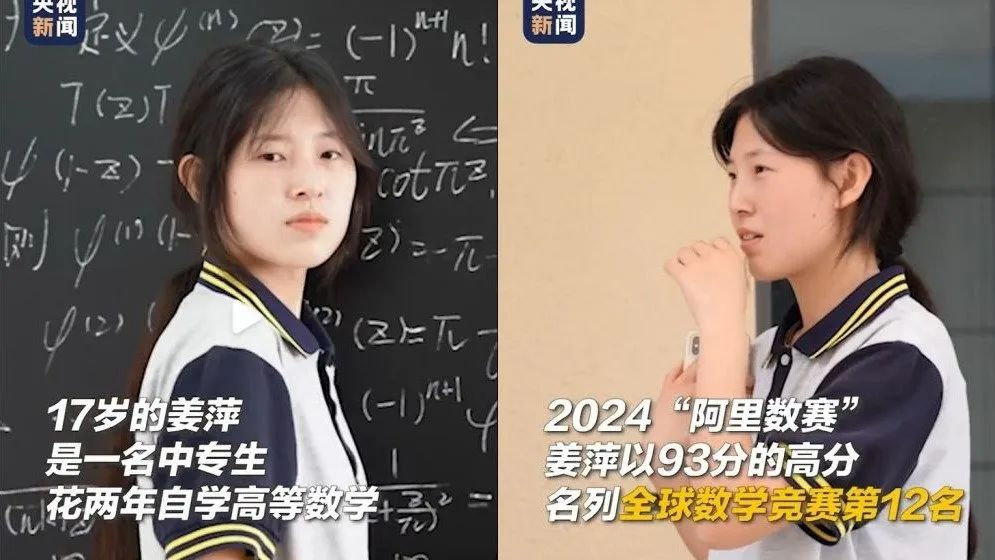
Image source: CCTV News
To stand out in GRE Math, you must solidify your understanding of each foundational concept. Many students, thinking their math background is already strong, skim through the math review, only to realize they lost crucial points when the scores come out.

Image source: Xiaohongshu
Thus, many students' GRE Math scores remain low not because of insufficient math ability, but because they fail to manage the pace of solving problems. Improving speed is directly tied to familiarity with the test points.
Today, BiKaoTi will summarize the high-frequency GRE Math concepts and formulas for you, helping students who are practicing questions to organize their knowledge across all areas!

Summary of High-Frequency Topics
1. Mathematical Geometry
Various trigonometric induction formulas; sum, difference, double-angle, and half-angle formulas; sum-to-product and product-to-sum formulas; plane analytic geometry.
2. Mathematical Analysis
Concepts of limits and continuity; single-variable calculus (differentiation rules, integration rules, derivatives); multivariable calculus and its applications; curve and surface integrals; introduction to field theory. Basic algorithms such as Gaussian iteration and interpolation methods.
3. Mathematical Formulas
Differential equations: basic concepts, solving methods for various types.
4. Mathematical Algebra
Linear algebra and general algebra; Eisenstein's criterion; determinants; vector spaces; solving systems of multivariable equations; characteristic polynomials and eigenvectors; linear transformations and orthogonal transformations; metric spaces. Abstract algebra, basic concepts and operations of group theory and ring/field theory.
5. Discrete Mathematics
Propositional logic; introduction to graph theory (basic concepts, representations, adjacency and incidence matrices, fundamental theorems such as V+F-E=2); set theory (note the concept of partial orders).
6. Mathematical Functions
Real variable functions: concepts of countability, measurability, integrability; metric spaces, inner products, etc.
Complex variable functions: basic concepts, analyticity (conjugate harmonic functions), Cauchy integral theorem, Taylor & Laurent expansions (key), conformal mappings (non-key), residue theorem (key).
7. Probability and Statistics
Classical probability models; single-variable probability distribution models; normal approximation to the binomial distribution.

Math Formula Collection
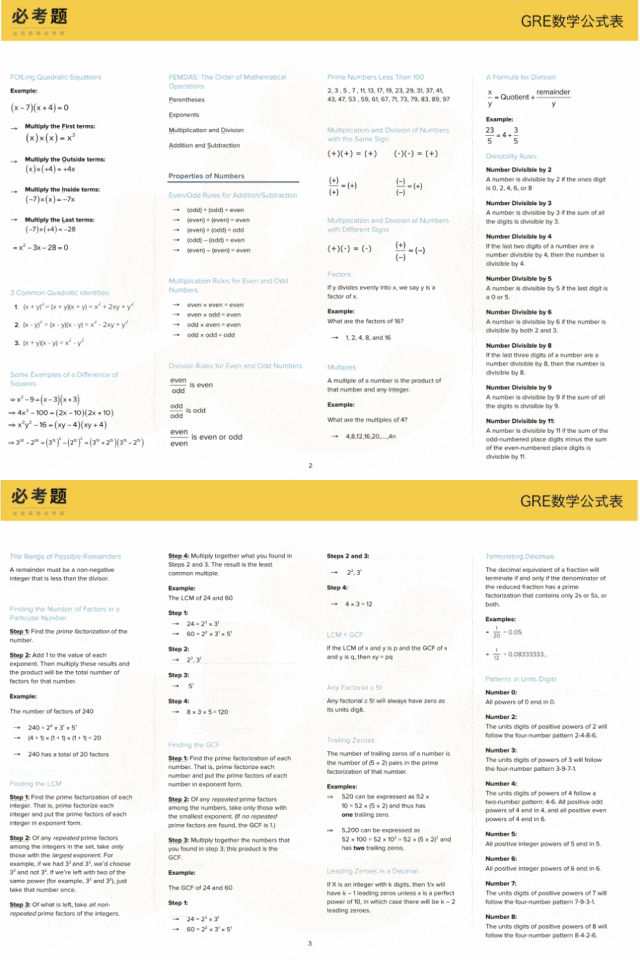
Below is a GRE Math formula collection. Memorize these formulas well—they can save you a lot of solving time on the exam!
Geometry
(8).gif)
Algebra
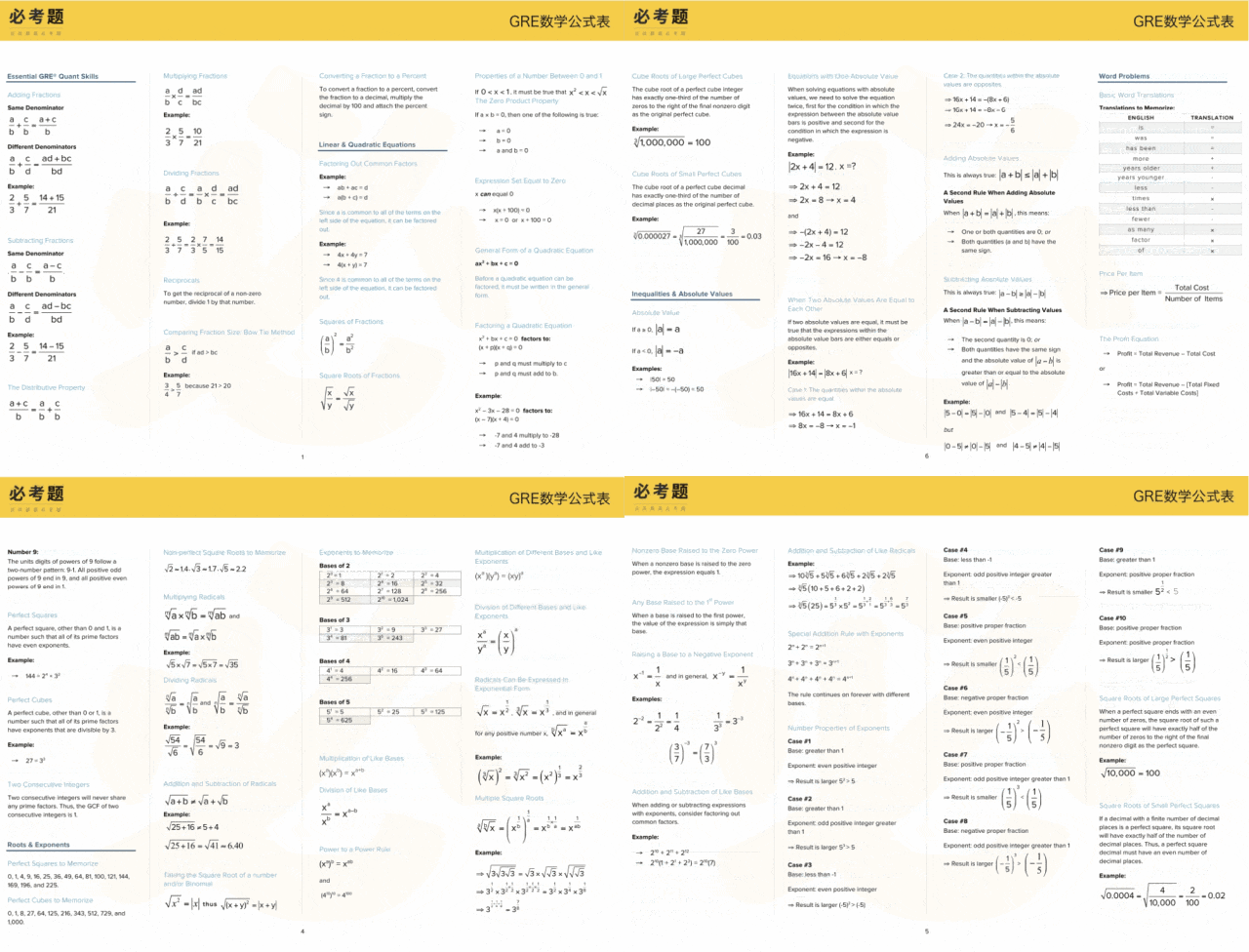
Number Properties
How to Get It for Free
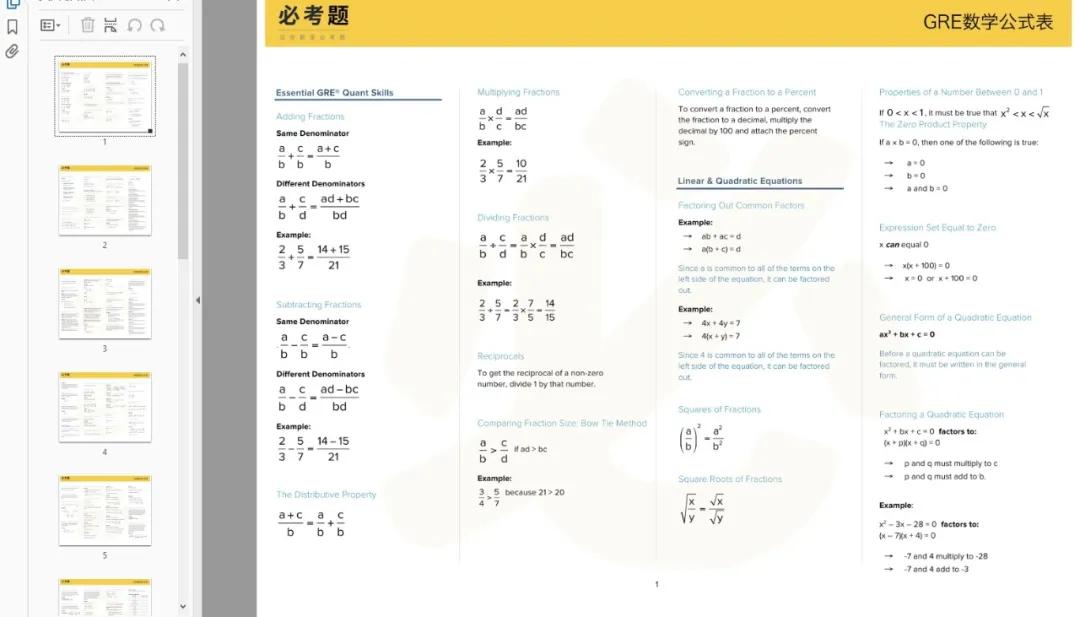
👇 Get the complete PDF version for free now 👇
Contact a CheersYou(清柚教育) teacher or scan the QR code,
reply with the keyword [Math Formulas]
to receive it instantly for free!

The point of knowing these formulas is that when you read a question, you should be able to immediately translate the problem into a known concept and formula in your mind. This will speed up your solving process, so you don't waste time slowly translating the question's meaning in your head before starting to work on it.
When reviewing, be sure to thoroughly go over all the concepts explicitly mentioned in the Official Guide. The most common topics on the GRE are: arithmetic, algebra, geometry, and data analysis.
Each broad category contains several core sub-topics. In the early stages of your prep, you should systematically review the Math Review section to identify and fill any gaps. This will allow you to flexibly tackle any question type.
We hope this super-comprehensive GRE Math review summary will effectively help you in your preparation.
We also wish all students currently preparing for the test the best of luck in achieving their target scores and successfully getting into their dream schools!