
Columbia University's Climate School and Business School have jointly launched a brand-new program—the Master of Science in Climate Finance. This interdisciplinary program is designed to cultivate financial experts specializing in future climate change solutions, combining environmental science, economics, finance, and policy analysis. It is a one-year full-time program. The first cohort will begin in Fall 2025, with the application portal expected to open in September 2024. For details about the program and more graduate application inquiries, you can also scan the QR code below for one-on-one consultation.

I. Program Overview
The Master of Science in Climate Finance is designed to equip students with the tools and knowledge needed to address global climate change challenges. Students will learn how to assess climate risks, design innovative financial products, and promote sustainable investment strategies, thus playing a key role in the financial industry.
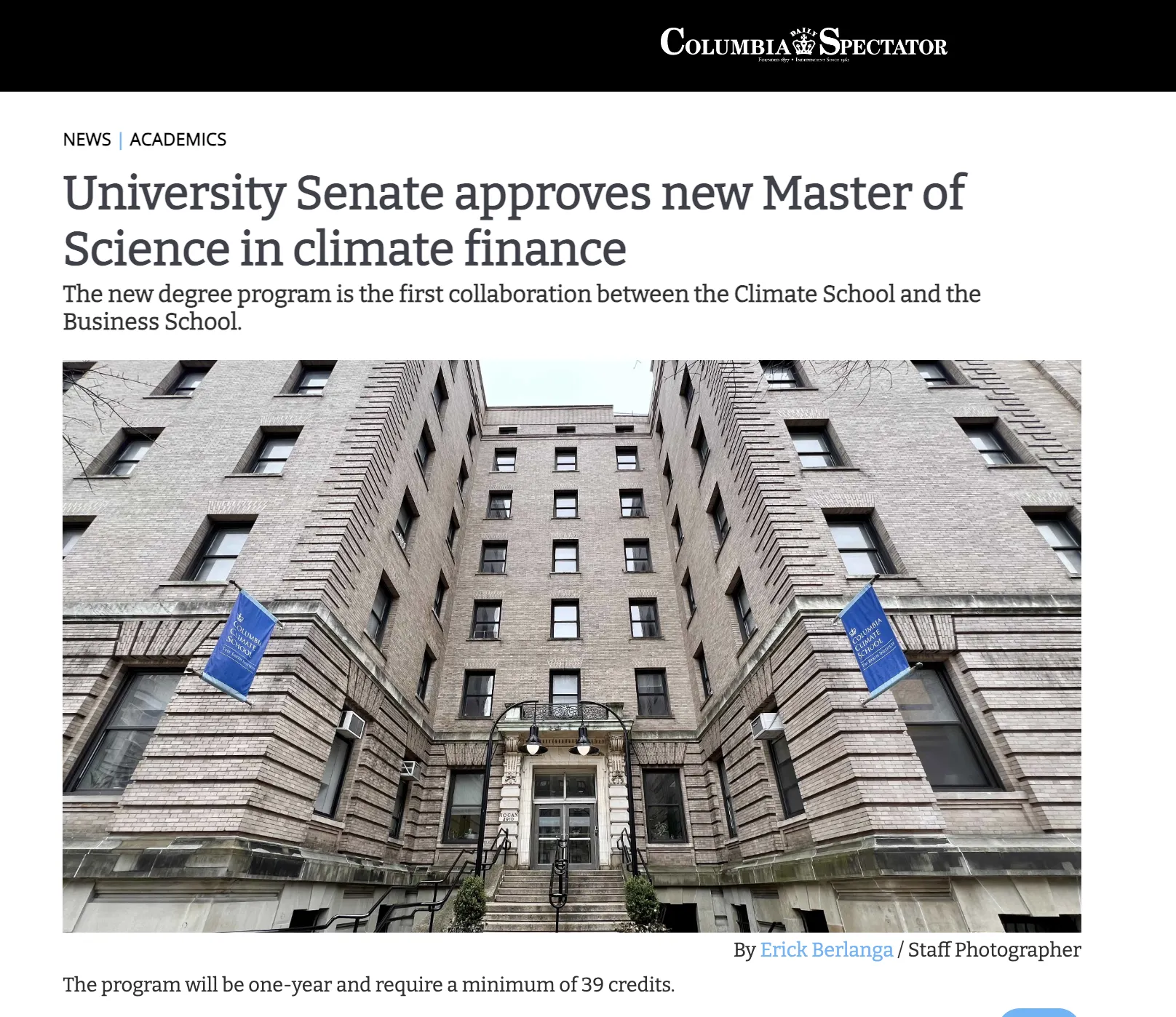
Source: https://www.columbiaspectator.com/news/2024/03/31/university-senate-appr...
II. Curriculum
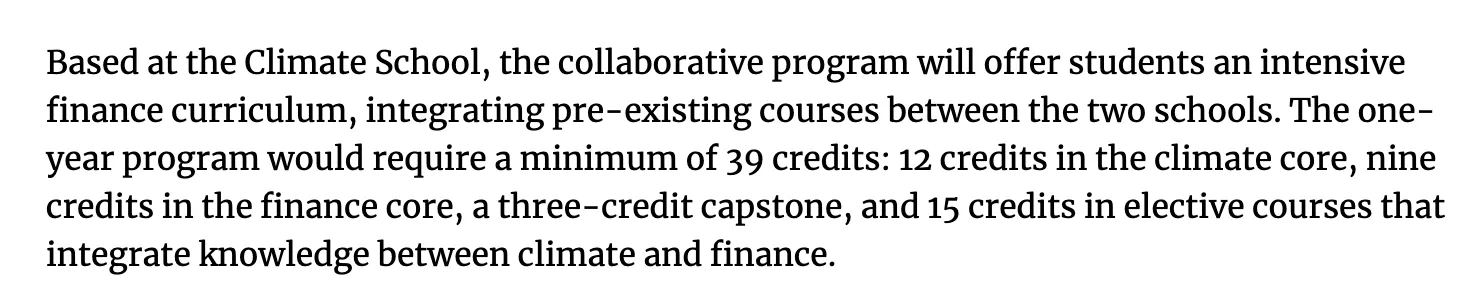
This one-year program requires a minimum of 39 credits: 12 credits of climate core courses, 9 credits of finance core courses, a 3-credit capstone course, and 15 credits of elective courses that integrate knowledge from both climate and finance. The curriculum covers the fundamentals of climate science, climate policy and economics, green financial product design, carbon markets and trading, and climate risk management. Students will gain in-depth understanding of the practical applications of climate finance through case studies, simulated trading, and field visits. Additionally, the program offers a range of elective courses, allowing students to explore specific areas such as renewable energy investment and climate change adaptation strategies according to their interests and career plans.
III. Application Requirements
Applicants typically need a bachelor's degree in a related field, such as economics, finance, environmental science, or public policy. In addition, based on the admission requirements of other programs, those with relevant work experience or a deep understanding of climate change issues will be more competitive. Application materials include transcripts, a personal statement, letters of recommendation, and possibly an interview. It is worth noting that in past admissions, Columbia University has encouraged diverse backgrounds and perspectives, so applicants from various academic and professional backgrounds have the opportunity to be admitted.
IV. Career Prospects
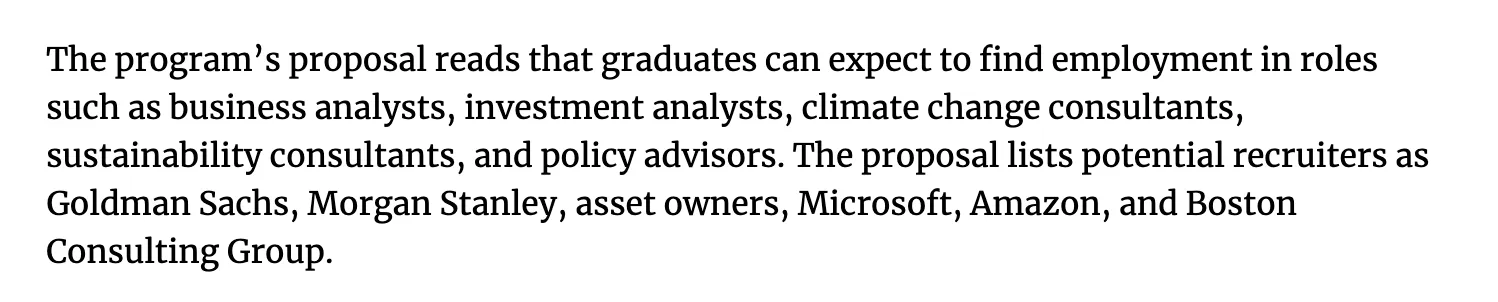
Graduates will be equipped to work in finance, consulting, government, and non-governmental organizations. They can take on roles such as climate risk analyst, green finance consultant, and sustainable investment manager in investment banks, asset management firms, insurance companies, green funds, international organizations, and government departments. As global attention to climate change increases, the demand for graduates in climate finance is rising within the industry, and they will become key drivers in the transition toward a low-carbon and sustainable economy.
Overall, Columbia University's Climate Finance program is a cutting-edge and practical course that not only provides students with in-depth theoretical knowledge but also prepares them with practical skills to tackle real-world challenges. In this program, students will acquire the necessary knowledge and networks to succeed in the rapidly growing field of climate finance and contribute to global sustainable development. For more admission cases and inquiries about graduate school applications, you can also add the contact information of CheersYou(清柚教育) advisors below to learn more.