The National University of Singapore (NUS) announced an innovative education program in December 2023—the MSc in Data Science for Sustainability. Designed to cultivate professionals who can play a key role at the intersection of data science and sustainable development, the program welcomed its first cohort in fall 2024. It proved immensely popular, receiving over 1,500 applications during its three-month-plus application window. This interdisciplinary program combines the latest advances in data science and environmental sustainability, both high-demand fields, equipping students with the skills and knowledge to address current environmental challenges.For more details and answers to graduate application questions, you can also scan the QR code below for a one-on-one consultation.

1. Program Overview
A key feature of this master’s program is its interdisciplinary nature. It not only covers core principles of data science—such as mathematics, statistics, and computer science—but also delves into sustainable development practices, including environmental engineering, climate change research, and analysis of socio-economic impacts. The curriculum is designed to ensure students master data science tools and apply them to real-world problems related to sustainability.
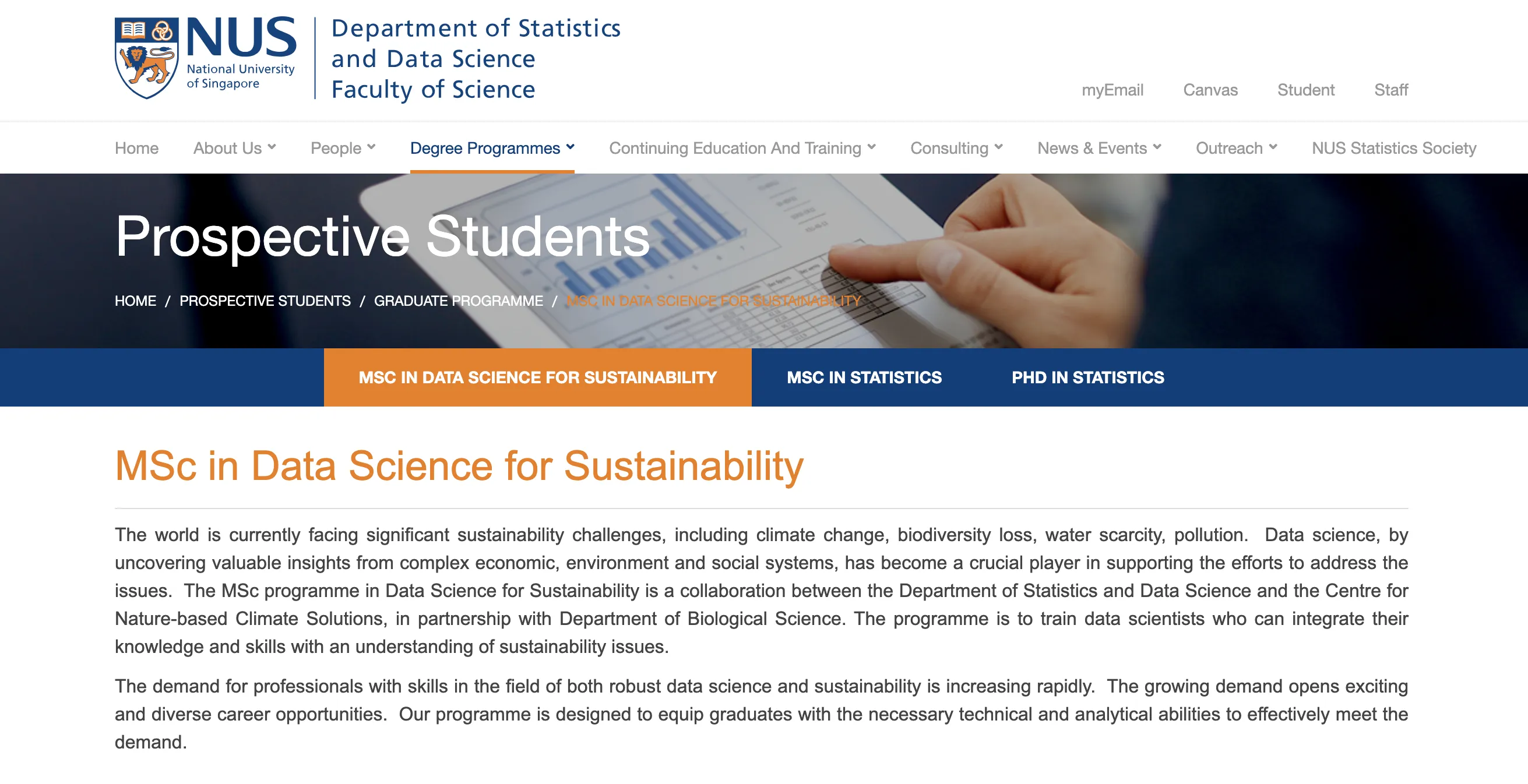
Official website: https://www.stat.nus.edu.sg/prospective-students/graduate-programme/msc-...
The two primary partners for the program are NUS's Department of Statistics and Data Science (DSDS) and the Centre for Nature-based Climate Solutions (CNCRS). DSDS is renowned for world-class statistics education and research, while CNCRS is a leading institution in global climate change research. Together, these departments bring together top statisticians, data scientists, and sustainability experts, providing a thorough and immersive educational environment. The full-time program can be completed in 1 to 2 years, while part-time study takes 2 to 4 years.
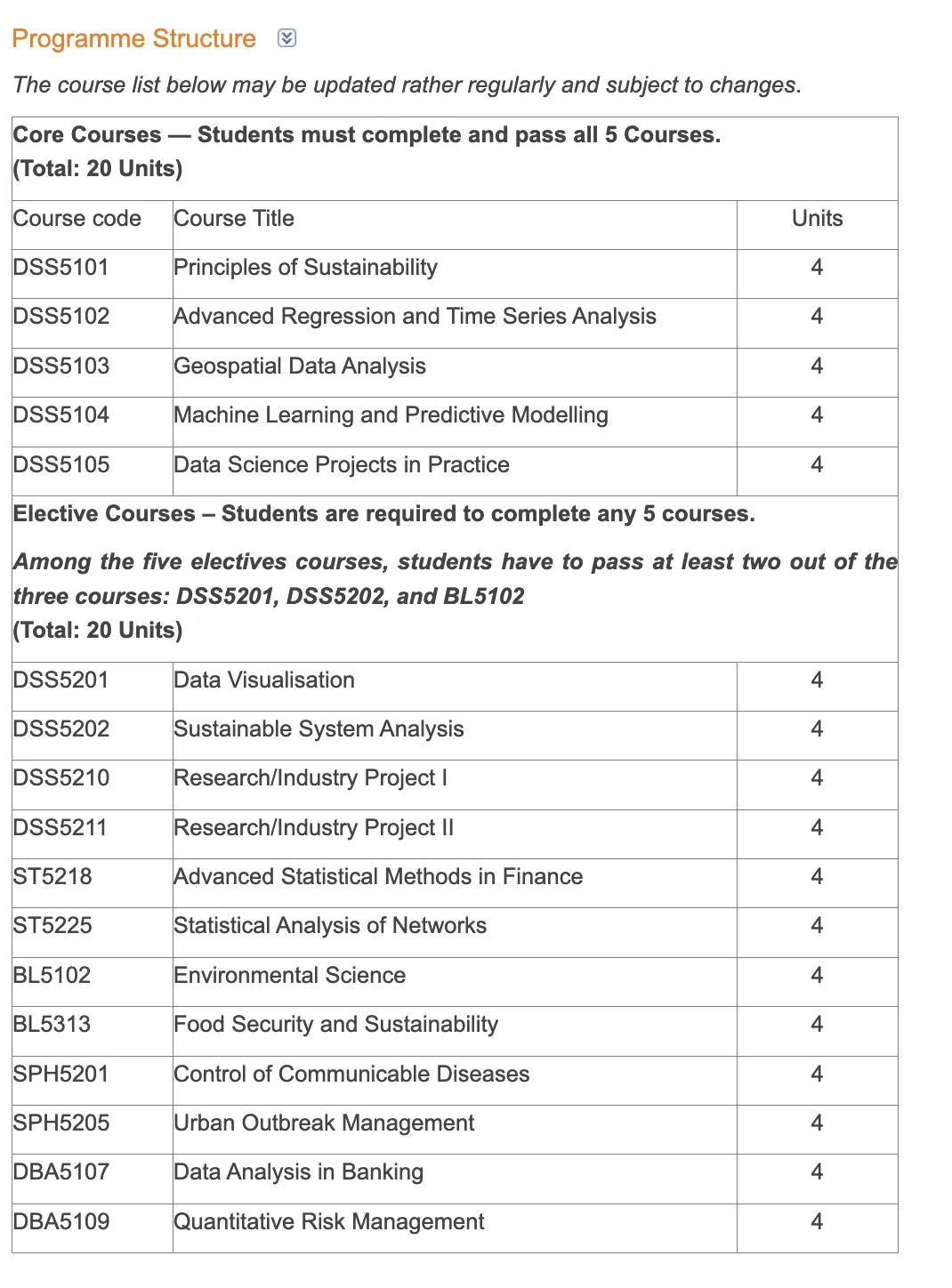
2. Curriculum
Students must complete 40 credits, including core courses, electives, and a practical project. The curriculum covers theoretical foundations of data science and applied sustainability practices, ensuring comprehensive training in both theory and practice.
3. Admission Requirements
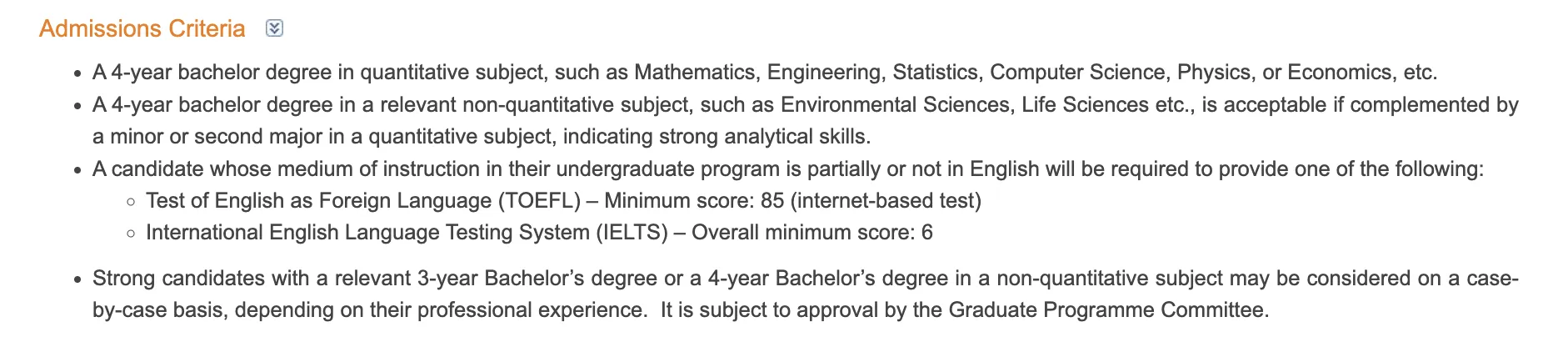
- A 4-year bachelor's degree in a quantitative discipline such as mathematics, engineering, statistics, computer science, physics, or economics.
- A 4-year bachelor's degree in a relevant non-quantitative discipline (e.g., environmental science, life sciences) with a minor or second major in a quantitative field demonstrating strong analytical ability is also acceptable.
- Candidates whose undergraduate instruction was not solely in English must provide one of the following:
- TOEFL — minimum score: 85 (internet-based)
- IELTS — minimum overall band score: 6
- Exceptional candidates with a relevant 3-year bachelor's degree or a 4-year bachelor's degree in a non-quantitative discipline may be considered on a case-by-case basis based on professional experience, subject to approval by the Graduate Programme Committee.
4. Career Prospects
Graduates of the NUS MSc in Data Science for Sustainability, an innovative interdisciplinary program, enjoy broad career prospects. Combining data science and sustainable development, the program cultivates professionals equipped with both data science skills and a deep understanding of sustainability principles. Graduates possess high competitiveness and a wide range of career options, whether in government agencies, corporations, non-profit organizations, entrepreneurship, or research—contributing to global sustainable development goals with their expertise. Below are potential career paths and development prospects for graduates:
1. Government & Non-Governmental Organizations
- Environmental Policy Analysis: Work in government departments, using data science skills to analyze the effectiveness of environmental policies and promote more scientific decision-making.
- Climate Change Research: Join international organizations or research institutes, focusing on climate change modeling and analysis, and provide data support for global climate action.
2. Corporate & Consulting
- Sustainability Consultant: Advise companies on sustainability strategies, using data analysis to help businesses reduce environmental impact and enhance social responsibility.
- Corporate Social Responsibility (CSR) Analysis: Within companies, monitor and analyze environmental, social, and governance (ESG) performance to drive sustainability goals.
3. Technology & Innovation
- Smart Energy System Development: In the energy sector, participate in the design and optimization of smart grids and renewable energy systems, promoting the digital transformation of the energy industry.
- Environmental Technology Entrepreneurship: Use acquired knowledge and technology to found startups focusing on environmental technology, such as innovative solutions in waste recycling and pollution control.
4. Finance & Investment
- Green Finance Analyst: In banks, investment firms, or asset management institutions, specialize in the analysis and investment of green financial products such as green bonds and sustainability funds.
- ESG Rating & Analysis: Provide ESG ratings for investors, assess corporate environmental, social, and governance risks, and direct capital toward sustainable projects.
5. Education & Research
- Sustainability Educator: Teach sustainability and data science courses in higher education institutions, nurturing the next generation of sustainability professionals.
- Researcher: Join research institutes to conduct data science research related to sustainability, providing scientific evidence for policy-making and industry practice.
For more admission case studies and questions about graduate applications, you can also contact CheersYou(清柚教育) advisors via the details below.