In an era where technology and medicine deeply intersect, the field of neuroimaging and informatics shows tremendous potential. The University of Southern California's Master of Science in Neuroimaging and Informatics (NIIN), a STEM-designated program, has attracted many students aspiring to develop in this area. Below, we will comprehensively analyze this program from aspects including program introduction, curriculum, requirements, and career prospects. For more details and any questions related to graduate school applications, you can also scan the QR code below for a one-on-one consultation.
Program Introduction
USC, as a world-renowned private research university, boasts strong capabilities in academic research and professional education. Its NIIN program leverages the university's strengths in neuroscience, imaging, computer science, and other disciplines, aiming to cultivate interdisciplinary professionals who are proficient in neuroimaging techniques and skilled in applying informatics methods to process and analyze neuroimaging data.
The program's most prominent feature is its interdisciplinary nature. It breaks down traditional boundaries between disciplines, organically integrating knowledge and technologies from fields such as medicine, biology, engineering, and computer science. Students not only delve into the fundamentals of neuroscience but also master the operation of advanced imaging equipment and the application of informatics algorithms, thereby developing a unique professional edge at the intersection of neuroimaging and informatics.
Moreover, the program emphasizes the integration of practice and research. The university has state-of-the-art research facilities and laboratories, allowing students to participate in various cutting-edge research projects and collaborate with renowned scholars and research teams, applying theoretical knowledge to practical research. This accumulates rich hands-on experience, laying a solid foundation for future career development. Additionally, the program has established close partnerships with numerous medical institutions, research organizations, and tech companies, providing students with broad platforms for exchange and employment channels.
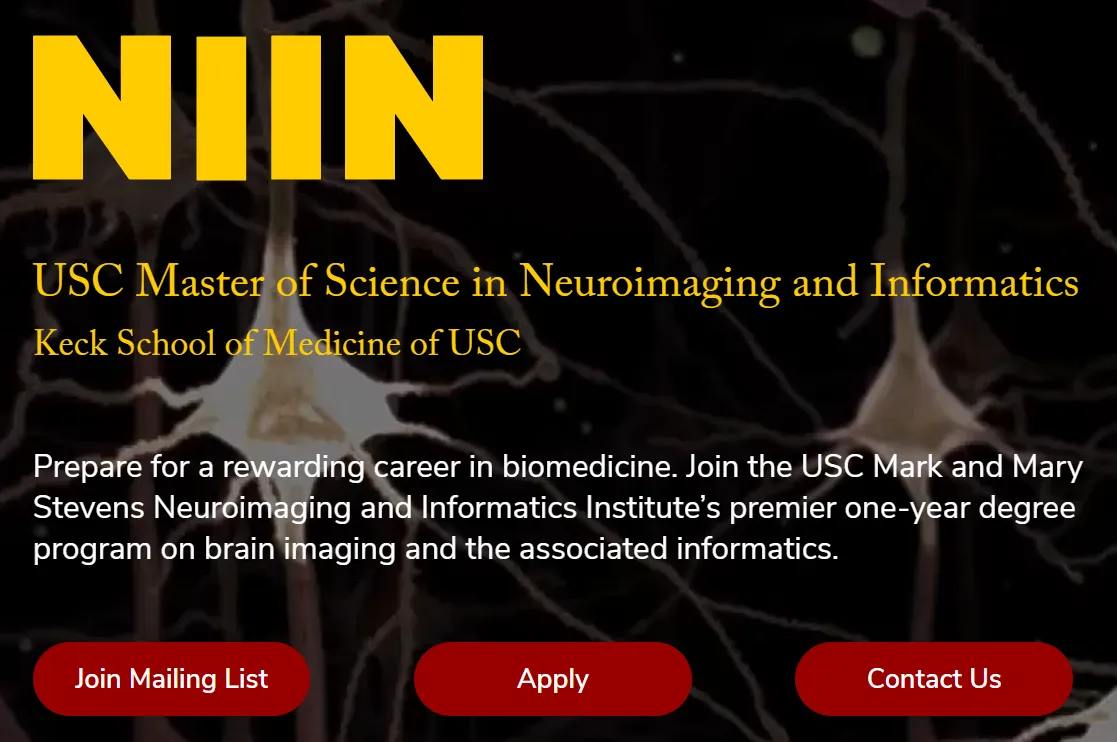
Official website: https://niin.usc.edu/
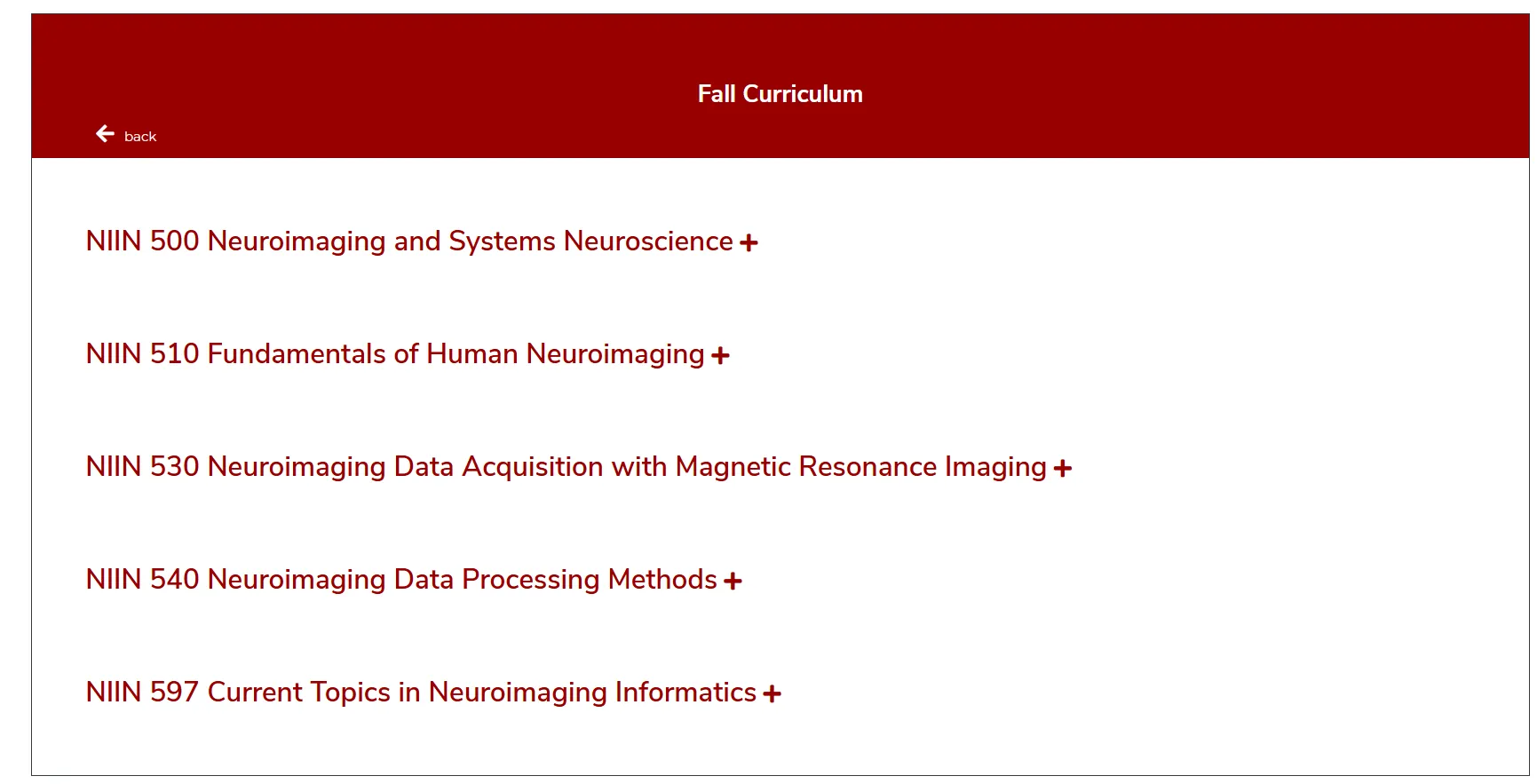
Curriculum
Core Courses
- Foundations of Neuroscience: This course lays the theoretical foundation for neuroscience, covering the anatomical structure, physiological functions, neural development, and pathological mechanisms of neurological diseases. Students will gain an in-depth understanding of the normal functioning of the nervous system and changes in disease states, providing biological background for subsequent neuroimaging research.
- Principles and Techniques of Neuroimaging: A detailed introduction to various neuroimaging methods, such as magnetic resonance imaging (MRI), positron emission tomography (PET), electroencephalography (EEG), including their physical principles, technical operations, and clinical applications. Students will learn how to acquire high-quality neuroimaging data and master basic image preprocessing and analysis methods.
- Introduction to Neuroinformatics: Focuses on how to use informatics approaches to process and interpret neuroimaging data. Course content includes data mining, machine learning, image processing algorithms applied in neuroscience, as well as the management and utilization of neuroinformatics databases. Students will learn to use computer programming and data analysis tools to extract valuable information from massive neuroimaging datasets.
- Neuroimaging Data Analysis and Interpretation: An in-depth exploration of advanced methods and techniques for neuroimaging data analysis, such as tensor-based morphometry, functional connectivity analysis, diffusion tensor imaging analysis, etc. Through real-world case studies and projects, students will master how to use these methods to unravel the mysteries of brain structure and function, providing scientific evidence for the diagnosis, treatment, and research of neurological diseases.
- Neuroethics and Legal Issues: With the rapid development of neuroscience technology, related ethical and legal issues are increasingly prominent. This course guides students to consider and discuss the ethical principles, legal norms, and social impacts involved in neuroscience research and applications, fostering ethical awareness and legal literacy to ensure lawful, compliant, and ethical research and application in their future work.
Elective Courses
The NIIN program offers a diverse range of elective courses to meet different students' interests and career development needs. For example, "Advanced Neuroimaging Techniques" will further delve into the latest neuroimaging technological advances, such as high-resolution MRI and multimodal imaging; "Cognitive Neuroscience" focuses on how the brain produces cognitive functions like perception, attention, memory, and language; "Special Topics in Neuroinformatics Frontiers" invites leading experts and scholars to introduce the latest research findings and hot topics in neuroinformatics.
Additionally, the program includes practical courses and a thesis requirement. Practical courses require students to intern in university laboratories or partner institutions, participating in actual neuroimaging research projects to experience the whole process from data acquisition to result analysis. The thesis requires students to independently complete a research project with a certain degree of innovation, comprehensively applying the knowledge and skills learned to demonstrate their research capability and professional level in neuroimaging and informatics.
Program Requirements
Academic Background
A bachelor's degree is generally required, with no strict limitation on the undergraduate major, though a background in biology, medicine, computer science, engineering, or related disciplines is recommended. Applicants should have a solid grounding in mathematics and statistics, having taken courses such as calculus, linear algebra, probability theory, and mathematical statistics, and be familiar with at least one programming language, such as Python or MATLAB.
Language Requirements
For international students, a TOEFL iBT total score of 90 or above, with no sub-score below 20; an IELTS total score of 6.5 or above, with no sub-score below 6.0. Some students may be required to take an English placement test organized by the university to determine if additional English language support courses are needed.
Standardized Test Scores
GRE scores are required; while the university does not set a specific minimum, competitive scores (especially in quantitative and analytical writing sections) will enhance the chances of admission.
Other Materials
- Personal Statement: Applicants should elaborate on their motivation for applying to the NIIN program, personal background, academic and research experiences, career goals, and their understanding and passion for the field of neuroimaging and informatics. Through the personal statement, the admissions committee seeks to understand the applicant's unique personality, drive, and fit with the program.
- Letters of Recommendation: Typically three letters are required, preferably from professors, mentors, or employers who can speak to the applicant's academic ability, research potential, or work performance. The letters should highlight the applicant's strengths, abilities, and potential for development in neuroimaging and informatics.
- Resume/CV: A comprehensive overview of the applicant's educational background, work experience (if any), internships, research projects, publications, awards, etc., demonstrating overall quality and professional competence.
Career Prospects
Graduates of USC's NIIN master's program, with their unique interdisciplinary knowledge and skills, enjoy broad career prospects in neuroimaging and informatics-related fields. In research institutions, they can participate in cutting-edge studies exploring the mechanisms of neurological diseases; in medical institutions, they can serve as neuroimaging analysts to aid diagnosis and research; in tech companies, they can engage in algorithm development to drive technological innovation; in pharmaceutical companies, they can work as neuroimaging experts to support new drug development and evaluation.
In summary, USC's NIIN master's program provides an excellent platform for students to delve deeply into neuroimaging and informatics. Through rigorous requirements, a rich curriculum, and broad career prospects, it empowers students to achieve their professional goals in this challenging and opportunity-filled field, contributing to the advancement of neuroscience and human health. In the Fall 25 application season, our student has also received an offer from the NIIN program. For detailed background and application timeline, scan the QR code below.

For more admission cases and questions about study abroad and graduate school applications, you can also add the contact information of CheersYou(清柚教育) advisors below for detailed information.