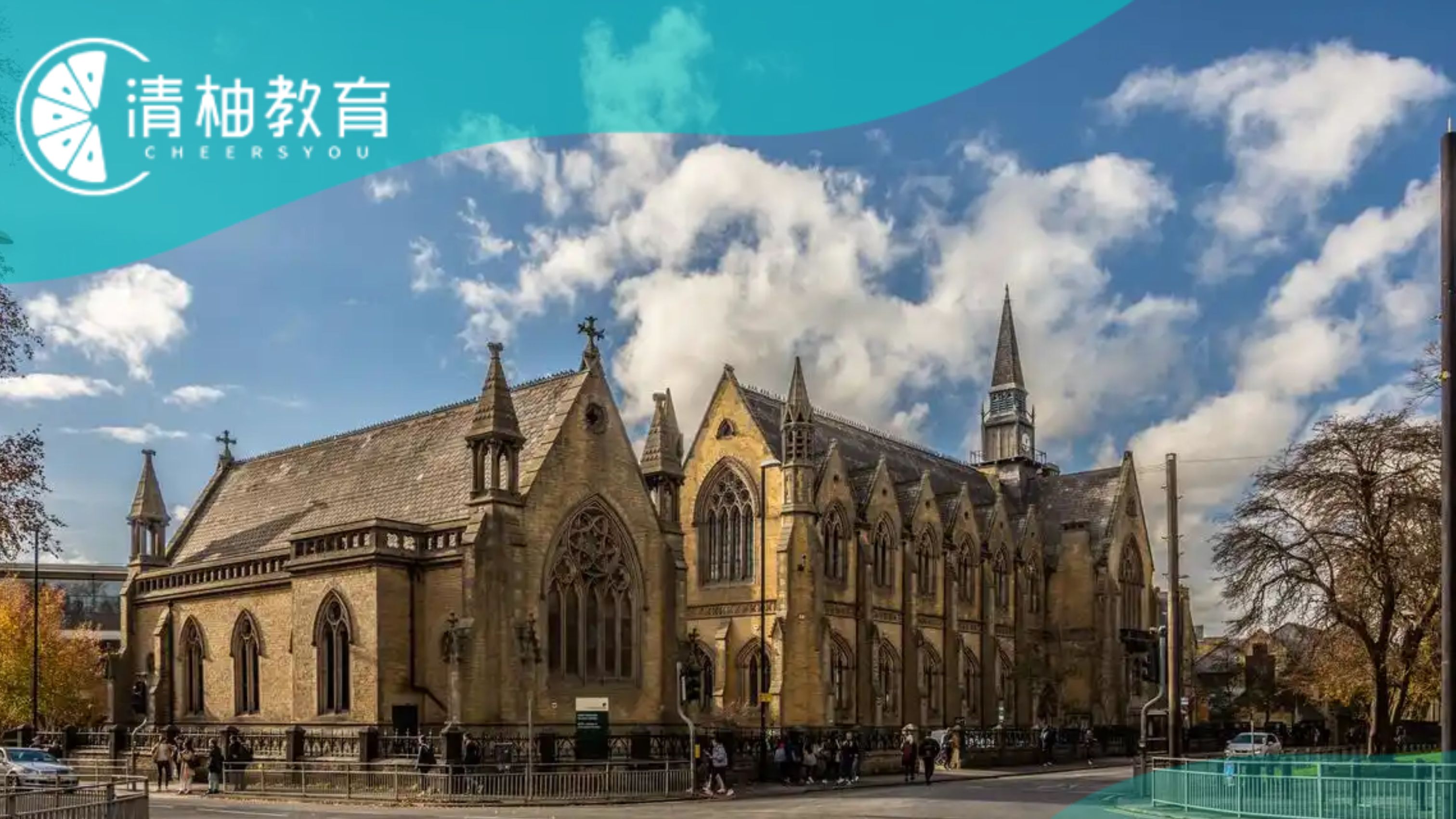
The University of Leeds, one of the UK's top institutions, has long been renowned for its academic research and teaching quality. Its MSc Sustainable Cities program is designed to cultivate professionals with interdisciplinary knowledge and skills to address the many sustainability challenges in urban development. Against the backdrop of accelerating urbanization and growing attention to sustainable development, the University of Leeds' MSc Sustainable Cities program offers an excellent learning platform for students aspiring to shape the cities of tomorrow. Below, we provide a comprehensive look at the program from several dimensions: program introduction, curriculum, admission requirements, and career prospects. For more details and one-on-one consultation on graduate applications, scan the QR code below.

Program Introduction
The program brings together experts and scholars from fields such as architecture, planning, engineering, and environmental science, forming a strong teaching and research team. This multidisciplinary environment allows students to deeply understand the building blocks of sustainable cities from different perspectives, break disciplinary silos, and develop comprehensive problem-solving skills.
The city of Leeds itself is a vibrant and sustainability-minded city, providing students with abundant practical settings. Students have opportunities to participate in local urban planning projects, community sustainability initiatives, and other activities, applying classroom knowledge to real-world situations and gaining valuable hands-on experience. Meanwhile, the university maintains close collaborations with numerous international organizations, government agencies, and enterprises, building a broad platform for exchange and cooperation. This widens students' international horizons and keeps them informed about the latest global trends and best practices in sustainable urban development.
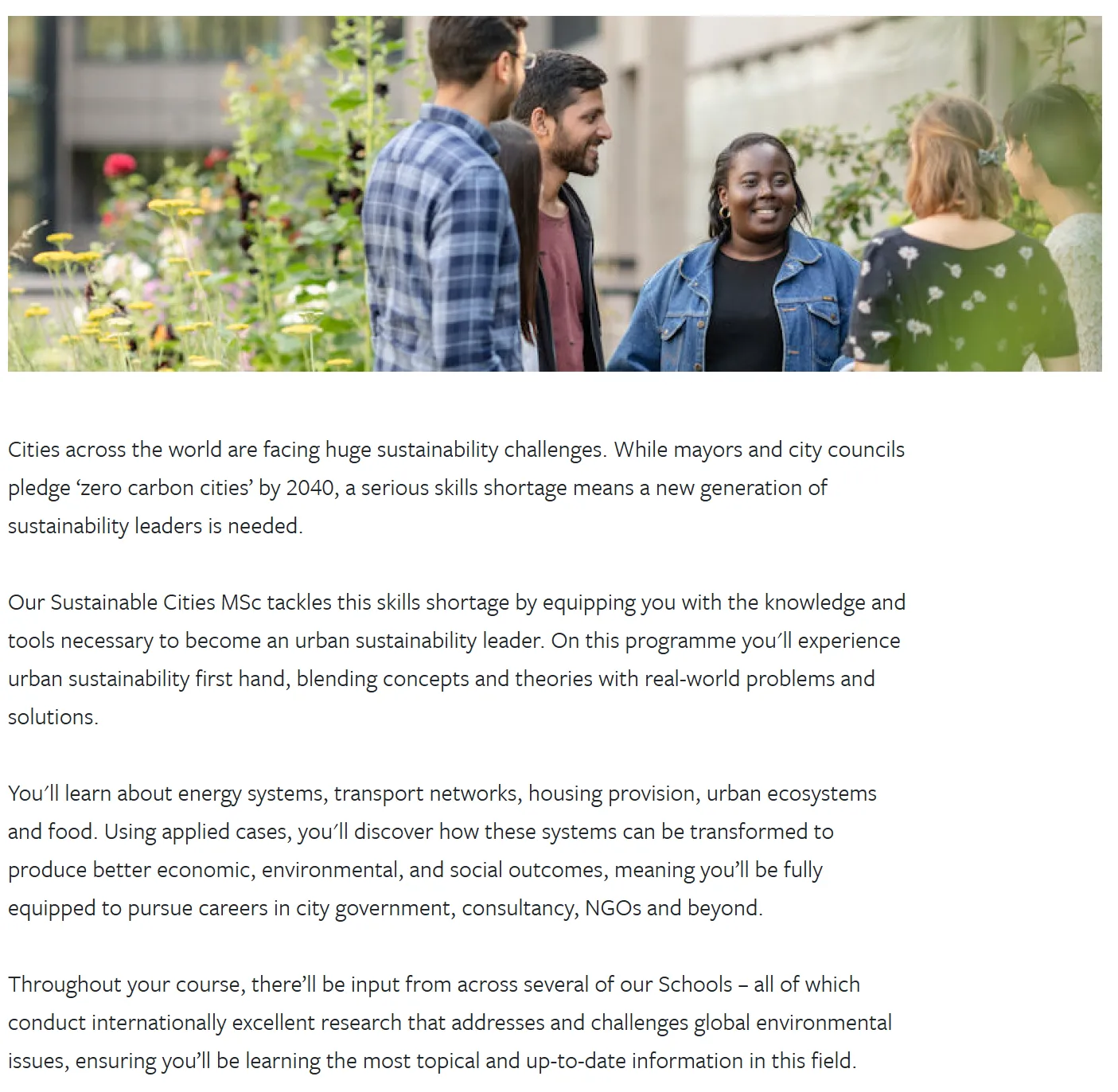
Official website link: https://courses.leeds.ac.uk/i429/sustainable-cities-msc
Curriculum
The MSc Sustainable Cities curriculum at the University of Leeds is carefully designed to balance theoretical study and practical application, comprehensively covering all key areas of sustainable urban development.
Core Modules
- Sustainable Urban Planning and Design: This module delves into the principles and methods of urban planning, integrating sustainable development concepts to teach students how to design efficient, livable, and eco-friendly urban spatial layouts. Students learn about urban land-use planning, transportation planning, green infrastructure design, and more, mastering the skills to shape sustainable urban forms from macro to micro levels.
- Urban Environment and Energy: Focusing on urban environmental issues and the sustainable supply and management of energy, students explore environmental topics such as urban air quality, water resource protection, and solid waste treatment, while also learning about the application of renewable energy technologies in cities—such as solar, wind, and biomass—and exploring strategies for urban energy transition.
- Urban Society and Culture: Emphasizing the importance of social and cultural factors in urban development, this module covers urban sociology, cultural geography, and related knowledge, guiding students to understand how the needs and values of different social groups influence city building, and how to promote sustainable urban development through cultural heritage and innovation, fostering urban communities with a sense of belonging and identity.
Elective Modules
Students can choose from a diverse range of elective modules based on personal interests and career plans, such as “Smart City Technologies and Applications,” which introduces the use of emerging technologies like big data, IoT, and AI in urban management, enabling students to understand how technology can enhance urban efficiency and sustainability. “International Development and Urban Poverty” focuses on global urban poverty issues, investigating poverty reduction strategies and how to ensure equity and inclusiveness in urban development.
Practical and Research Components
In addition to classroom learning, the program includes practical modules and a dissertation. Practical modules typically require students to participate in actual urban sustainability projects, collaborating with local governments, enterprises, or NGOs to solve real problems, honing project execution and teamwork skills. The dissertation provides an opportunity for in-depth research on a specific sustainable urban topic, demonstrating students' mastery of knowledge and research capabilities through independent investigation, data analysis, and theoretical exploration.
Admission Requirements
Academic Background
Applicants must hold a bachelor's degree, preferably in a related field such as urban planning, architecture, environmental science, or civil engineering. However, the university also welcomes applicants from other backgrounds with a strong interest in sustainable cities. Generally, a satisfactory undergraduate average score is required. For Chinese students, this typically means graduating from a recognized university with a four-year average of 75–85% or above (specific score requirements vary depending on the undergraduate institution's background).
Language Requirements
As the program is taught in English, international students must demonstrate good English proficiency. The university accepts various English language test scores, with common requirements as follows:
- IELTS: Overall score of 6.5 or above, with no individual component below 6.0.
- TOEFL: Overall score of 92 or above, with Listening and Reading no less than 21, Writing no less than 22, and Speaking no less than 23.
Personal Statement
The personal statement is an important part of the application. Students should clearly explain their interest in the sustainable cities field, relevant experiences (such as internships, project involvement), and reasons for choosing this program. They should also outline their career plans and what they aim to achieve through the program. The typical length is around 500–1,000 words.
Letters of Recommendation
Normally two letters of recommendation are required. Recommenders should ideally be university professors, advisors, or employers who can evaluate the applicant's academic ability, professional qualities, and work attitude. The letters should detail the relationship with the applicant, the extent of understanding, and assess the applicant's strengths, potential, and suitability for the program.
Resume/CV
The resume should concisely present the applicant's educational background, work experience (if any), academic achievements (such as publications, research projects), internship experience, volunteer activities, and awards/honors, highlighting experience and skills relevant to the sustainable cities field.
Career Prospects
Graduates of the University of Leeds MSc Sustainable Cities program are highly competitive in the job market. With the increasing global emphasis on sustainable development, related career opportunities are growing.
Career Directions
- Urban Planning and Design Firms: Graduates can work on sustainable urban planning and design, participating in projects such as formulating urban development strategies, comprehensive plans, and detailed plans. For example, designing green transportation systems and planning ecological landscape spaces for new urban areas to ensure construction meets sustainable principles.
- Government Departments and Public Agencies: Positions in local government urban planning departments, environmental protection departments, or housing and construction departments, responsible for formulating and implementing urban sustainability policies, supervising environmental impact assessments of urban construction projects, etc. Graduates may also apply their expertise in urban development-related projects at international organizations such as the UN, advancing the global sustainable urban agenda.
- Environmental and Energy Enterprises: Joining environmental consulting firms, renewable energy developers, and other enterprises, providing sustainable city solutions, conducting energy audits and environmental impact assessments; or participating in the development and operation of renewable energy projects, such as planning and constructing urban solar power stations.
- Research Institutes and Higher Education: Pursuing further studies at the doctoral level to engage in academic research in the sustainable cities field, contributing to theoretical advances; or taking up teaching positions at universities to impart sustainable urban knowledge and cultivate the next generation of professionals.
Employment Advantages
The University of Leeds' brand recognition and the program's professionalism provide graduates with a solid foundation for employment. Through the program, students not only acquire solid professional knowledge and skills but also develop interdisciplinary thinking and teamwork abilities—qualities highly valued by employers. Additionally, the university's Career Center offers abundant employment support, including career fairs, job-seeking skills training, and assistance in building professional networks. The practical experience and international perspective gained during the program also make graduates more competitive in global job markets, enabling them to better adapt to working environments and requirements in different countries and regions.
In summary, the University of Leeds' MSc Sustainable Cities program offers students a comprehensive and in-depth learning experience. Whether interested in academic research or seeking to launch a career in sustainable urban development, the program provides strong support and broad development space. For more admission cases and inquiries about studying abroad and graduate applications, feel free to add the contact information of the CheersYou(清柚教育) consultant below.