Cambridge's MPhil in Technology Policy attracts many students aspiring to work at the intersection of technology and policy with its unique strengths. Below, we provide a comprehensive and detailed interpretation based on official information, covering key dimensions: program introduction, curriculum, application requirements, and career development. For more details and questions about graduate applications, scan the QR code below for one-on-one consultation.
Program Introduction
This program aims to cultivate professionals who can deeply understand the relationship between technology and policy, and possess the ability to formulate, analyze, and implement technology policies. Its outstanding feature is interdisciplinary integration, covering knowledge from engineering, natural sciences, social sciences, law, economics, and other fields.
During their studies, students can experience the collision of ideas from different disciplines. For example, when discussing AI policy, they can analyze it from multiple dimensions such as technical principles, legal norms, and social impact. Cambridge's rich academic resources support the program, with top scholars and advanced research facilities. Moreover, the university has extensive collaborations with global universities, research institutions, enterprises, and governments, offering students opportunities to participate in international projects and exchange activities, broadening their international perspectives and building professional networks.
Official website link: https://www.jbs.cam.ac.uk/masters-degrees/mphil-technology-policy/
Curriculum
Core Courses
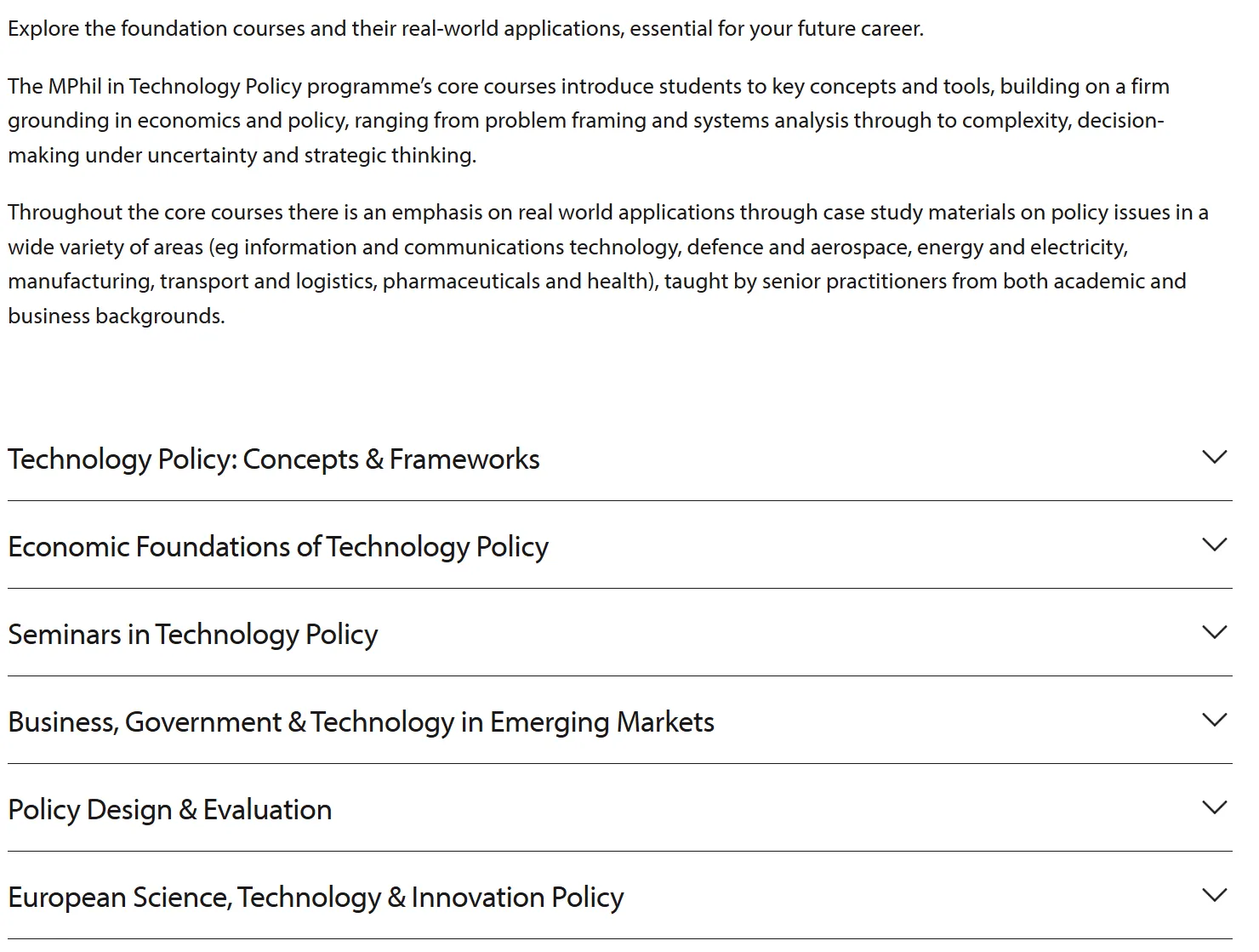
- Technology Policy: Builds a theoretical framework for technology policy, explaining its essence, goals, development history, and functions.
- Economic Foundations of Technology Policy: From an economic perspective, teaches how to apply economic theories and methods to understand technology policy, such as economic factors of technological innovation and the impact of policies on technology investment.
- Seminars in Technology Policy: Conducted in seminar format, discussions revolve around cutting-edge hot topics and real-world cases, cultivating students' critical thinking and communication and collaboration skills.
Elective Courses
A variety of options are available, such as Innovation Policy and Management, which focuses on innovation policy formulation and innovation management practices; Regulatory Policy for Emerging Technologies, exploring the characteristics, risks, and regulatory policies of emerging technologies; and International Technology Transfer and Cooperation, introducing models of international technology transfer and policy environments.
Applied Final Group Project
Students work in groups to conduct research on real-world technology policy issues, comprehensively applying their knowledge to investigate, analyze, and propose solutions, thereby honing their practical and teamwork skills.
Application Requirements
Academic Background
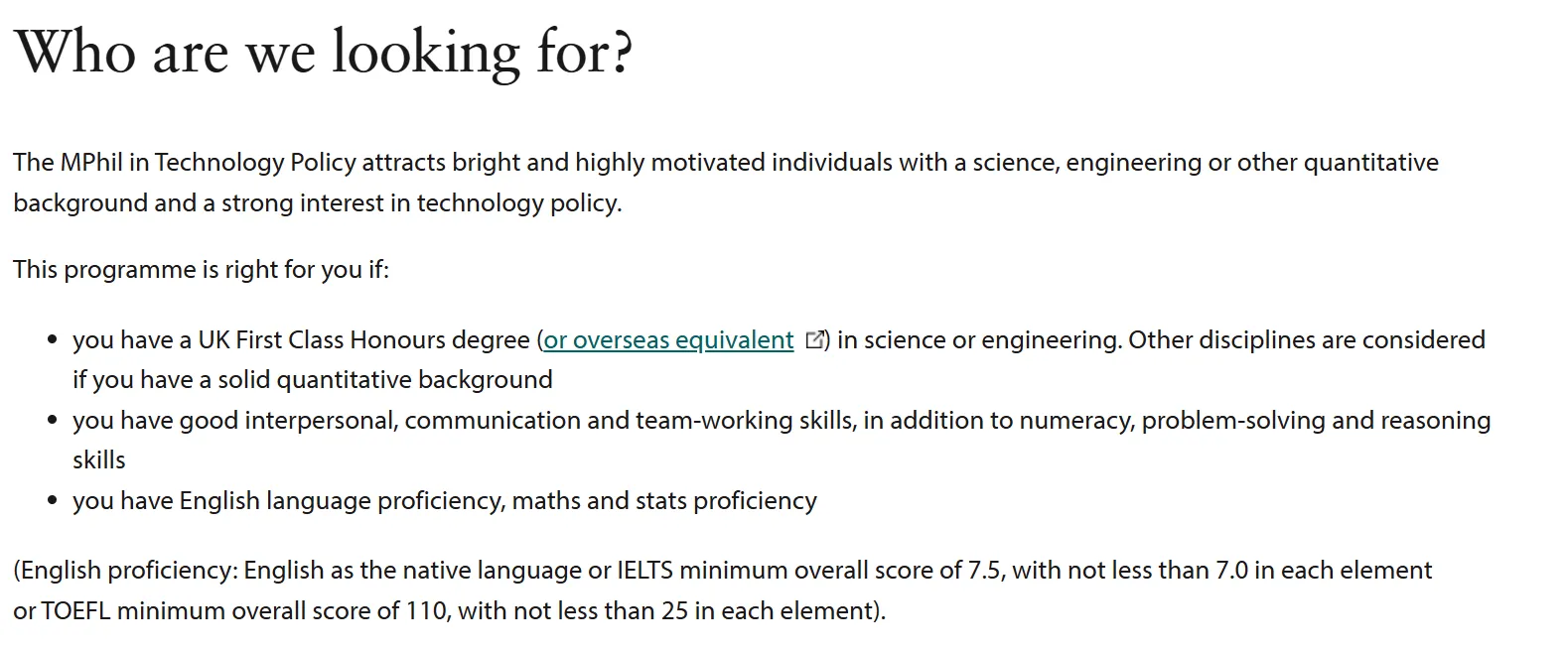
A bachelor's degree is required, with a background in relevant disciplines advantageous. For UK undergraduates, a first-class degree is required; Chinese students are recommended to have a weighted average score above 90% or rank in the top 10% of their major. The university will comprehensively assess factors such as course difficulty.
Standardized Test Scores
- Language Proficiency: IELTS overall score of 7.5 or above, with no band lower than 7.0; TOEFL overall score of 110 or above, with no section lower than 25. Some students may be required to attend an oral interview.
- GRE/GMAT (not required but recommended): Strong scores can enhance competitiveness. A GRE verbal score above 160 and quantitative score above 165, or a GMAT total score above 700, is considered ideal.
Personal Statement
Explain your interest in the field of technology policy, relevant practical experiences, reasons for choosing the program, and clearly state your research interests and career plans. The word count should be 1000-1500 words, highlighting personal insights and passion.
Letters of Recommendation
Two letters of recommendation. Recommenders should be familiar with the applicant's academic and personal circumstances. The letters should be written on official letterhead, signed, and stamped.
Other Materials
Prepare a detailed resume showing education, work experience, academic achievements, and other information. In some cases, a writing sample or research proposal may be required to assess academic writing skills and alignment of research interests.
Career Development
Diverse Career Fields
Graduates have broad employment prospects and can develop in various fields. In government departments, they can serve as policy analysts and participate in policy formulation and evaluation; in international organizations, engage in technology policy research and international cooperation coordination; in research institutions, conduct cutting-edge theoretical research; and in the corporate world, provide policy support for technology strategy, market expansion, etc.
Strong Employment Competitiveness
Cambridge's outstanding reputation ensures its degrees are widely recognized. The interdisciplinary training model equips graduates with a diverse knowledge structure and comprehensive abilities, enabling them to quickly adapt to different roles. The practical experience and broad network accumulated during studies also provide strong support for career development.
In summary, this program offers students an excellent platform for learning and development in the field of technology policy, making it an ideal choice for those pursuing excellence in this area. In the 25fall application cycle, a CheersYou(清柚教育) student also received an offer for this program.

If you want to know the application timeline and background, as well as more admission cases and study abroad application questions, you can also add the contact information of the CheersYou(清柚教育) consultant below to learn more.