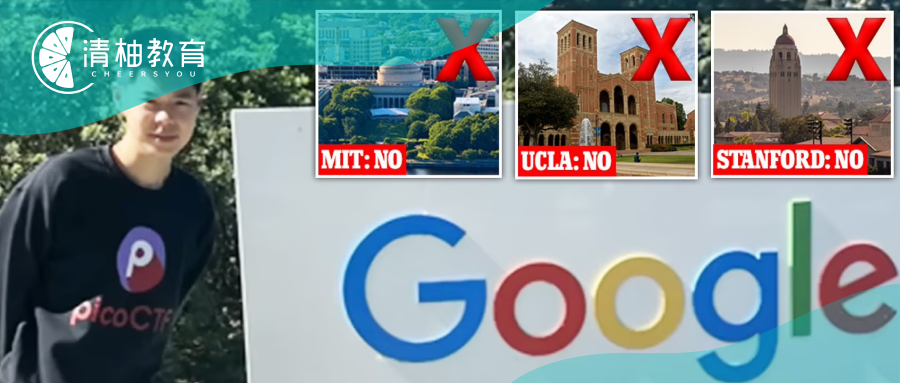
With a near-perfect SAT score, a 4.42 GPA, having founded his own startup in high school, and landing a Google L4 offer before graduation...
Stanley Zhong, a Chinese-American teen, had an almost perfect college application résumé.
However, despite his top-tier application materials, Stanley was rejected by 16 colleges in the 2023 admissions cycle, including Harvard, MIT, and other elite schools.
Stanley's parents were shocked and angered, believing that with his stellar grades and background, he should have been admitted to top universities.
They believe the rejections may be tied to his Asian identity, and they decided to sue the University of California and the University of Washington.
Source: NY Post
Top-notch Application, 16 Rejections from Elite U.S. Colleges
In 2023, Stanley Zhong applied to 18 colleges, and 16 of them rejected him, including: Cal Poly San Luis Obispo, Caltech, CMU, Cornell, Georgia Tech, MIT, Stanford, UC Berkeley, UCLA, UC Davis, UCSD, UCSB, University of Illinois, University of Michigan, University of Washington, and University of Wisconsin.
However, only the University of Maryland and UT Austin extended offers—their acceptance rates are 31% and 44%, respectively.
Stanley's father was stunned: 'I had indeed heard that Asians face higher bars in college admissions, but I thought it was just an urban legend. But when the rejection letters kept coming, I was floored. It went from surprise to frustration, and finally just anger.'
The father believes his son was racially discriminated against in the admissions process and filed lawsuits against the UC system, University of Washington, and University of Michigan.
The lawsuit states: 'Stanley’s admissions outcomes stand in stark contrast to the full-time offer he received from Google, a role requiring a PhD or equivalent experience. His case is a textbook example of UC’s racial discrimination against highly qualified Asian applicants.'
Stanley’s father drafted the complaint with the help of AI and represented his son in court pro se. 'We chose to represent ourselves not because we wanted to,' he explained. 'Left-leaning lawyers wouldn’t take the case, and right-leaning lawyers felt the courts in California [and other states] might be biased.'
He says he is most motivated to fight for the mental health of other Asian American kids who, despite their relentless efforts, feel lost and helpless after being rejected.
Using Stanley as an example, 'Even if you’re as qualified as someone with a PhD, you still might not get an undergraduate admission.'
As of now, the UC system has not issued a detailed response to Stanley’s lawsuit. But in recent years, UC has emphasized the fairness and transparency of its admissions process, stating that decisions are based on 'Holistic Review' including academics, extracurriculars, personal background, and more. UC also notes that its admissions policies comply with California law, which prohibits discrimination based on race, gender, and other factors.
Source: UC Berkeley
A University of Washington spokesperson responded to the lawsuit, saying that the school has limited spots and cannot admit all highly talented and capable applicants; the University of Michigan stated it has not yet received the lawsuit documents.
After the admissions cycle, Stanley did not immediately enroll at UT Austin but chose to work at Google. Reflecting on this gap year, he admitted, 'It was a great experience, with everyone giving me tremendous support.' He is still weighing whether to continue at Google or return to school to complete his degree.
Meanwhile, Stanley and his father co-founded the 'Students Who Oppose Racial Discrimination' (SWORD) and filed a lawsuit in California court, accusing the UC system of racial discrimination in admissions. This move aims not only to protect their own rights but also to fight for fair educational opportunities for the entire Asian student community.
Source: SWORD
Is There Admissions Bias Against Asian Americans?
Stanley’s case has ignited broad discussion about fairness in college admissions.
On one hand, his academic achievements are indeed remarkable and meet the standards of top universities. On the other hand, U.S. college admissions are not purely grade-driven; admissions officers also consider personality, background, and potential. While Stanley’s profile was outstanding, it may have lacked sufficient uniqueness or diversity, causing him not to stand out in fierce competition.
However, the phenomenon of Asian students facing higher barriers in college admissions is not unfounded. In recent years, multiple studies and lawsuits (like the Harvard case) have pointed out that Asian students need to achieve higher standardized test scores than other groups to gain equal admission chances. Stanley’s case may be a microcosm of this.
Here is Stanley’s college application profile:
-
GPA: Unweighted 3.97, Weighted 4.42
-
SAT: 1590 (out of 1600)
-
Extracurriculars: Founded e-signature platform Rabbit-Sign in high school, received mainstream media coverage, and excelled in programming competitions
-
Work experience: Recruited by Google at age 13 and, due to outstanding technical abilities, earned a software engineer position at the PhD level
On one side, an offer from Google; on the other, merciless rejections from elite schools. To his parents, he is an IT prodigy; but in college admissions, his excellence became a Schrödinger-like existence.
Regarding the alleged admissions unfairness, many netizens have raised doubts.
'His dad is a Google manager, did no one mention that? Guess how HR found this kid?'
'Gunn High School explains it: the Bay Area is insanely competitive. At his school he’s an A, but to get into Top 30, he needs to be an A+.'
'Even with a 4.0+ GPA, tons of people get rejected every year.'
Source: Reddit
'Suing UC? The UC system probably has the highest percentage of Asian students in the country.' 'So no lawyer took the case, they even drafted the complaint themselves using AI.'
'This isn’t discrimination at all; college admissions just work this way. Some rich white kid gets into Harvard and ends up unemployed; some high school dropout becomes a billionaire. That’s life. The software engineers living in the Silicon Valley pink bubble probably don’t get that.'
Source: Reddit
Facing the overwhelming online discourse, Stanley decided to step back from the media spotlight. Stanley’s father said, 'As an Asian person trying to defend your rights, you’re treated as public enemy number one. It’s unbelievable.'
However, quite a few netizens expressed sympathy or support:
'Support the lawsuit. If college admissions don’t look at grades, what do they look at? They’ve been spoiled.'
'If he were Black or Latino, he’d get into all 16 colleges easily.'
Source: Reddit
'He’s already at Google L4, what more does he want? He’s a total winner in life.'
'College admissions aren’t just about grades. But standing in front of the media to face public judgment takes a lot of courage.'
Source: Internet
No Fixed Formula for Admissions, the Fight for Rights is Long and Arduous
While the Zhong family’s voice may be controversial, Stanley’s bravery in fighting for the rights of Asian applicants deserves respect. His case also illustrates that there is no fixed formula for U.S. college admissions; even a top-tier profile doesn’t guarantee acceptance. Sometimes admission really comes down to the admissions officer’s personal impression and subjective judgment.
At the same time, the issue of educational equity in the U.S. remains a long and difficult journey. The challenges Asian students face in admissions reflect deeper structural problems in higher education.
Source: NBC News
A speck of dust from the era, when it falls on an individual, becomes a mountain.
Still, sometimes a loss in one area is a gain in another. Stanley didn’t get into his dream school, but he went to Google—who’s to say it isn’t another kind of fortune?
Admissions results cannot define a person’s worth; young lives hold infinite possibilities.
In 'Modern Family,' overachiever Alex was rejected by Harvard but found her own path at Caltech.
A failure at 18 is nothing. Life is a wilderness, not a track, and can never be defined by a rejection letter. The possibilities you hold in your hands are far broader than any admissions officer’s judgment.
Finally, CheersYou(清柚教育) hopes everyone can find the most suitable path for themselves. Regardless of admissions results, true success lies in continuous exploration, growth, and shining on your own stage.