
As society places increasing emphasis on safety and the rule of law, the demand for professionals in criminology and sociolegal studies continues to grow. The diversification and complexity of crime, such as the emergence of new forms like cybercrime and financial crime, have raised higher requirements for the comprehensive qualities and innovation abilities of professionals. The University of Toronto's Criminology and Sociolegal Studies program is a distinctive and far-reaching academic program. It is dedicated to exploring the intricate relationships among criminal behavior, legal systems, and social structures, providing students with a comprehensive and in-depth knowledge system and research perspectives. Next, it will be elaborated from four aspects: program introduction, curriculum, admission requirements, and career prospects. For more detailed information and any questions regarding graduate applications, you can also scan the QR code below for one-on-one consultation.

1. Program Introduction
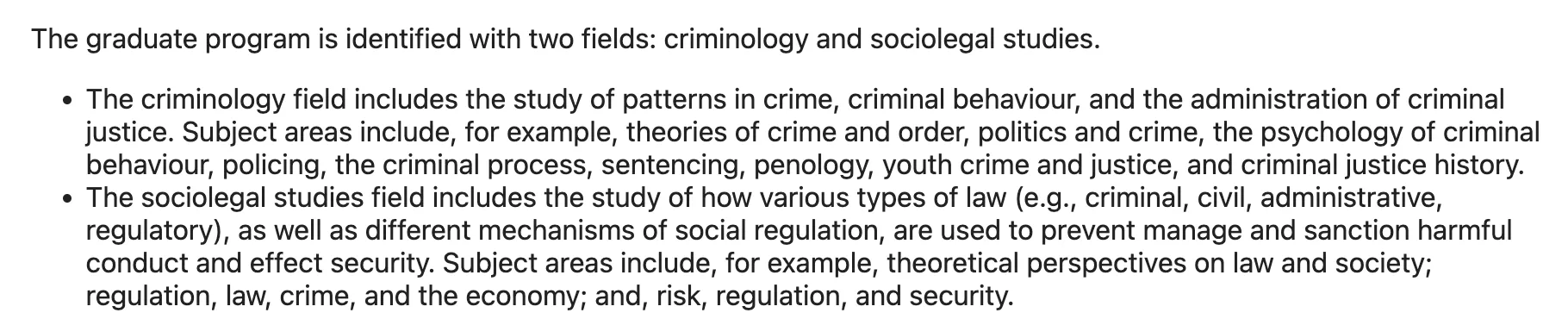
This program integrates multidisciplinary theories and methods, covering fields such as sociology, psychology, law, political science, etc., breaking down disciplinary barriers and cultivating students to understand criminal phenomena and their underlying socio-legal roots from multiple dimensions. Through rigorous academic training and rich practical activities, students will learn to apply critical thinking to analyze criminal issues and propose feasible solutions.
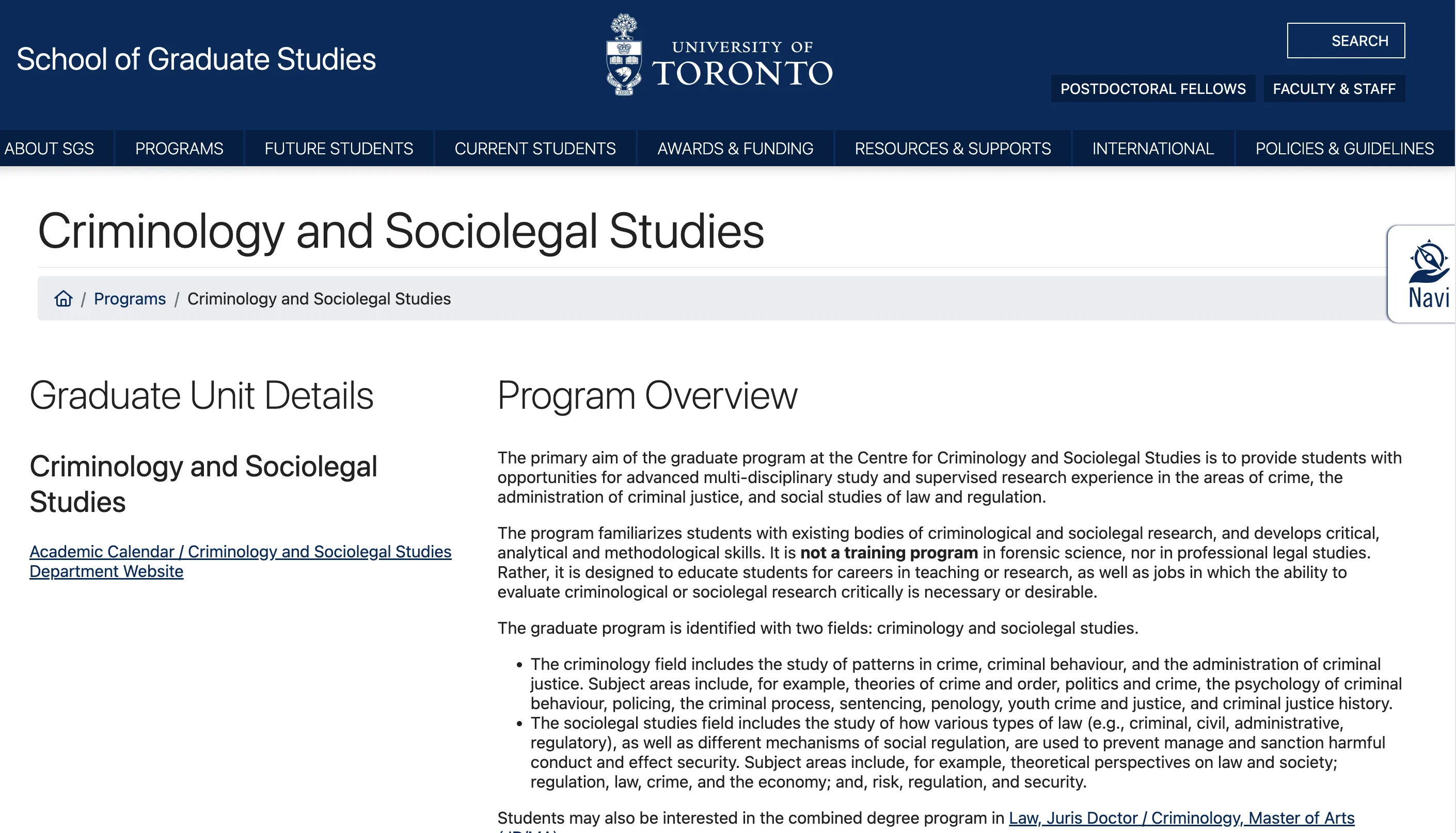
Official website link: https://www.sgs.utoronto.ca/programs/criminology-and-sociolegal-studies/
2. Curriculum
Core Courses
- Fundamentals of Criminology: This course builds the basic theoretical framework of criminology, introducing the definition, classification of criminal behavior, and major criminological theoretical schools, helping students understand the essence and evolution of criminal phenomena from a macro level.
- Introduction to Sociolegal Studies: Focusing on the role, function, and operation mechanisms of law in society, it explores the interaction between law and social norms, power structures, laying the foundation for further in-depth study of the relationship between crime and law.
- Psychology of Criminal Behavior: Analyzing the causes of criminal behavior from a psychological perspective, studying individual psychological traits, cognitive processes, and the influence of social environment on criminal decision-making, enabling students to understand the psychological drivers behind criminal behavior.
Elective Courses
- Criminal Justice System: Detailed interpretation of various links of the criminal justice system, including police enforcement, court trials, and penal execution, analyzing existing problems and reform directions, and cultivating students' in-depth understanding of judicial practice.
- Gender and Crime: Focusing on the significant impact of gender factors in criminology, studying differences in crime rates between genders, characteristics of crime types, and the intrinsic connection between gender inequality and crime, broadening students' perspectives on criminal issues.
- Globalization and Transnational Crime: Looking at new forms of crime in the context of globalization, such as transnational drug trafficking, cybercrime, human trafficking, etc., and discussing strategies and challenges of international cooperation in combating crime.
3. Admission Requirements
Academic Requirements
- A bachelor's degree from a recognized university. Backgrounds in related fields such as sociology, psychology, law are preferred, but not limited to these. Students from unrelated majors who have a strong interest in criminology and sociolegal studies and possess certain academic capabilities may also apply.
- An undergraduate average of B+ or higher (based on the University of Toronto's grading system). The grade requirements for different undergraduate institutions may be slightly adjusted.
Language Requirements
- For non-native English speakers, an overall IELTS score of 7.0 or above with no band lower than 6.5; or a TOEFL iBT total score of 100 or above, with writing no less than 22 and other bands no less than 20. Valid language test scores must be submitted by the application deadline.
Statement of Purpose
Applicants are required to submit a clear, coherent, and convincing statement of purpose, approximately 500-800 words. In the personal statement, explain your motivation for applying to the program, your specific interest in the field of criminology and sociolegal studies, relevant learning or practical experiences, and future academic and career plans.
Letters of Recommendation
Two letters of recommendation are generally required. Ideally, recommenders should be university professors familiar with the applicant's academic performance or employers who can attest to the applicant's work abilities and potential. The letters should focus on evaluating the applicant's academic ability, research potential, critical thinking, and teamwork spirit, among other aspects.
Transcripts
Complete official transcripts of the undergraduate stage are required, in both Chinese and English, and must be stamped by the university's academic affairs office. The transcripts should clearly display the name, grade, and credit hours of each course.
4. Career Prospects
Career Directions
- Crime Analyst: Graduates can work as crime analysts in government agencies, law enforcement agencies, or research institutions, responsible for collecting, organizing, and analyzing crime data, predicting crime trends, and providing data support and professional advice for formulating crime prevention strategies.
- Criminal Policy Advisor: Leveraging in-depth understanding of criminology and socio-law, provide professional advice to governments on criminal policy formulation. Participate in the policy-making process, evaluate policy effects, and promote the reform and improvement of the criminal justice system.
- Correctional Worker: Work in prisons, community correctional agencies, and other related settings, responsible for the rehabilitation and reintegration of offenders into society. Use professional knowledge to help offenders recognize their mistakes, provide psychological counseling and vocational training, and reduce recidivism rates.
- Legal Researcher: Engage in legal research in law firms, legal research institutions, or courts. Conduct in-depth research on specific legal issues, draft legal opinions and research reports, and provide reference for legal practice and decision-making.
Graduates of the University of Toronto's Criminology and Sociolegal Studies program have a significant advantage in the job market due to their profound academic foundation, interdisciplinary knowledge system, and practical skills. They enjoy broad career development space both domestically in Canada and internationally. Graduates can leverage their professional expertise in various fields such as the public sector, non-profit organizations, and private enterprises, contributing to the maintenance of social fairness and justice and the construction of the rule of law, while also realizing their personal career aspirations and social value.
In the 25fall application season, CheersYou(清柚教育) students have also received offers for this program. For information on application timelines and backgrounds, as well as more admission cases and graduate study abroad related questions, you can add the CheersYou(清柚教育) consultant's contact information below for detailed information.