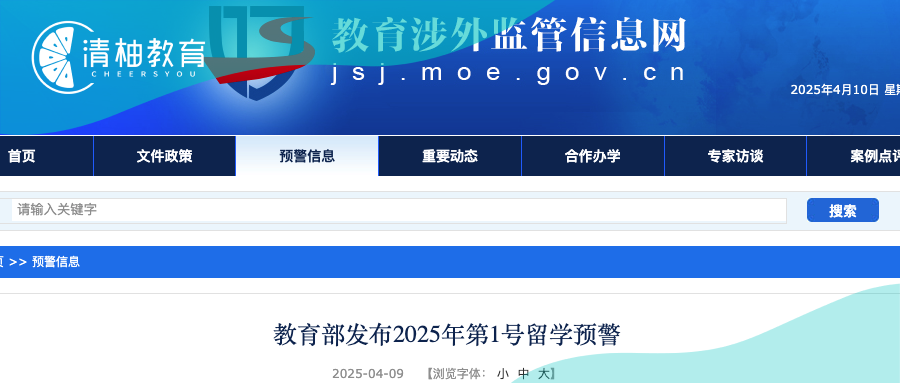
On April 9, the Ministry of Education issued the 2025 No. 1 Study Abroad Alert.
Source: Ministry of Education
The alert primarily targets a few negative China-related provisions in the higher education bill recently passed by the U.S. state of Ohio, advising study abroad personnel to conduct safety assessments and strengthen awareness of precautions.
Upon the release of this news, it garnered extensive attention from Chinese families planning to study abroad. CheersYou(清柚教育) also provides related interpretation here to address concerns and clarify doubts.
Study Abroad Alerts Are Not Unprecedented
First, it is worth noting that this alert is a study abroad reminder targeting individual U.S. states, not a ban on studying in the U.S.
In the past, the Ministry of Education has also issued study abroad alerts for different regions. Such information is primarily a risk prevention advisory, aimed at reminding relevant individuals to assess the situation and conduct reasonable evaluations.
Source: Ministry of Education
What Does the Ohio Education Bill Restrict?
The higher education bill mentioned in the alert is Senate Bill 1, passed by the Ohio legislature in March, and will take effect at the end of June.
The bill applies to 14 public universities and 23 public community colleges in Ohio. If they violate the bill, the institutions will lose state funding.
The specific provisions related to China are as follows:
-
Prohibition of Accepting Donations from China: No Ohio state university may accept donations or funding from Chinese party, government, or military entities.
Source: Senate Bill 1
-
Restrictions on Cooperation with Chinese Institutions: Ohio public universities are restricted from establishing or maintaining academic partnerships with Chinese academic or research institutions. Such collaborations must be reported and are subject to limiting conditions.
Source: Senate Bill 1
How Does This Affect Students Studying in the U.S.?
The education bill also explicitly states:
It does not prohibit state universities from accepting tuition and other educational expenses from Chinese students, meaning it does not restrict Chinese students from funding their own education through personal or family support.
Source: Senate Bill 1
The bill may affect institutional cooperation projects such as joint research and master's/doctoral training programs, or Sino-American cooperative programs where the partner is from Ohio. Students involved in such programs are advised to promptly inquire with their institutions about the situation and consider countermeasures.
Ordinary international students applying and studying on their own will not face restrictions or impacts on their daily academic life. At the same time, the bill is only effective within Ohio; other U.S. states are not affected.
Some students and parents may ask whether the passage of this bill signals the beginning of obstacles to studying in the U.S.
Republican-led states like Ohio, Florida, and Texas have consistently taken a hard-line stance toward China. In 2023, Florida enacted a law prohibiting Chinese graduate students and postdoctoral researchers from working in labs at 12 public universities.
Source: Science
Such measures only restrict a small number of students; they are not a blanket ban on all Chinese international students. Moreover, the majority of Chinese students' target schools are located on the East and West Coasts, which are generally more friendly toward China and home to the most prestigious private and public universities in the U.S.
Overall, studying in the U.S. has not changed significantly. Students intending to study in the U.S. can still apply as usual. If a target university or program is particularly sensitive, it may be advisable to lower its priority.
In the complex global environment, policy fluctuations have become the norm. We advise students and parents to verify the authenticity of information when reading related news online, to avoid unnecessary anxiety and worry.