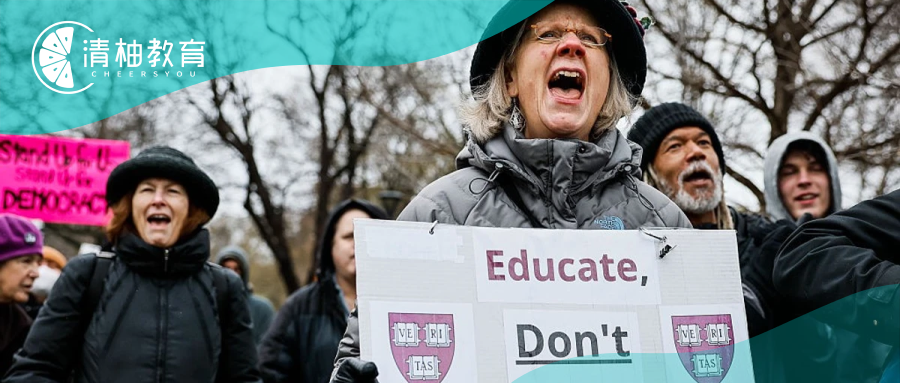
Less than three months into his term, Trump is at it again.
Earlier, President Trump launched a political pressure campaign targeting U.S. colleges and universities, with many receiving "warning letters" or "rectification notices" from the federal government, and the situation escalating day by day.
While many schools chose silence or even capitulation, Harvard University became the first top-tier institution to speak out publicly and refuse to back down.
It gave the Trump administration a firm "No."
Source: Harvard University
Harvard's Counterattack
March 31
The U.S. Department of Health and Human Services (HHS), the Department of Education, and the General Services Administration (GSA) jointly announced a comprehensive review of all contracts and grant agreements between Harvard University and its affiliates and the federal government.
April 11
Harvard received a list of corrective demands from the Trump administration, including but not limited to:
-
Reduce the power of students and faculty in university affairs;
-
Conduct plagiarism checks on all current and future faculty members;
-
Provide all admissions data to the federal government and the public, including information on rejected and admitted applicants, broken down by race, nationality, GPA, and standardized test scores;
-
Immediately report foreign students who violate rules to federal authorities;
-
Commission an external team to ensure "viewpoint diversity" among students, faculty, and leadership;
-
Immediately shut down any programs related to diversity, equity, and inclusion (DEI);
-
Investigate and impose disciplinary measures on participants in protests from 2023 to 2025.
The letter implicitly suggested that Harvard must comply with the demands, or risk losing $9 billion in federal funding.
April 14
Harvard's acting president, Alan M. Garber, officially responded to the government's demands with an open letter to all faculty, staff, and students, announcing: Harvard refuses to accept these demands.
In the response, Harvard stated that while some of the government's demands aim to combat anti-Semitism, the majority represent direct federal oversight of Harvard's "intellectual environment."
Alan Garber wrote in the letter: "No government—no matter which party is in power—has the right to dictate what a private university should teach, whom it can admit or hire, or what areas of research and inquiry to pursue."
This letter is not only a statement of position, but a powerful counterstrike. Harvard University will not surrender its independence or its constitutional rights.
After reading it, many netizens couldn't help but exclaim, "That's Harvard for you!"
Source: rednote
However, no sooner had Harvard made its stance clear than the Trump administration announced the freezing of nearly $2.2 billion in grants and $60 million in contracts for Harvard.
And on Truth Social, he said: Everyone knows Harvard has "lost its way." (What a paternalistic remark...)
Source: Truth
April 16
The U.S. Department of Homeland Security sent another threatening letter to Harvard on Wednesday, demanding that it submit disciplinary records of international students involved in protests, or risk losing its eligibility to enroll international students.
In response, Harvard stated it was "aware" of the letter, but maintained its previous stance and refused to compromise, vowing, while complying with the law, "not to abandon its independence or constitutional rights."
Source: NBC News
Harvard Is Neither the First Nor the Last
In this wave of funding cuts, Harvard is not the only university threatened and having its funding frozen.
As early as March 10, the Office for Civil Rights at the Department of Education sent formal warning letters to 60 universities, demanding that they "immediately fulfill their federal legal obligations" to safeguard the rights of Jewish students, or face funding cuts or legal action.
Source: U.S. Department of Education
Among them, Columbia University was the first to bear the brunt, threatened with a $400 million cut in federal funding.
As a result, Columbia, under pressure, had to cooperate with the U.S. government, suspending or expelling students involved in pro-Palestinian protests, implementing a mask ban, hiring new security teams and department leadership, and even losing its interim president.
Despite all this, the Trump administration has yet to announce whether the $400 million will be restored, and two weeks later ordered the National Institutes of Health (NIH) to suspend all funding to Columbia University, including new grants and salaries for all researchers on existing NIH projects.
Source: Research funding sources for various universities
Subsequently, the White House announced the suspension of $210 million in research funding to Princeton University, pending the completion of the Department of Education's investigation into anti-Semitic harassment at Princeton.
Even Trump's alma mater, the University of Pennsylvania, has not been spared. Reports indicate that Penn will see $175 million in federal funding frozen for failing to ban transgender athletes from participating in women's sports.
In addition, the Trump administration is reportedly reviewing Brown University's diversity, equity, and inclusion policies and its response to anti-Semitism, putting more than $500 million in grants to Brown at risk.
Source: AP reports
Of course, with Harvard's public stand, Columbia University, which had been negotiating with the Trump administration to restore funding, also took a firmer position. Columbia's Executive Vice President Claire Shipman stated unequivocally: "The university will not let Washington dictate whom Columbia hires or what it teaches."
Meanwhile, more universities have joined forces to speak out in defense of academic independence.
These include Cornell University, Brown University, California Institute of Technology, University of Illinois, Massachusetts Institute of Technology, University of Michigan, Michigan State University, Princeton University, and the University of Rochester—nine major research universities—along with three higher education associations, who together filed a lawsuit on Tuesday against the Trump administration, seeking to restore $400 million in research funding cut by the Department of Energy last week.
Source: NBC News
"For Freedom, Any Price Is Worth It"
Harvard history professor David Armitage remarked that as the wealthiest university in the U.S., Harvard has the capacity to resist such moves, and for freedom, any price is worth it.
He stressed: "This action by the Trump administration is not surprising—it's baseless retaliation with the sole purpose of suppressing free speech."
Of course, we are well aware that not all U.S. universities have such deep financial resources to respond to government pressure with such a firm stance.
Yet Harvard's actions remain deeply moving.
It is not just a declaration by one university, but more like a signal—that even in difficult times, some are still willing to fight for principles.
No matter where we are, academic freedom, freedom of thought, and space for independent inquiry are non-negotiable core values of higher education. Once this foundation is shaken, it will affect not only students and schools themselves, but the innovative vitality and cultural independence of the entire society.
CheersYou(清柚教育)also believes that more and more voices will join this movement to defend academic freedom in the future!
Together, we look forward to the day when the cold wave will finally recede and spring will not be absent.