

The Crime Science MSc program offered by the Department of Security and Crime Science at University College London (UCL) is the world's first postgraduate course to systematically study crime using scientific methods. The program emphasizes applying interdisciplinary scientific approaches to crime prevention, detection, and policy-making, equipping students to tackle complex security challenges in the real world. Below, we will elaborate on four aspects: program introduction, curriculum, admission requirements, and career prospects. For more details and other graduate application questions, you can scan the QR code below for a one-on-one consultation.

1. Program Introduction
UCL's Crime Science MSc aims to achieve immediate and sustainable crime reduction through scientific methods. The curriculum integrates knowledge from psychology, sociology, statistics, mathematics, architecture, forensic science, design, geography, computer science, and other disciplines, emphasizing interdisciplinary collaboration. Students will learn how to apply scientific techniques to understand crime problems, develop prevention strategies, and improve crime detection and arrest success rates.
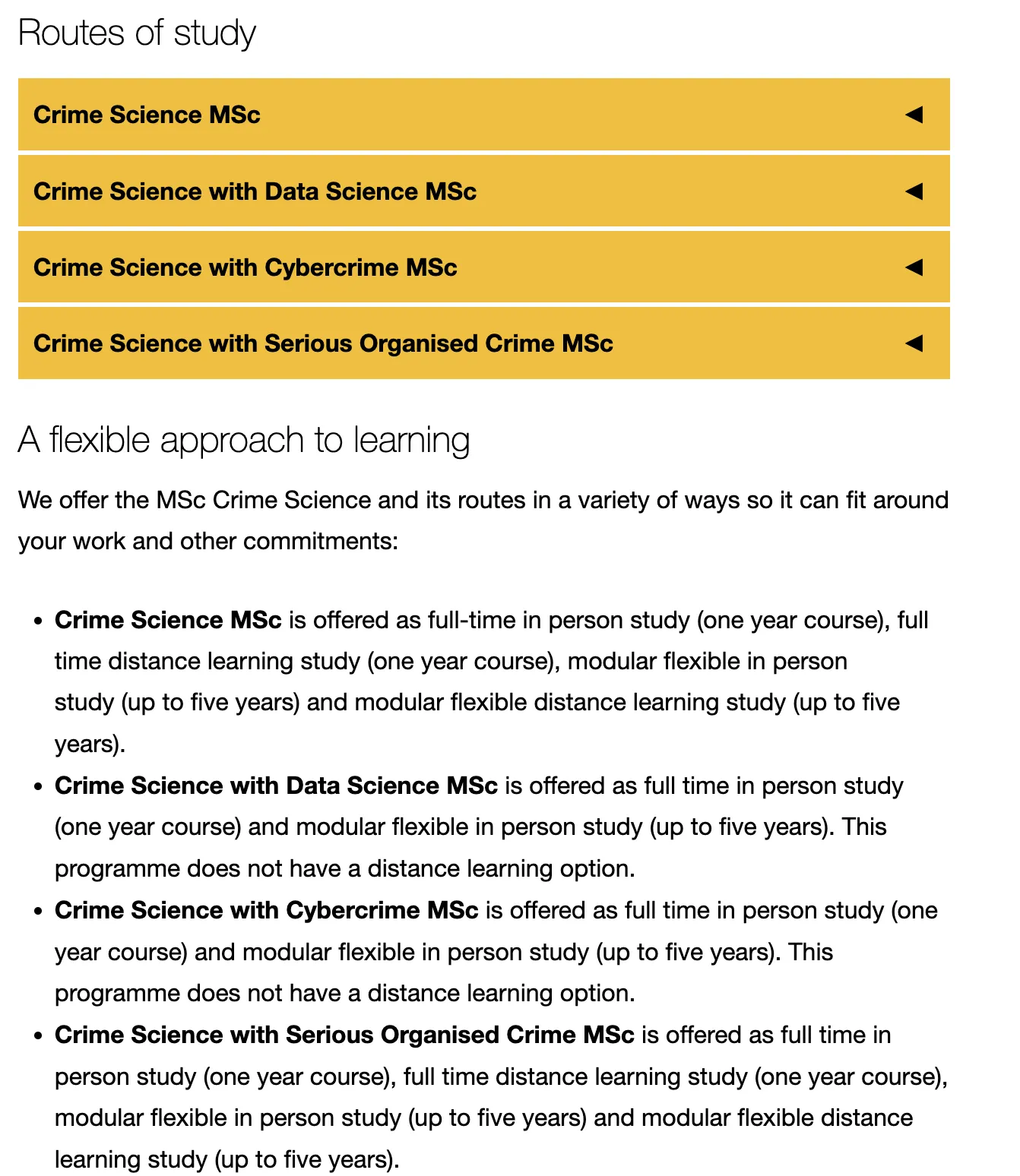
The program offers four study tracks, allowing students to choose based on personal interests and career goals:
-
Crime Science MSc: Provides comprehensive training in crime science, emphasizing the application of scientific methods in crime prevention and detection.
-
Crime Science with Data Science MSc: Focuses on data-driven crime analysis, building students' professional skills in data science.
-
Crime Science with Cybercrime MSc: Studies the motivations, methods, and prevention strategies of cybercrime to meet digital-age security challenges.
-
Crime Science with Serious Organised Crime MSc: Delves into the structure, operation mechanisms, and countermeasures of organized crime.
The program can be taken full-time (1 year) or modular flexible study (up to 5 years), with some tracks supporting distance learning.
Official link: https://www.ucl.ac.uk/security-crime-science/study/postgraduate-taught/c...
2. Curriculum
Students must complete 180 credits, including core courses, electives, and a research dissertation. The curriculum covers areas such as crime prevention, research methods, data analysis, cybersecurity, and organized crime.
Core Courses (Examples):
-
Preventing Crimes
-
Designing and Doing Research
-
Quantitative Methods
-
Foundations of Security and Crime Science
-
Introduction to Cybersecurity
-
Cybercrime
-
Security and Crime Science Dissertation
-
Understanding Multivariate Modelling and Causal Inference
Elective Courses (Examples):
-
Crime Mapping and Spatial Analysis
-
Perspectives on Organised Crime
-
Investigation and Detection
-
Intelligence Gathering and Analysis
-
Risk and Contingency Planning
-
Qualitative Research Methods
-
Horizon Scanning and the Changing Nature of Crime
-
Applied Data Science
-
Simulation for Research
-
Information Security Management
-
Emerging Dilemmas in Digital Technology Policy
-
Online Extremism and Hate Crime
-
Assessing Extremism Risk
-
Human Trafficking, Smuggling and Exploitation
Teaching methods include lectures, seminars, practical projects, and data analysis exercises. Assessment methods include coursework, exams, project reports, and the dissertation.
3. Admission Requirements
-
Academic Background: Typically requires a UK second-class Honours bachelor's degree in a relevant discipline (or overseas equivalent). Relevant disciplines include engineering, computer science, psychology, criminology, geography, etc.
-
Work Experience: Applicants with five or more years of relevant work experience (e.g., police, crime prevention workers) may apply.
-
English Language Requirements: Non-native English speakers must provide proof of English proficiency; specific requirements can be found on the UCL website.
-
Application Materials: Include a personal statement, two letters of recommendation (at least one academic), transcripts, etc.
-
Application Deadlines: Deadlines vary depending on visa requirements; please refer to the UCL website for specific dates.
4. Career Prospects
The program's interdisciplinary training equips graduates with broad employability, capable of taking on various roles in government, law enforcement agencies, private companies, and NGOs. Common career paths include:
-
Intelligence Analyst
-
Crime Prevention Consultant
-
Policy Analyst
-
Data Scientist
-
Security Consultant
Many graduates work in UK national security, police departments, the Ministry of Defence, and other public sectors, or in private enterprises in roles related to crime prevention and community safety. Some graduates pursue PhDs and enter academic research.
The UCL Department of Security and Crime Science has partnerships with over 60 industry and public sector partners, offering students ample internship and job opportunities. Additionally, the program provides various networking events, such as career events, seminars, and an annual conference, to help students expand their professional networks.
In the 25fall application season, CheersYou(清柚教育) students also received offers for this program. If you want to know about the application timeline and background, more admission cases, or other graduate study related questions, you can add the contact information of CheersYou(清柚教育) advisors below for detailed information.