
QuantNet has just released its 2022 rankings of the best financial engineering programs across the United States!
Baruch College's Financial Engineering program remains at the top for another year, UC Berkeley's MFE surged to second place, and NYU's Financial Engineering and Mathematical Finance programs together outperformed MIT and Cornell!
This year, QuantNet surveyed financial engineering, mathematical finance, and quantitative finance programs, assessing them on admissions, employment, and career services to determine the rankings.
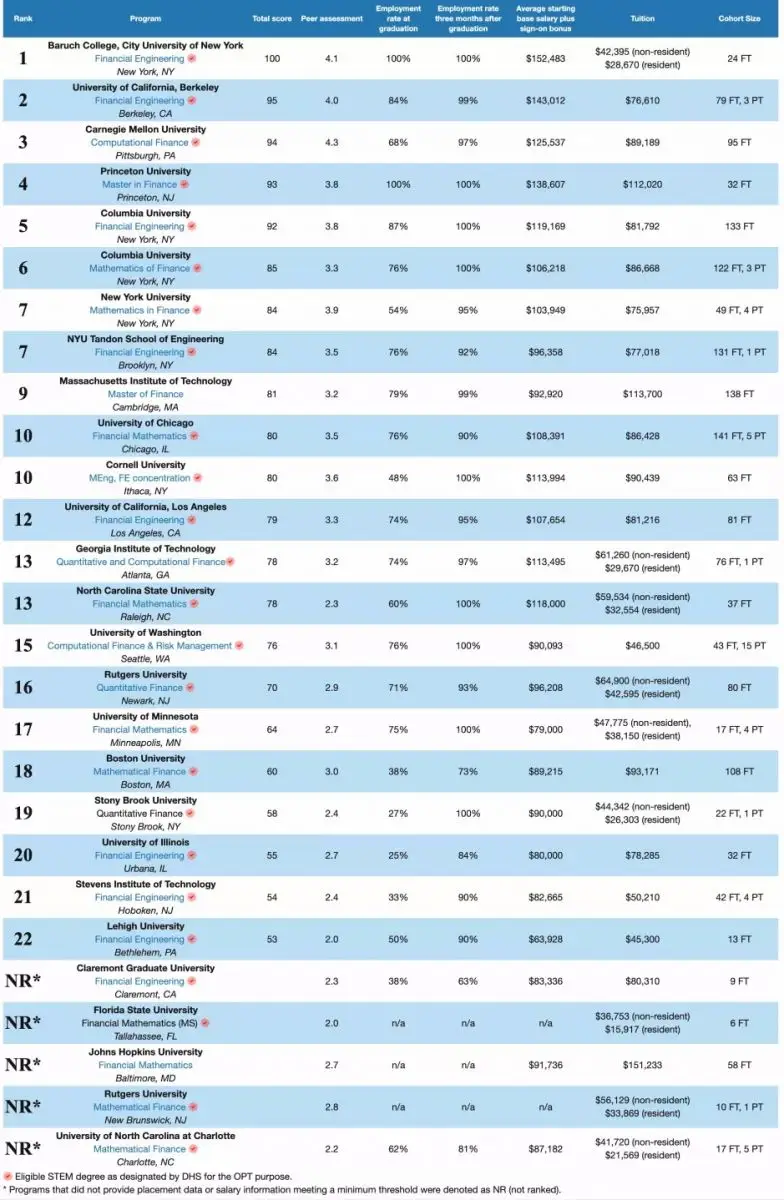
2022 Complete Rankings
Baruch College's Master of Financial Engineering held onto the top spot, while UC Berkeley's MFE jumped three places to rank second.
Carnegie Mellon, Princeton, and Columbia's Financial Engineering programs took third through fifth place, respectively. Columbia's Mathematical Finance rose one spot to sixth.
NYU's Financial Engineering and Mathematical Finance each climbed (one and four spots, respectively), tying for seventh and edging out MIT and Cornell.
UCLA's Financial Engineering and the University of Minnesota's Mathematical Finance also saw big gains, rising four and three spots to 12th and 17th. Lehigh University's Financial Engineering program entered the ranking this year as well.
Overall, with changes in ranking methodology, there was significant movement in this year's list.
Here is the full ranking:
2022 Ranking Criteria
Peer Assessment (20%)
Placement Success (55%)
- Employment Rate at Graduation (10%)
- Employment Rate Three Months After Graduation (15%)
- Average Starting Salary and Sign-On Bonus (20%)
- Employer Satisfaction (10%)
Student Selectivity (25%)
- Undergraduate GPA (17.5%)
- Program Acceptance Rate (7.5%)
Due to the pandemic, some MFE programs adopted a GRE optional policy last year, so GRE scores were temporarily removed from the student selectivity indicator in this year's ranking.
What the QuantNet Rankings Mean
The QuantNet rankings are crucial for students in financial engineering, especially those planning to work in the U.S. for some time. During the post-pandemic period, this ranking is even more valuable for making informed application decisions.
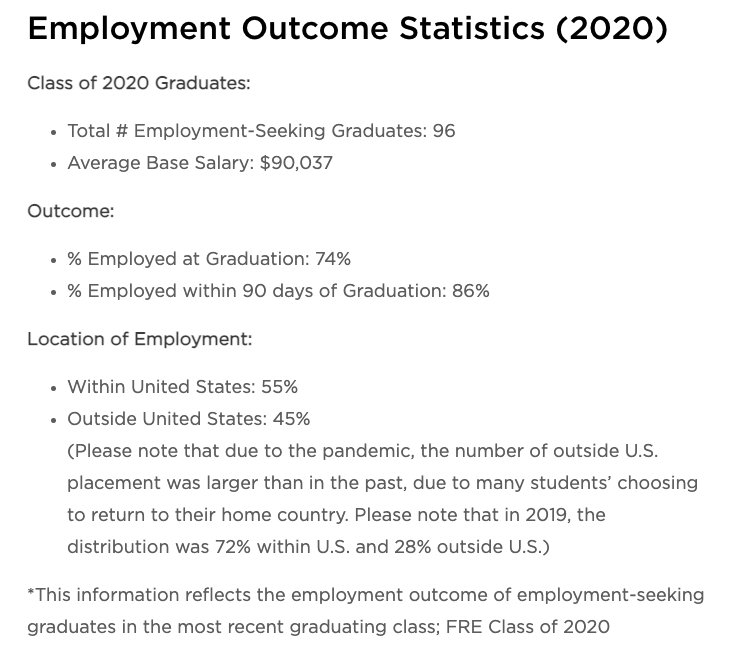
Take NYU Tandon as an example. According to the latest employment statistics for the FRE division graduates:
- Average annual salary: $90,037
- Employment rate at graduation: 74%
- Employment rate within 90 days of graduation: 86%
It's clear that NYU Financial Engineering graduates remained resilient in the harsh job market of 2020.
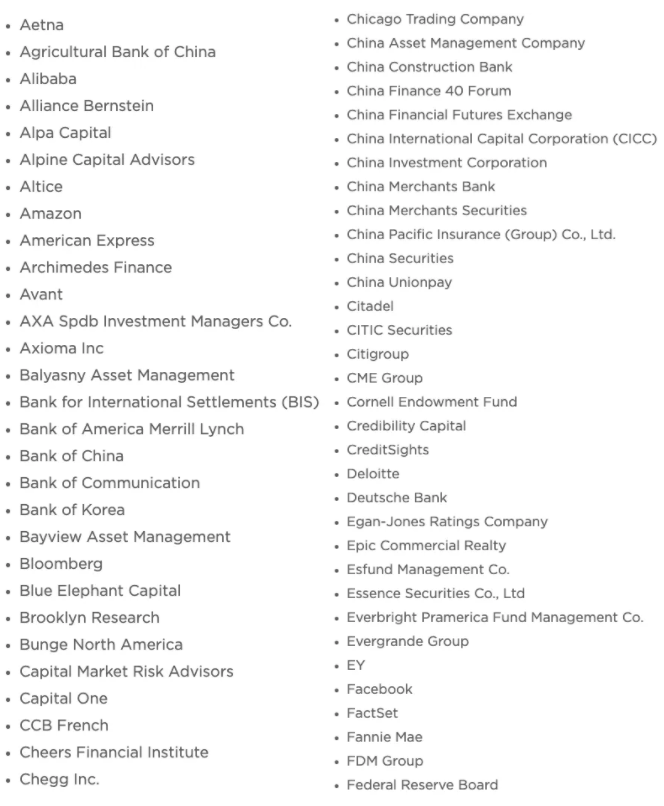
We can also see that among the companies hiring graduates, in addition to top U.S. firms like Goldman Sachs, J.P. Morgan, and Facebook, prominent Chinese state-owned enterprises such as Alibaba, CICC, and Bank of China are also on the list.
Outstanding programs lead to strong career prospects and return on investment. With placement success holding the highest weight, the QuantNet ranking is particularly useful for MFE applicants who prioritize employment, helping them choose the best programs for their goals.
In recent years, the number of MFE applicants has continued to rise, and admission standards have steadily increased.
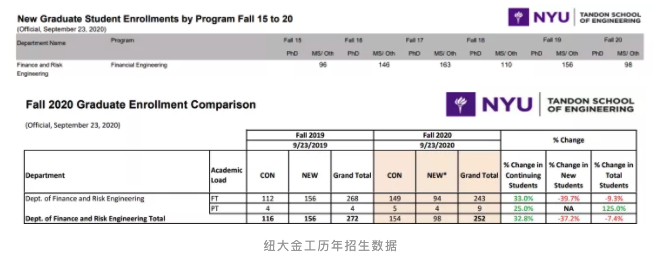
According to the latest data from Fall 2020, NYU Financial Engineering admitted only 98 students—a 39.7% drop compared to the Fall 2019 incoming class.
With such a large applicant pool, the sharp decline in admissions — back to levels seen five years ago — highlights just how intense the competition has become.
For MFE applicants in the new season, CheersYou(清柚教育) still advises: Start your applications early!
Choosing the right school and program is critical. Spotting the unique strengths and future potential of each program will help you succeed tomorrow.