
On November 18, the University of California officially decided to completely eliminate standardized admissions tests!
After more than three years of tug-of-war, UC Provost Michael Brown announced at Thursday's Board of Regents meeting: SAT/ACT will no longer be used as a condition for admissions selection, and the university will abandon the adoption of alternative entrance exams.

Although standardized test supporters believe that scores provide a uniform measure to evaluate applicants from different family and educational backgrounds, the UC system ultimately concluded that high school grades are sufficient to assess academic ability, and there are no unfair factors related to race, income, or parents' education level.
Provost Michael Brown stated: "The UC system will completely eliminate standardized tests from the admissions process going forward."
If the previous temporary suspension of tests was a trial balloon, the UC system is now serious.
The Story Behind UC Dropping SAT/ACT
UC's complete elimination of standardized admissions tests did not happen overnight, but rather after years of back-and-forth, including a lawsuit.
Back in 2018, then-UC President Janet Napolitano asked the Academic Senate to review the use of standardized tests in admissions and propose revisions.
After over a year of study, UC academic leaders concluded that standardized admissions tests actually benefited disadvantaged students, so they recommended retaining them.
However, controversy around the SAT persisted. In 2019, a civil rights group sued the University of California, arguing that the system's admissions tests were unfair and illegally discriminated against low-income, minority, and disabled students, placing them at a disadvantage.

After two years of litigation, UC reached a settlement in May this year, announcing that from fall 2021 to spring 2025, none of the 10 UC campuses would consider SAT and ACT scores in undergraduate admissions or scholarship decisions. Even if students submit SAT scores, admissions officers will disregard them.
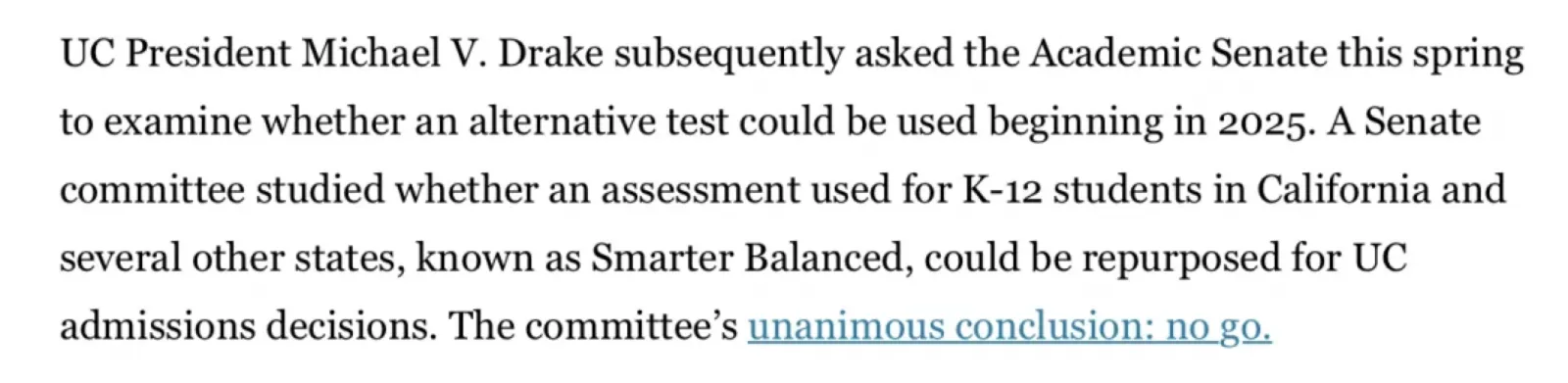
However, the UC system originally planned to find a new entrance exam system by 2025 as a replacement for the SAT. At one point, the university considered the Smarter Balanced assessment system, but ultimately abandoned it due to various factors. The university stated: it is difficult to have a standardized test that completely avoids unfair factors in the admissions process.
After much wavering, the dust has now settled. The UC system chose a clean-sweep approach, completely abandoning standardized admissions tests.
As the largest public university system in the U.S., the UC system encompasses 10 campuses including UC Berkeley, UCLA, and UCSD, many of which are world-renowned top-10 institutions and highly popular among applicants.
Particularly after the removal of test requirements for fall 2021, UC applications surged dramatically, with UCLA, UCB, UCSD, UCSB, and UCI each receiving over 100,000 applications; the admitted class was also the most diverse in history, with over 84,000 new students.

Experts say the UC system's announcement to completely eliminate standardized admissions tests could become a benchmark for test-optional admissions nationwide.
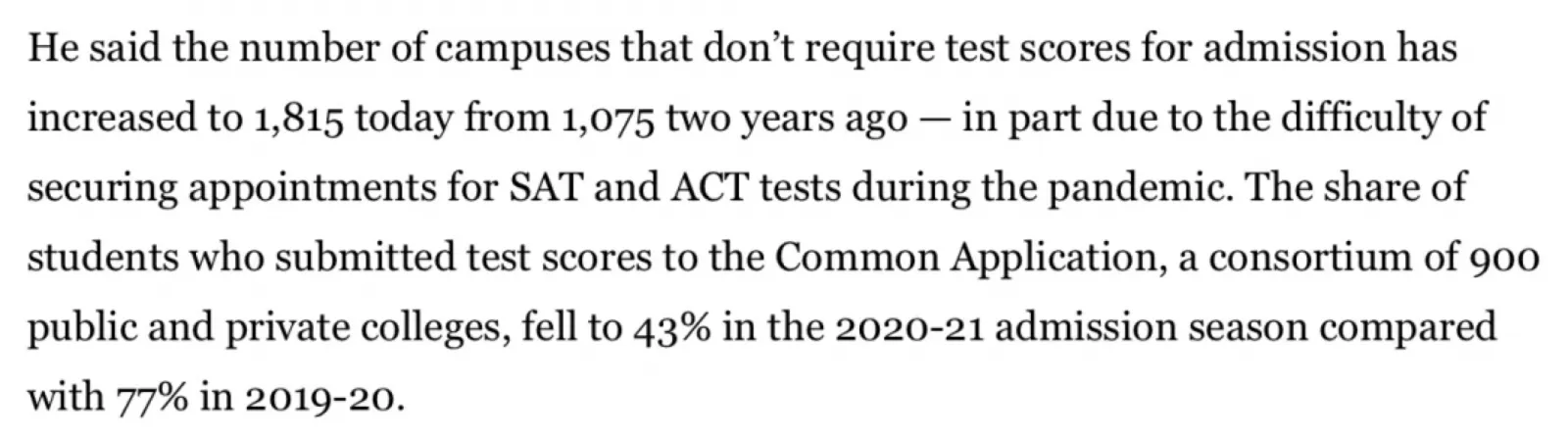
Since the pandemic, the importance of standardized tests in U.S. undergraduate admissions has been gradually fading. The number of colleges adopting test-optional policies has nearly doubled from 1,075 two years ago to 1,815 today. The percentage of students submitting standardized test scores via the Common Application also plummeted from 77% in the 2019-20 admissions cycle to 43% in 2020-21.
However, it remains to be seen how many colleges will continue test-optional policies after the pandemic. The UC system will be the first to take the leap.
Without SAT/ACT, What Will UC Admissions Look At?
As we all know, standardized tests used to be the threshold for U.S. undergraduate applications. Now that SAT/ACT and other standardized tests are completely eliminated, what will UC admissions evaluate?
UC admissions officers say there will be 13 criteria, primarily including:
-
GPA in A-G courses
-
Number, content, and performance in courses beyond the A-G basic requirements
-
Number and performance in UC-approved honors, AP, IB, and transferable college courses
-
Being in the top 9% of the class by the end of junior year
-
Quality of coursework planned or in progress during senior year
-
Academic performance relative to the educational opportunities available at the high school
-
Outstanding performance in specific subject areas
-
Superior performance in specific academic projects
-
Recent, significant improvement in academic performance as evidenced by GPA and quality of coursework
-
Special talents, achievements, or awards in extracurricular activities such as arts or athletics
-
Special projects completed through coursework or special school activities
-
Academic achievements shaped by life experiences and special circumstances
-
Location of school and home
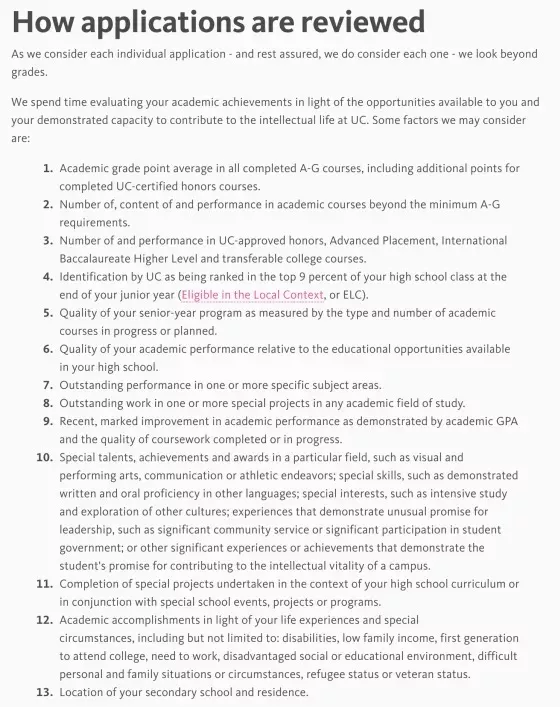
The UC system, without standardized tests or alternatives, still places great emphasis on evaluating applicants' academic abilities. But the focus will now shift to high school GPA and course rigor, including the number and grades of AP/IB/honors courses.
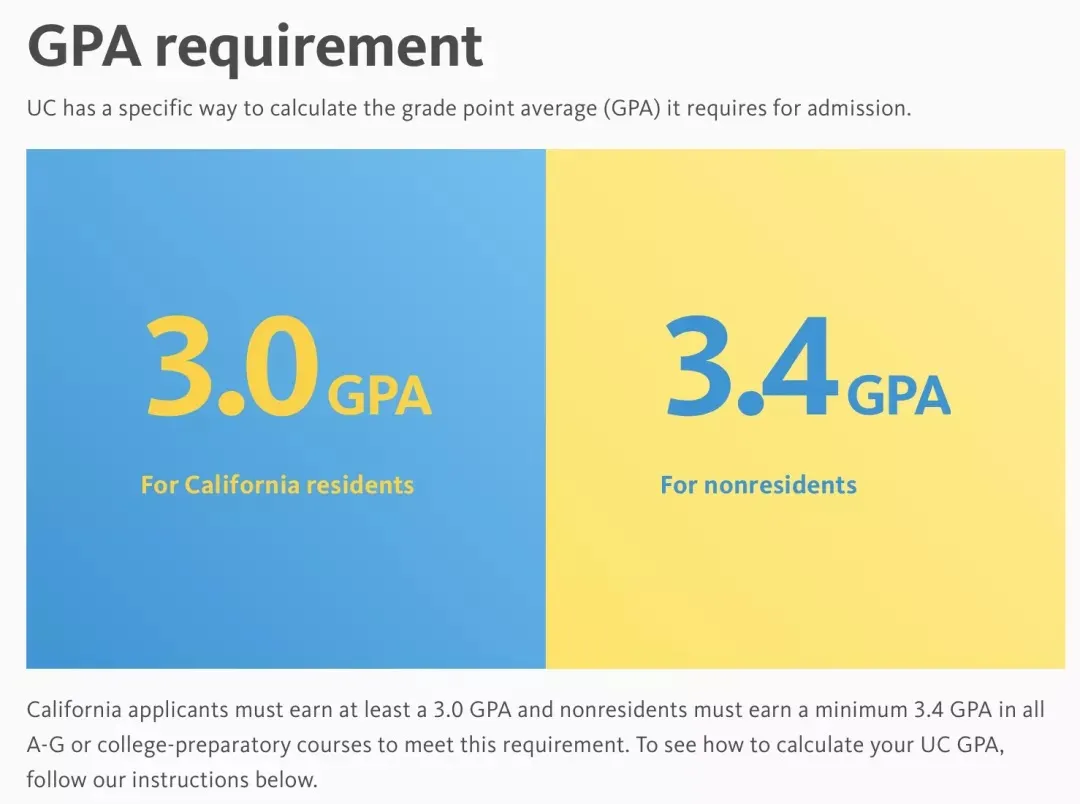
First, high school grades will become more important. The UC system requires out-of-state applicants to have a GPA of 3.4 or above:
Second, AP/IB/honors courses and grades will be even more crucial, becoming key academic factors in admissions.
These advanced courses demonstrate both academic interest and ability, as well as time management skills. UC admissions officers can assess an applicant's academic strength and future potential through their selection and performance in AP/IB/honors courses, factors that top U.S. colleges generally value.
In addition, most international students still need to submit English proficiency test scores, with UC requiring TOEFL 80, IELTS 6.5, or Duolingo 115:

Moreover, the importance of extracurricular activities and personal statements will increase. Valuable extracurricular activities, competition results, and other soft skills will help applicants stand out. The significance of personal statements goes without saying—they are the best opportunity for applicants to showcase their personality and strengths.
In short, with straightforward, uniform standardized test scores removed, applicants must demonstrate their advantages and uniqueness in other areas. It's hard to say whether UC applications without tests will truly become easier or more competitive.
With the elimination of tests and a surge in applications, many UC campuses saw lower admission rates compared to previous years. For instance, UC Berkeley, which had an admission rate around 16% in previous years, saw its rate drop to 14.6% for fall 2021.

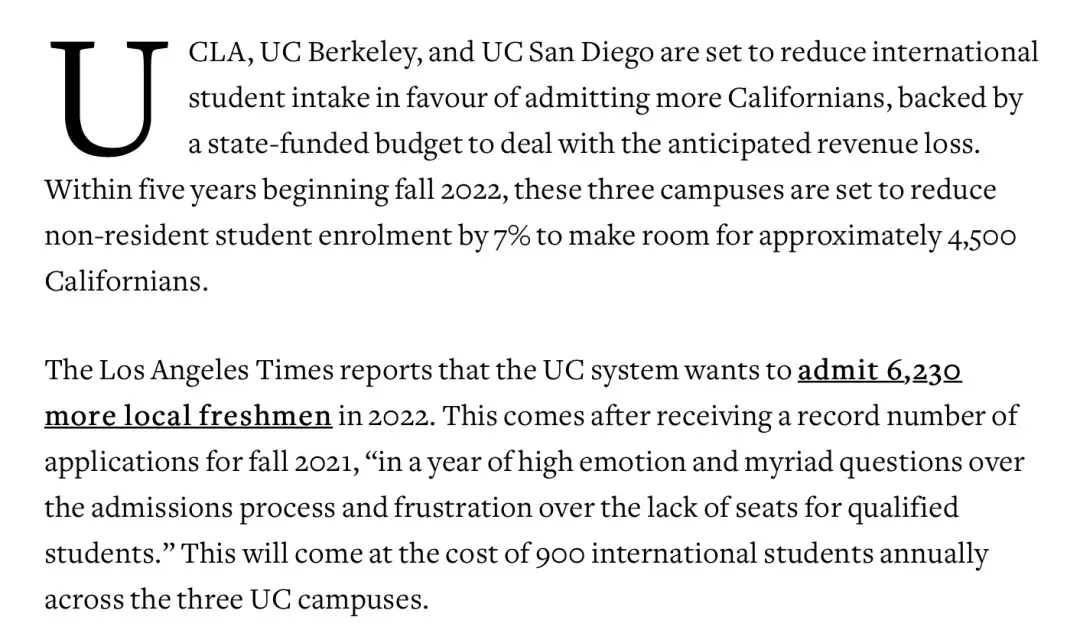
To make matters worse, under various pressures, the three most popular UC campuses—UCLA, UC Berkeley, and UCSD—plan to reduce international student admissions over five years starting from fall 2022, giving priority to in-state students. Out-of-state admissions are expected to decrease by 7%, freeing up about 4,500 spots for California residents.
Combining these policies, the outlook for international students is not particularly optimistic.
So, are there any shortcuts to get into a dream UC school? In fact, for students whose application competitiveness isn't very strong, transferring is another viable path.
Transferring to UC: Higher Admission Rates
Transfer Methods
First, let's go over two common ways to transfer to UC.
1. Inter-UC Transfer
Transferring from one U.S. university to another is a relatively common route. Students can first attend a less preferred university to improve their GPA and then apply for transfer to their dream school.
Transfers within the same university system, between different campuses, are often easier. Inter-UC transfers benefit from more lenient admission policies. Consider enrolling at a UC campus with a higher admission rate first, then transitioning to a more competitive UC school.
2. Transferring from Community College to UC
Transferring from a community college to a four-year U.S. university is also a common pathway. Nearly one-third of UC students transferred from community colleges.
California community college students find it easy to transfer to UC schools, with admission rates far higher than freshman admission rates and even higher than inter-UC transfer rates.
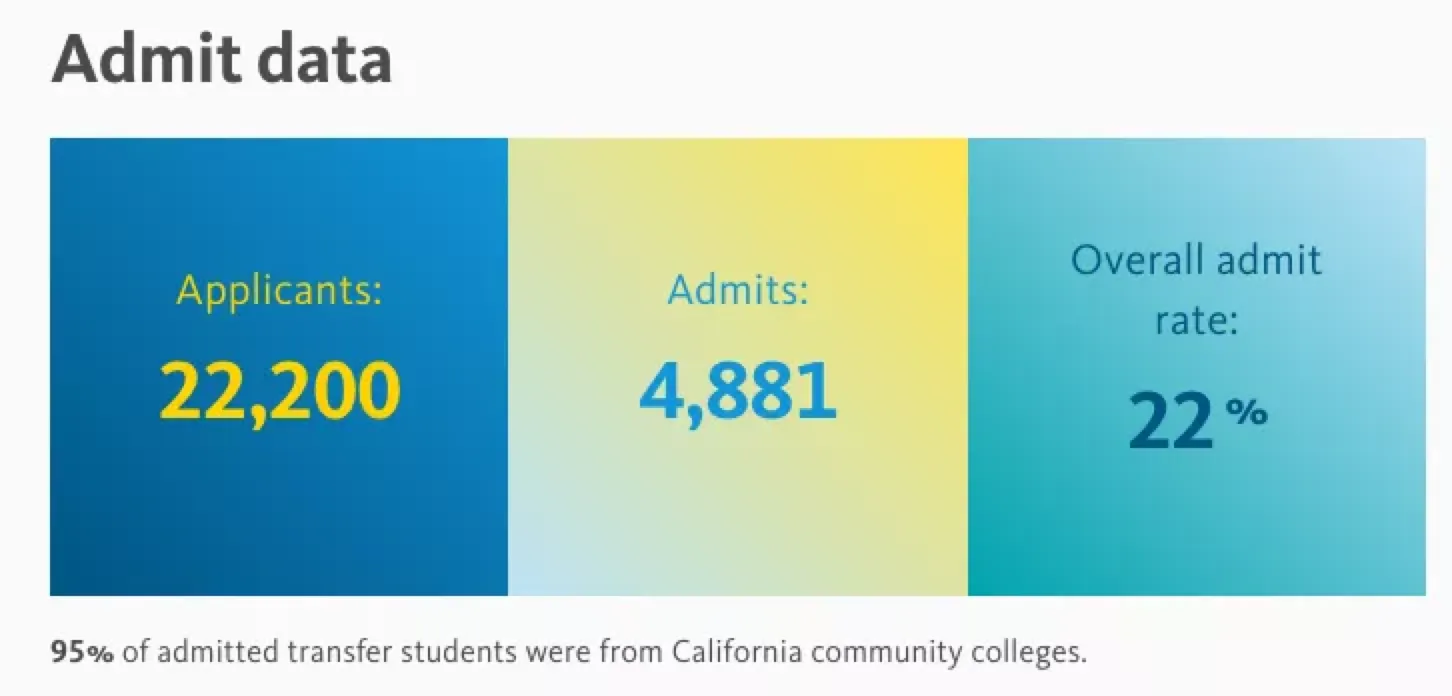
Take UC Berkeley as an example: its freshman admission rate for 2021 was 14.6%, while the transfer admission rate reached as high as 22%. Moreover, up to 95% of admitted transfer students came from California community colleges.
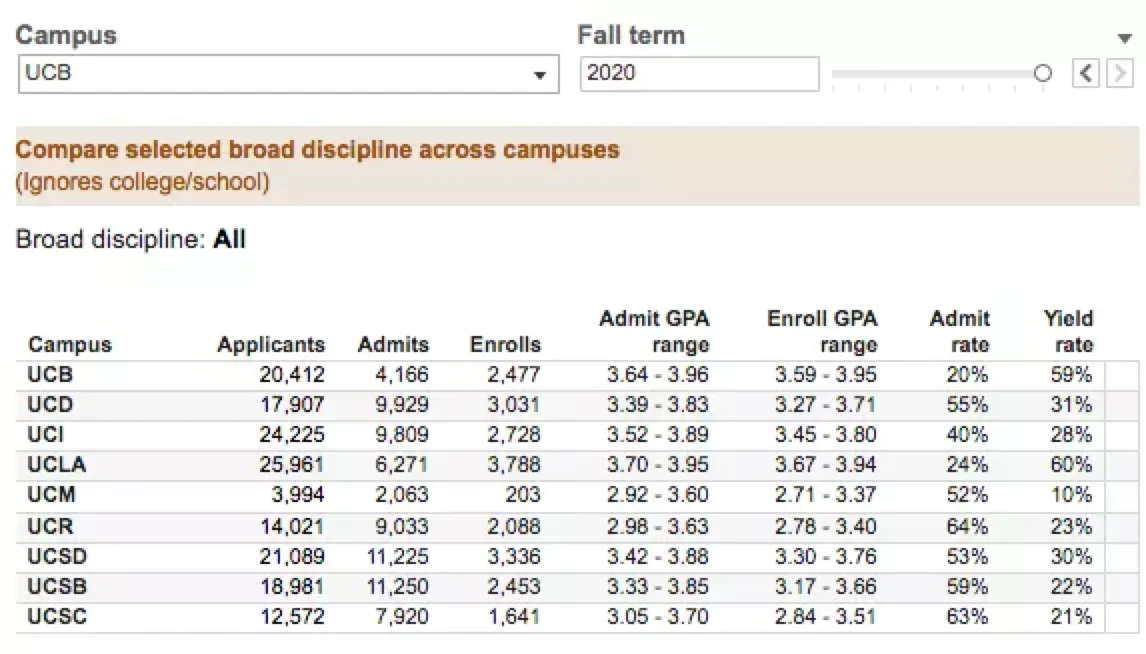
UCSD's transfer admission rate in 2020 was even higher, at 53%:
TAG Guaranteed Admission
Additionally, six UC campuses have Transfer Admission Guarantee (TAG) agreements with California community colleges. As long as applicants meet the minimum requirements, they are guaranteed admission to one of these six UC campuses:
-
UC Davis
-
UC Irvine
-
UC Santa Barbara
-
UCSC
-
UC Riverside
-
UC Merced

GPA requirements vary slightly by campus but generally require a 3.0 or above. However, higher-ranked campuses like UCI and UCSB may require a higher GPA, around 3.4 or above. See the table below for details:
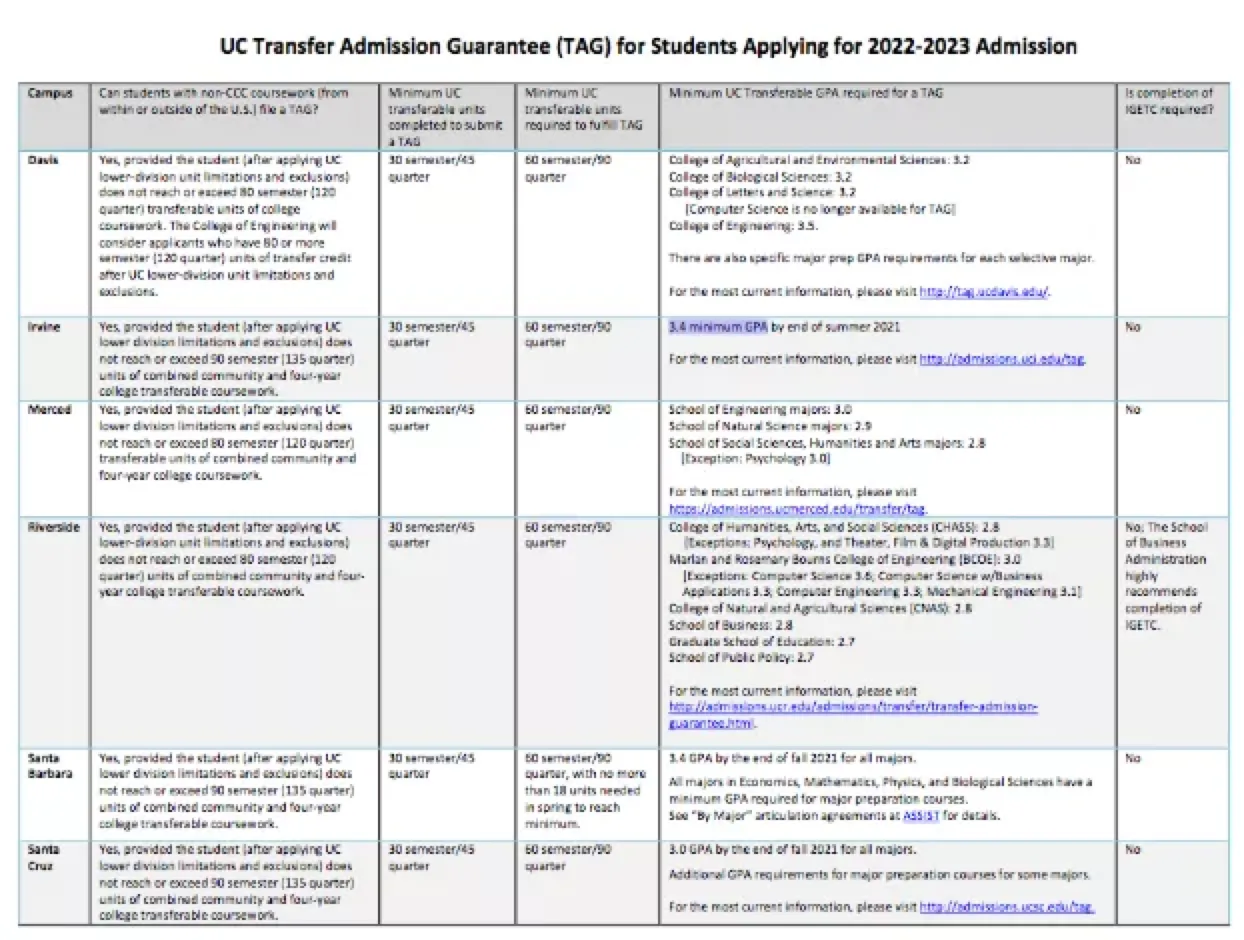
Note that some majors at certain UC schools do not participate in the TAG program, such as Business Administration at UCI and all majors in the College of Engineering at UC Santa Barbara.
Overall, transferring from a California community college to a UC campus offers relatively high chances. For students whose academic and overall qualifications do not yet meet the mark but who are eager to attend a top UC school, this can be a strategic stepping stone.
The fall freshman and transfer application deadlines for the UC system are both at the end of November. Best of luck to everyone in preparing well and securing that dream school offer!