
Recently, the 2022 Risk.net Global Quantitative Finance Master's Ranking has been freshly released!
Princeton University once again tops the list, with Imperial College London ranking first in the UK. Compared to last year, NYU suffered a sharp decline. And the biggest dark horse in this year's RiskNet ranking is surprisingly JHU.

Financial engineering and financial mathematics have always been among the most popular programs for international students, especially those in science. As an interdisciplinary field combining business and engineering, it carries labels such as "popular," "high-paying," and "tech-focused."
Whether abroad or domestically, there is an insatiable demand for top talent in these fields. There are countless excellent STEM-designated programs in the US, which can make choosing a school a real headache.

When making a choice, you need to consider graduation salaries, employment situation, school program rankings, and also program acceptance rates. Where on earth can you find all this information?
The latest RiskNet ranking has also done the analysis and summary for everyone!
Is the RiskNet Ranking a "Fraud"?
Many people may not be very familiar with the RiskNet ranking. When it comes to rankings for financial engineering programs, they only recognize QuantNet and consider other rankings to be "fake." In fact, RiskNet, like QuantNet, is a highly authoritative ranking.

As a world-leading news media, RiskNet is dedicated to providing in-depth news reporting and analysis in the fields of risk management, financial derivatives, and regulation. The list compiles the best financial engineering programs at global universities.
The RiskNet ranking also includes statistics on each school's acceptance rate, employment rate, and salary, making it a good reference for applications.
2022 RiskNet Ranking Criteria
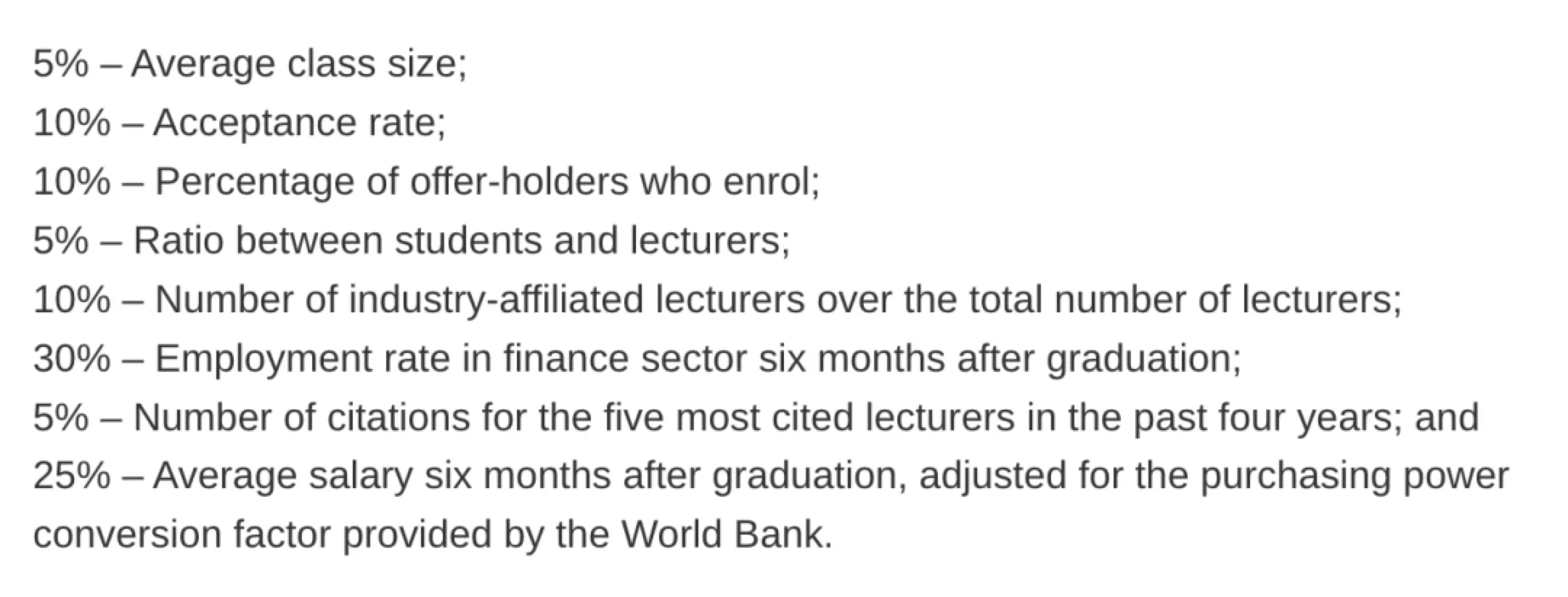
· 5% - Average class size
· 10% - Acceptance rate
· 10% - Percentage of offer holders
· 5% - Student-to-faculty ratio
· 10% - Percentage of lecturers with industry links over total lecturers
· 5% - Top five most cited graduates in the last four years
· 30% - Employment rate in the financial sector six months after graduation
· 25% - Average salary six months after graduation, adjusted by purchasing power parity conversion factors provided by the World Bank
RiskNet also places great emphasis on the employment data of master's programs, with employment-related criteria accounting for up to 55%.
2022 RiskNet Financial Engineering/Financial Mathematics Ranking
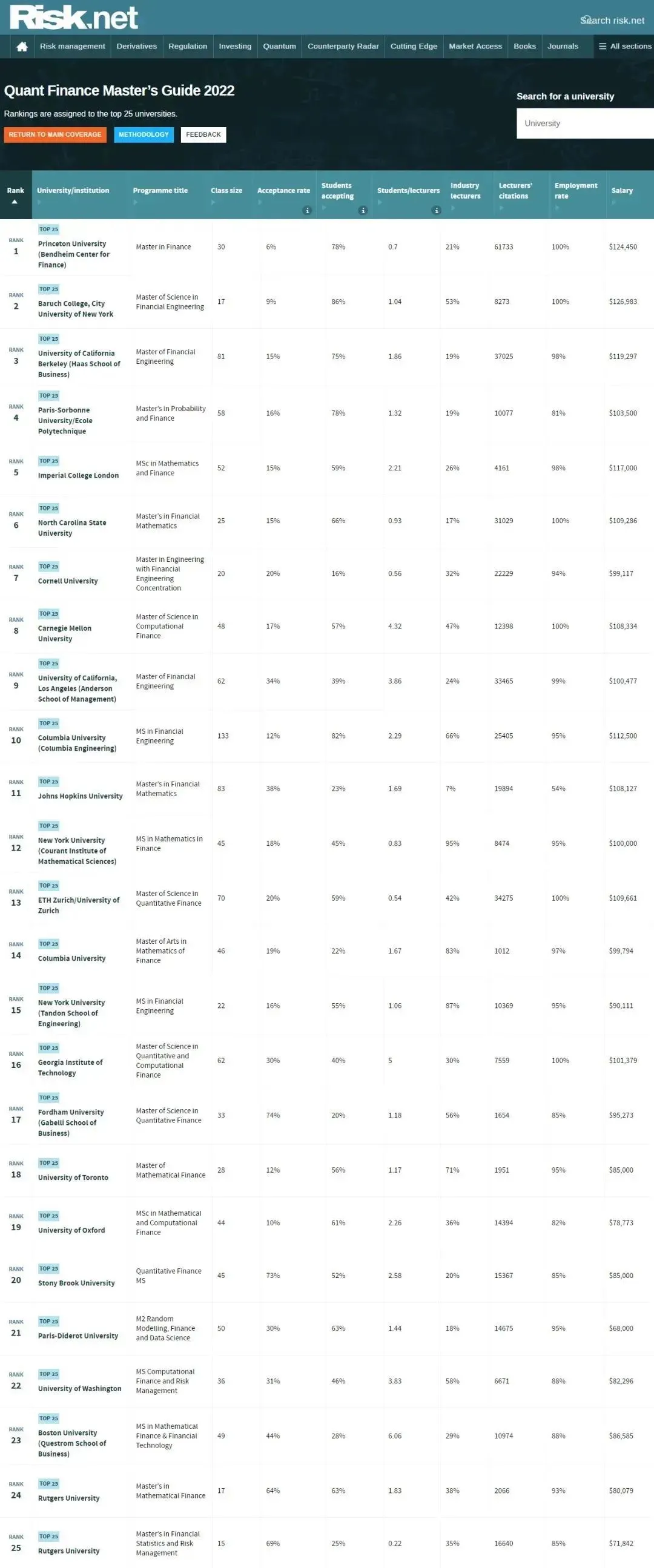
Like QuantNet, this year's RiskNet ranking selected only 25 schools.
We can see that Princeton University continues to top the list, with an employment rate of 100%, having been the champion of the RiskNet ranking for many years. The program has many applicants, and its acceptance rate is the lowest among all, at only 6%.
Similarly, with a 100% employment rate, Baruch College, which has long held the top spot on QuantNet, ranks second in this list. Imperial College London ranks fifth globally, first in the UK, leaving Oxford more than ten places behind. "I'm better than Oxford, no problem."
UC Berkeley, Imperial College London, Cornell, and Carnegie Mellon also made strides, each rising two places from last year. UCB also achieved a high second place in this year's QuantNet ranking.
Although JHU only ranked 23rd on the 2022 QuantNet list, it is undoubtedly the dark horse of this year's RiskNet ranking! After being unranked for the past two years, it has suddenly soared to 11th place, surpassing NYU and Columbia!
Meanwhile, NYU, which had a "double celebration" by entering the top ten in both financial engineering and financial mathematics on the 2022 QuantNet ranking, had been in the top three in previous years, but this year unexpectedly dropped nine places out of the top ten, landing at 12th. Rankings are so unpredictable.
Differences Between QuantNet and RiskNet Rankings
As authoritative rankings, the biggest difference between QuantNet and RiskNet is that RiskNet compiles global master's programs in financial engineering and financial mathematics, while QuantNet ranks only U.S. programs in these fields.
Both the QuantNet and RiskNet rankings actually center around data in three main areas:
Admissions Program Career
That is, admissions, program, and career. In fact, the two rankings this year assigned almost identical weights to these three aspects.
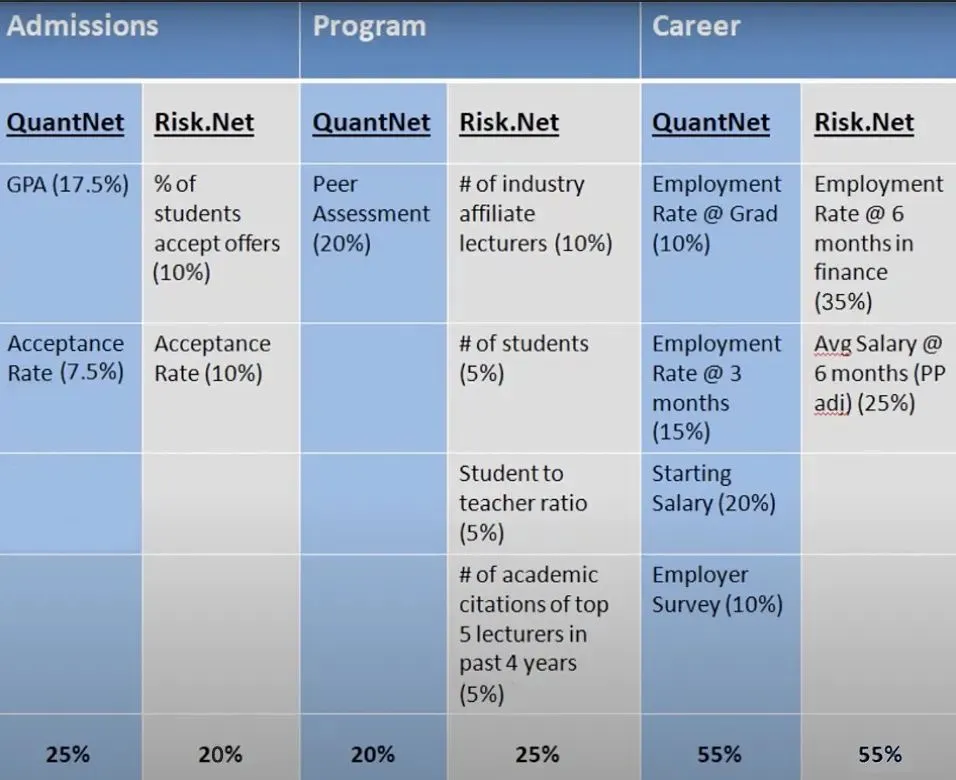
It can be seen that the two rankings differ by only 5% in the weighting of Admissions and Program, and both place great importance on employment data, with a 55% weighting. Both lists summarize graduation salaries and employment rates.
In comparison, QuantNet focuses more on admissions data, especially the standardized test scores of admitted students, such as average GPA and GRE scores.
(*Due to the impact of the pandemic, some MFE programs adopted a GRE optional policy, so the 2022 Quant ranking criteria temporarily excluded the GRE weight.)
RiskNet, on the other hand, leans more towards student acceptance and enrollment rates in this area. One reason for NYU's sharp decline this year is that its student enrollment rate dropped significantly compared to last year.
For program data, RiskNet breaks it down in more detail, including the student-faculty ratio, which provides a clear picture of the class sizes at different schools and offers good reference value.
Program rankings are only a reference for applicants when making choices, and each ranking has its own emphasis. There is no need to overly focus on a single ranking or rely too heavily on rankings to the point of getting stuck, as this is an improper over-reliance on rankings.
Rather than the simple rankings, what deserves more attention are the data summaries provided in the rankings, such as each school's acceptance rate, average scores, employment rate, graduation salary, program student-faculty ratio, etc.
By further analyzing these data, selecting the school that best matches your actual situation and personal goals is the true meaning these rankings bring to us.
Finally, no matter what program or school you are applying for, we still hope everyone will start early to get a head start! Especially for these well-known strong programs, the competition is fierce at every school. Be sure to start preparing as early as possible so that you can receive your dream school's offer sooner!