
In this period of recurring pandemic challenges, data analysis has provided effective support in addressing biomedical problems, bringing more possibilities and opportunities to the global healthcare industry. Biostatistics is undoubtedly set to excel in this field, becoming a hot research topic.
Georgetown University, a world-renowned top private research institution located in the heart of Washington, D.C., has nurtured countless leaders and scholars.
The standout Biostatistics (Biostats) master's program at GU is also drawing considerable attention this application season.
Program Overview
1. School Introduction
Georgetown University, founded in 1789 by the Society of Jesus, has its main campus, medical school, and law center located in Washington, D.C., the capital of the United States.
Georgetown University ranks 23rd in the 2022 U.S. News Best Colleges rankings. Its School of Foreign Service is the oldest of its kind in the United States. Georgetown is also considered one of the most selective universities by U.S. News and one of the most favored by Wall Street.
2. Program Introduction
Biostatistics is derived from biology and involves statistics through the accumulation, tracking, analysis, and application of data. Biostatistics is commonly used in large-scale work such as drug testing and environmental modeling. Many pharmaceutical companies heavily rely on biostatistics to track and examine data, and to provide recommendations for experimental drugs based on these findings.
The Biostatistics master's program at Georgetown allows students to specialize in cancer biostatistics, bioinformatics, or epidemiology. Its curriculum includes core methodology, a distinctive research practicum (providing experience in exploring quantitative problems in biomedical research), and bi-weekly seminars with national and international experts in the field.
This program is STEM-designated, offering graduates up to 3 years of OPT.

3. Program Duration
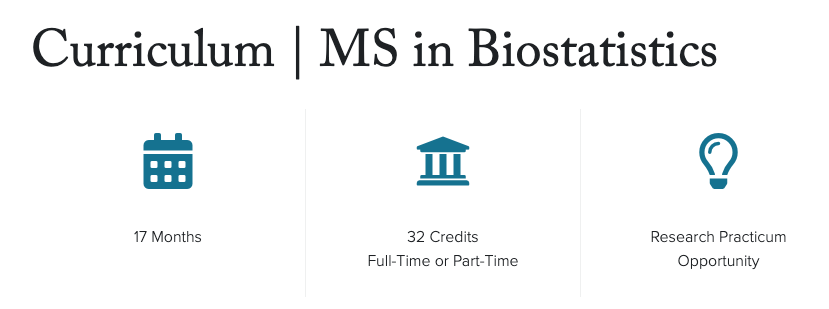
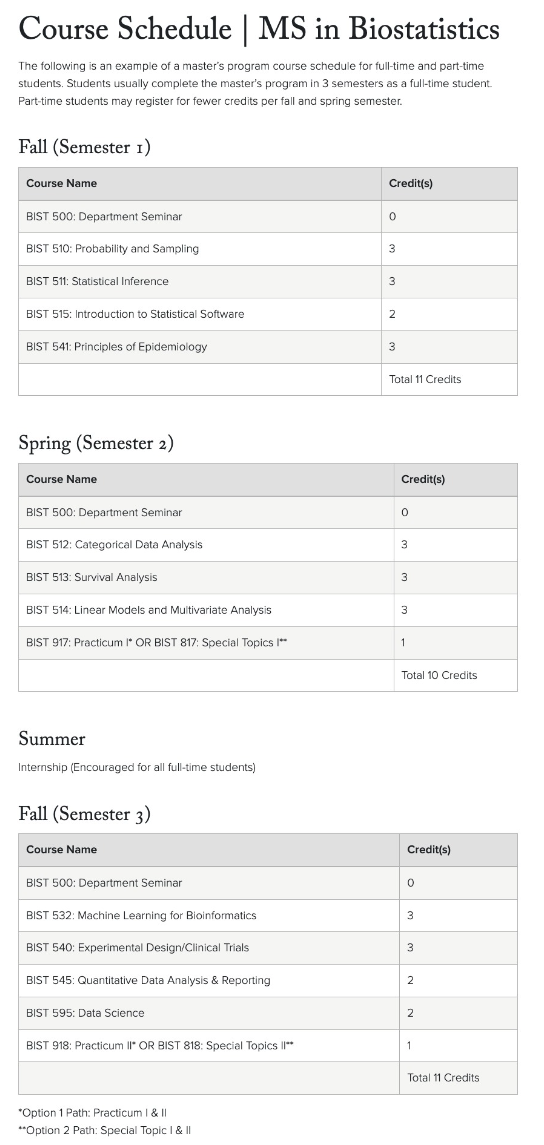
This program takes approximately 17 months (three semesters) and requires the completion of 32 credits. Both full-time and part-time study are available.
First semester: Students will learn foundational theoretical knowledge.
Second semester: Students will study statistical methodology.
Third semester: Students will learn how to apply these methods in practice.
4. Application Deadlines
Fall Admission:
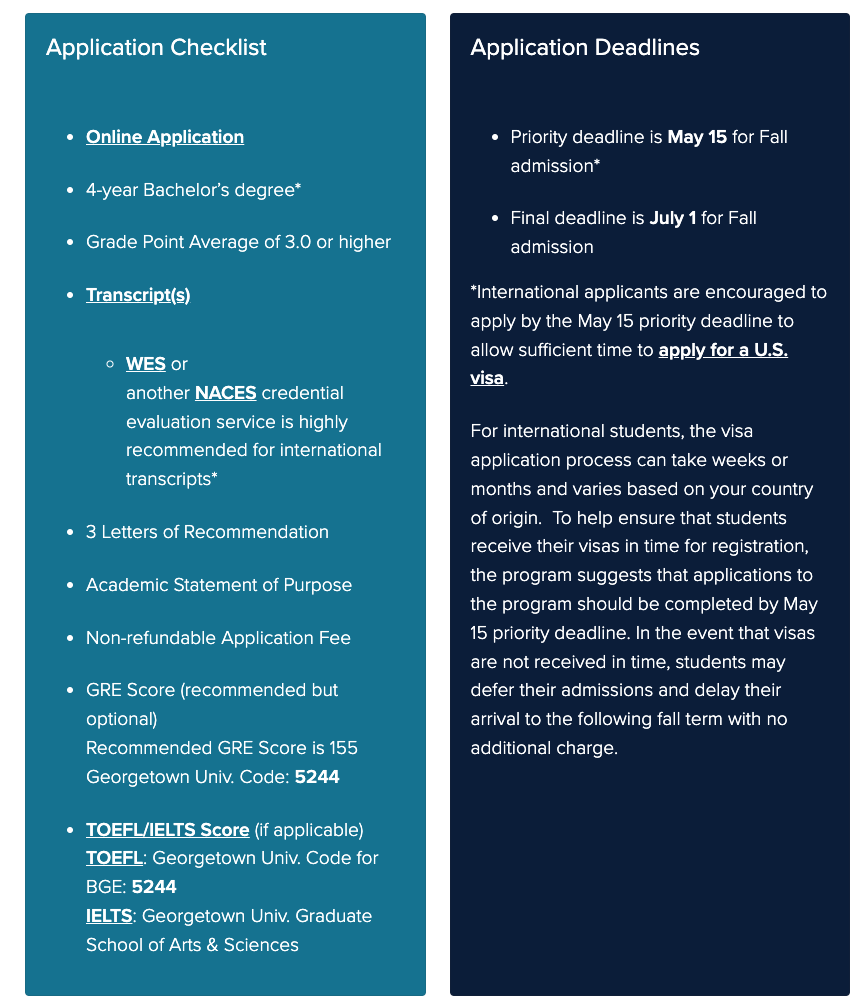
Round 1: Submit by May 15
Round 2: Submit by July 1
(* To prevent international students from missing U.S. visa processing, it is recommended that they submit their application by the Round 1 deadline!)
5. Basic Application Requirements
- Submit application online
- Hold a 4-year bachelor's degree
- GPA of 3.0 or higher; official transcripts required, with WES or NACES evaluation for international students
- Three letters of recommendation
- One personal statement (Statement of Academic Purpose)
- Submit GRE (optional but recommended), TOEFL/IELTS (if applicable)
6. Program Tuition
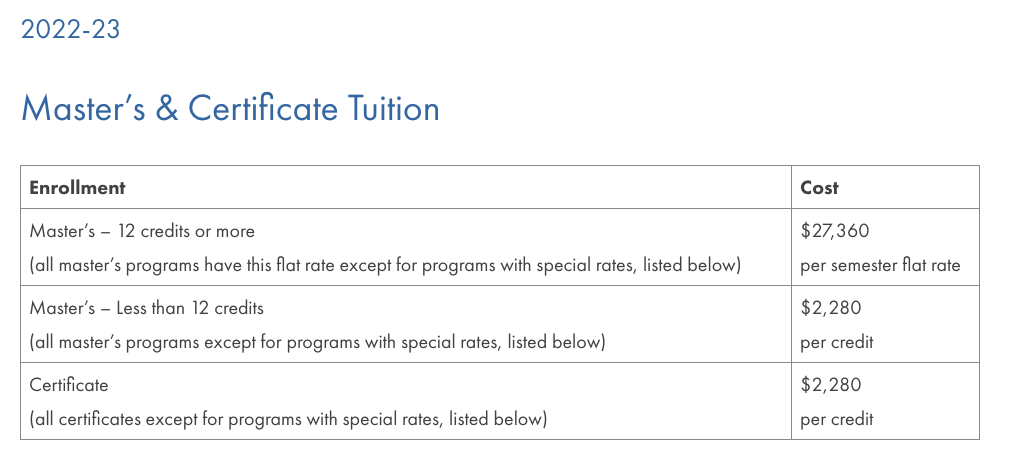
For the 2022-23 academic year, the total master's program cost is $82,080.
If taking 12 or more credits per semester, the flat tuition rate is $27,360 per semester; if taking fewer than 12 credits or enrolling as a non-degree student, the rate is $2,280 per credit.
Curriculum & Program Highlights
1. Curriculum Requirements
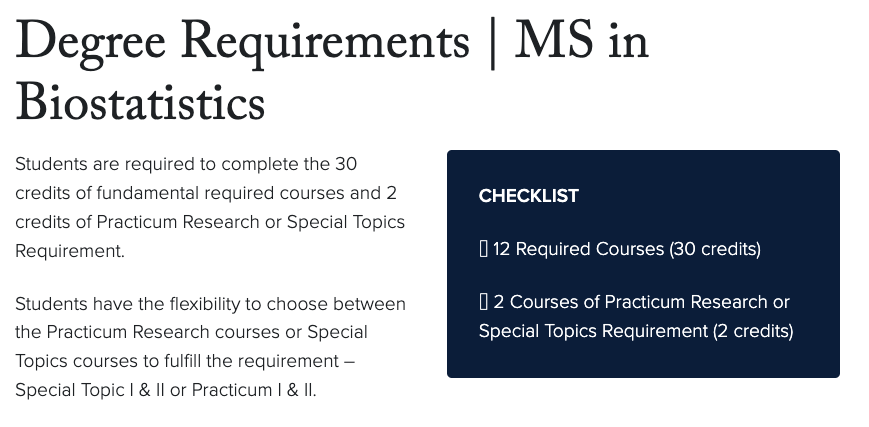
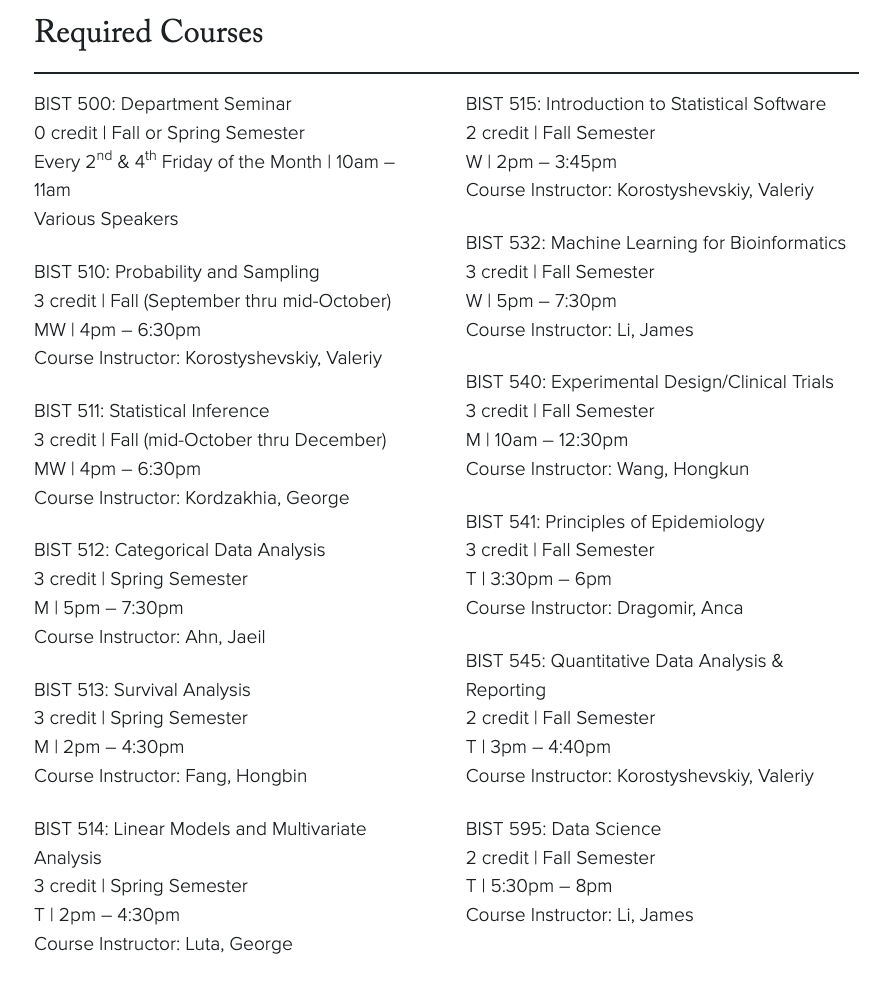
Students must complete 30 credits of core courses and 2 credits of practicum research or special topics.
Students will participate in bi-weekly seminars and learn statistical methods (including software applications, probability and sampling, statistical inference, experimental design, data analysis, linear and multivariate analysis, etc.) as well as medical and pharmacological knowledge (such as bioinformatics, clinical trials, epidemiology principles, and survival analysis).
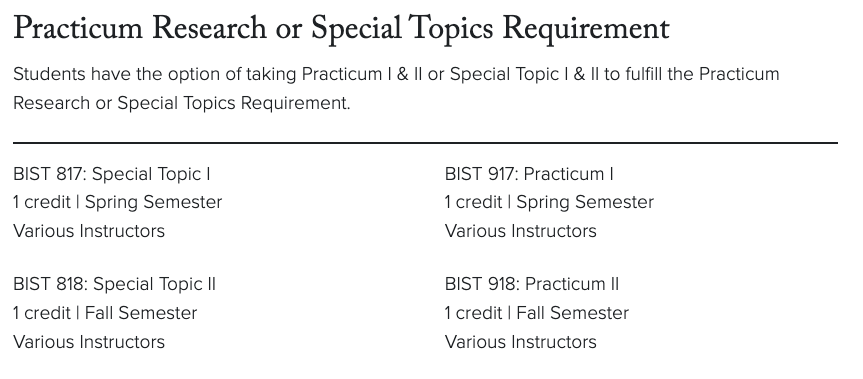
For the 2-credit practicum, students can choose from the following to fulfill the Practicum Research or Special Topics requirement.
Below is a recommended sample schedule for the master's program:
2. Program Highlights
"Research Practicum"
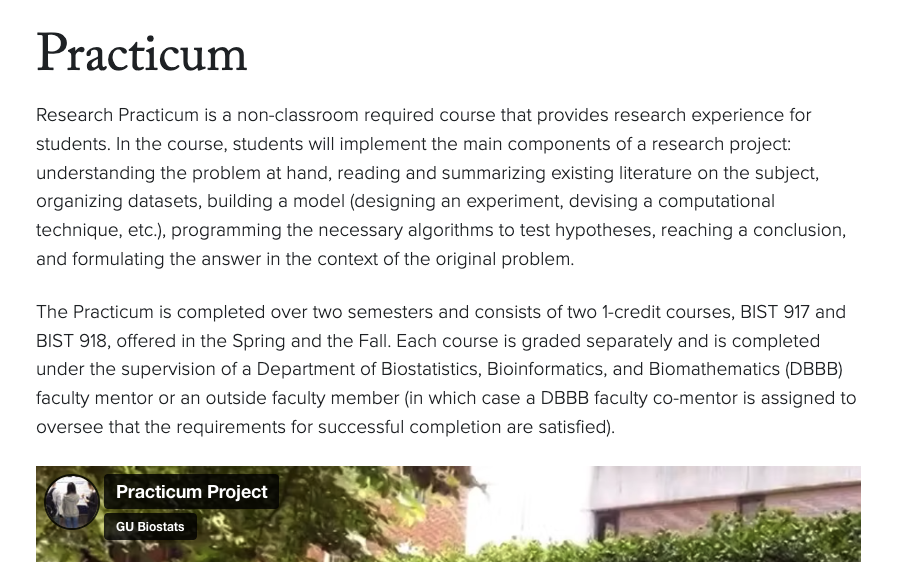
This is a lab course that provides students with research experience and is a required course before graduation.
The course offers students an opportunity to integrate the skills they've learned and apply them in a constrained environment, thereby gaining practical experience and new techniques while also enhancing their communication and teamwork abilities.
During the course, students will practice key components of a research project, such as: understanding the problem at hand, summarizing existing literature on the topic, summarizing dataset construction, and programming necessary algorithms to generate results, among others. The most important part of this class is exposing students to techniques not typically covered in standard courses.
Upon graduation and in subsequent employment, students may need to venture beyond their "comfort zone," where the usual curriculum may fall short. Learning new techniques helps them solve non-standard problems in innovative ways. Moreover, the research experience not only supplements regular coursework but also enriches students' quantitative worldview.
"Graduate Research Assistant"
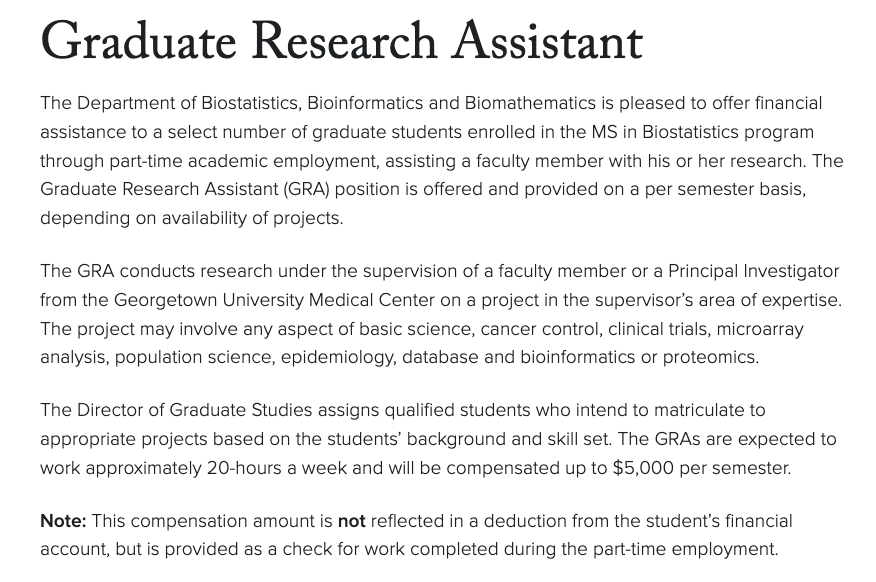
Georgetown's Department of Biostatistics, Bioinformatics, and Biomathematics offers students financial support through part-time academic work assisting faculty with research. GRA positions are offered each semester based on project availability.
GRAs conduct research on a project within the supervising faculty member's or principal investigator's area of expertise. This may involve basic science, cancer prevention, clinical trials, microarray analysis, population science, epidemiology, databases, and bioinformatics.
GRAs are expected to work 20 hours per week and will receive a stipend of up to $5,000 per semester.
Faculty
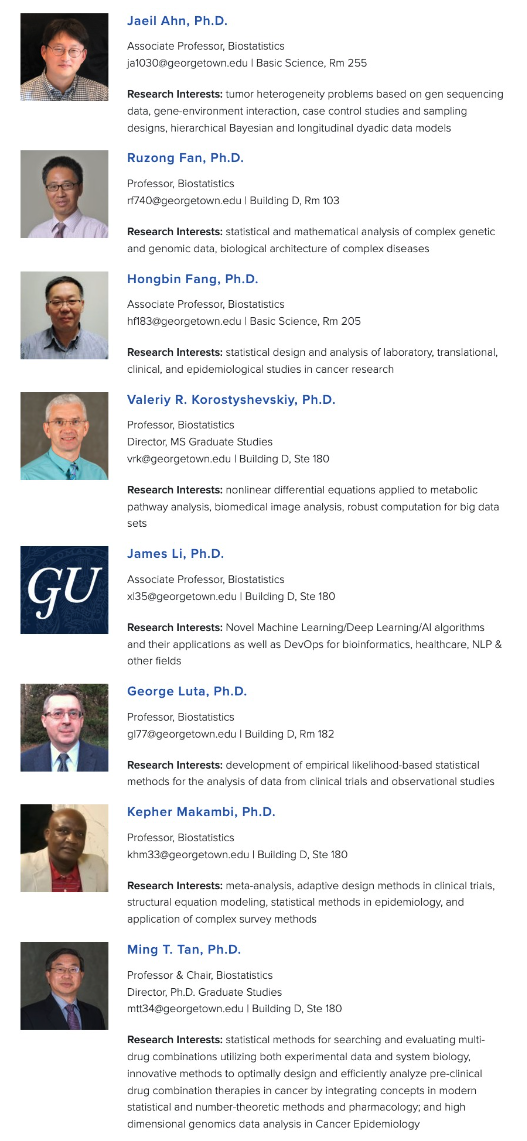
The faculty for Georgetown's Biostatistics program is also very strong. Professors' backgrounds span statistics, mathematics, biology, computer science/informatics, medicine, and various other fields, providing students with solid academic support.
Career Outcomes
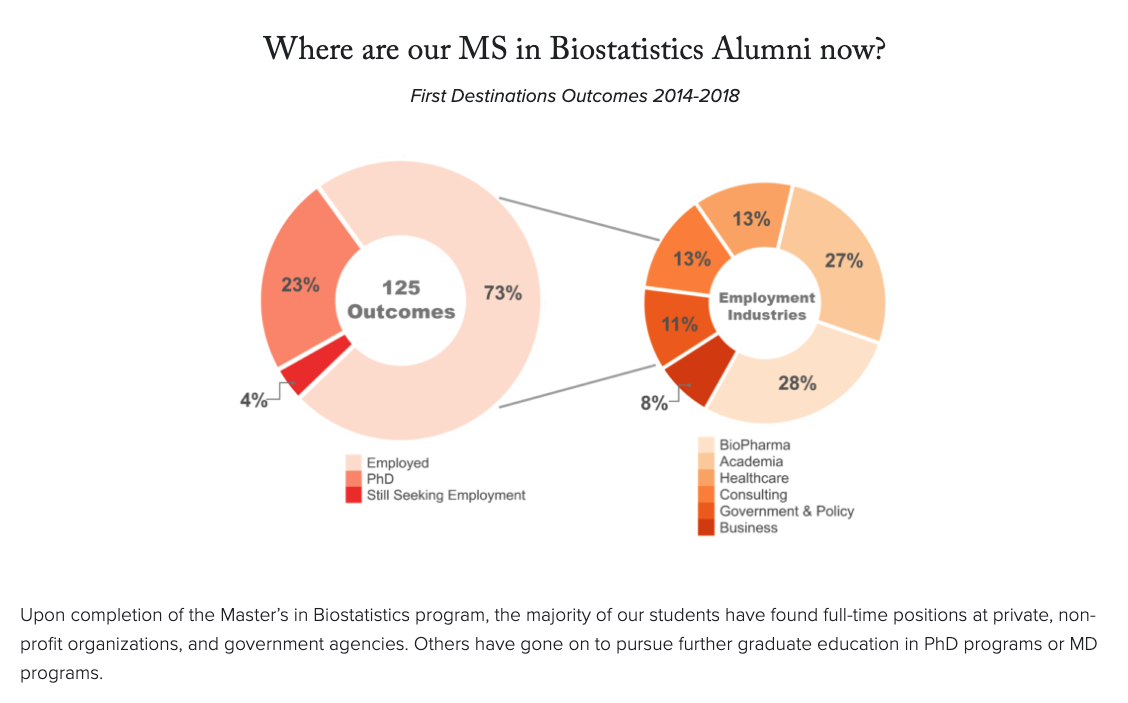
From 2014 to 2018, among graduates of Georgetown's Biostatistics master's program, only 4% were still seeking employment, 23% pursued further studies in PhD programs, and the rest found jobs.
Among those employed, 28% work in biopharmaceuticals, 27% in academic research, 26% in healthcare and health consulting, with the remainder working in government and business.
Most students found full-time positions at nonprofits, private companies, or government agencies, while others pursued further education in the field.
Who Is It For?
As humanity faces recurring viral crises, the biomedical field will inevitably gain more importance, and healthcare big data will become increasingly critical.
Biostatistics encompasses not only biology but also statistics, requiring strong logical thinking and memory. It is generally recommended for applicants with a strong quantitative and mathematical background.
This program is 1.5 years long, shorter than many other biostatistics programs, and offers ample internship opportunities to help students quickly adapt to practical work. For those looking to complete their degree quickly and then enter the biopharmaceutical or healthcare consulting fields or pursue further academic studies, Georgetown's Biostatistics master's program is an opportunity not to be missed!