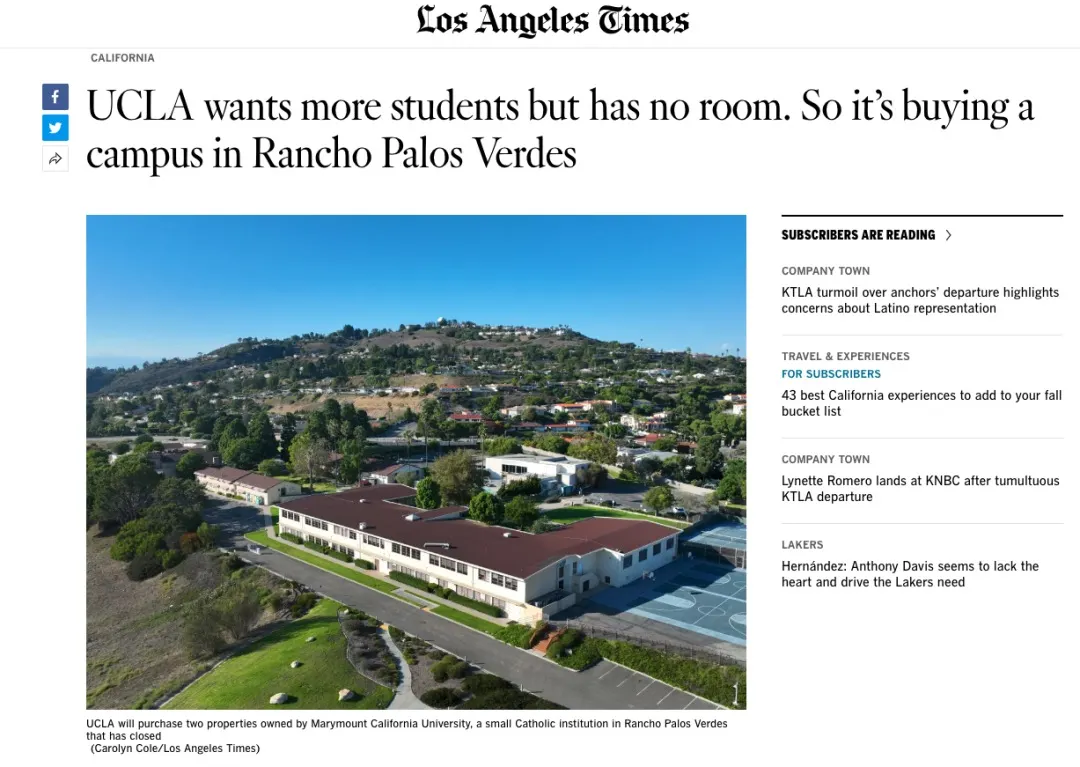
On September 22, the University of California Board of Regents approved UCLA's proposal to purchase two properties for $80 million—located in Rancho Palos Verdes and San Pedro.
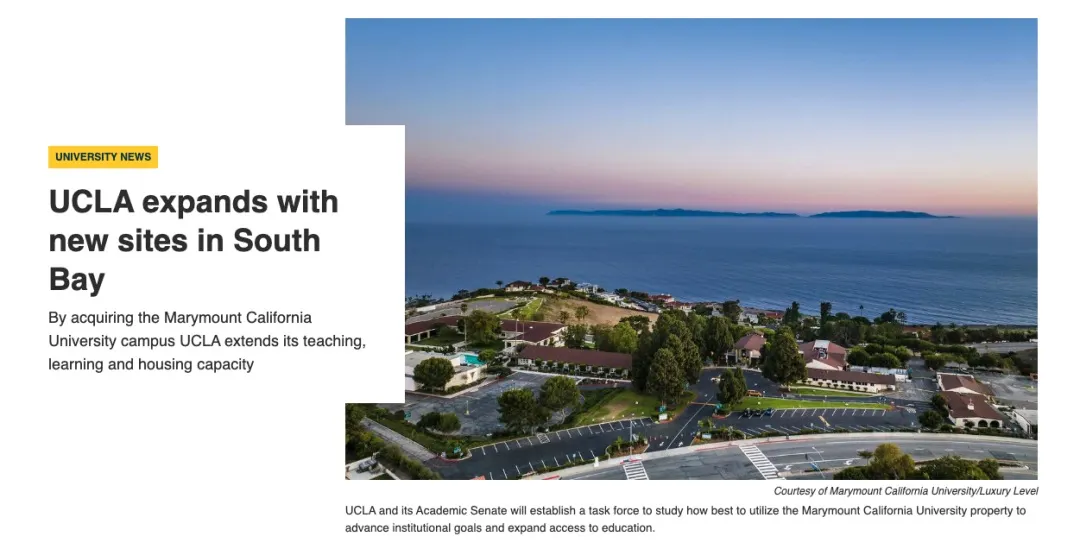
The two parcels originally belonged to Marymount California University. Due to rising costs and declining enrollment rates in recent years, that institution decided to cease operations in April after deliberation.
So, what does this expansion by UCLA signify?
New Campus Can Accommodate 1,000 Students
This move is also UCLA's most significant expansion to date, and the primary reason behind it is to enroll more new students.
According to admission data released by the UC system, UCLA's admissions office received a total of 149,779 freshman applications in 2022, while only 12,825 freshmen were ultimately admitted, resulting in an overall acceptance rate of just 8.6%. One of the main reasons for the enrollment squeeze was the limited resources of the school.
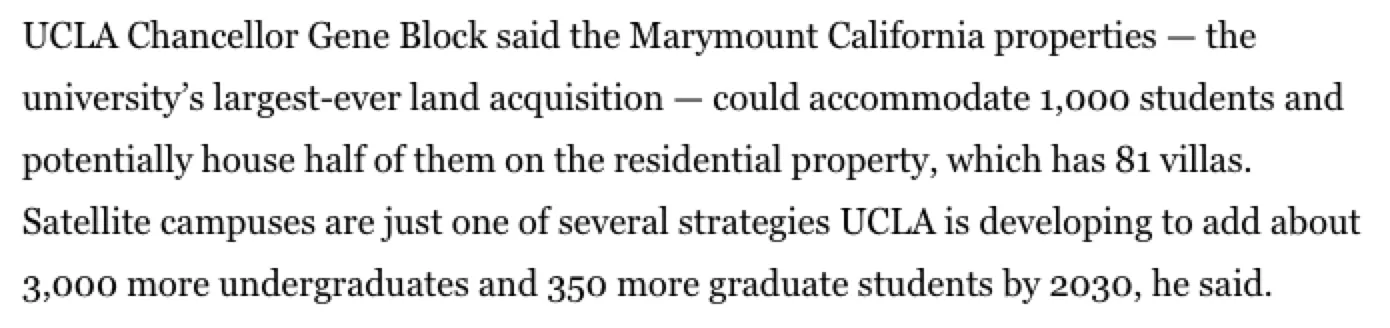
This campus expansion is also meant to cope with the increasingly fierce application landscape. The newly acquired land totals 35.5 acres and is expected to accommodate 1,000 students, thereby meeting the academic, work, and living needs of more students and faculty.

Expansion in Response to the UC 2030 Plan
Meanwhile, UCLA Chancellor Gene Block stated in an interview that this expansion also actively responds to the University of California's 2030 Plan. UCLA plans to add 3,000 undergraduate students and 350 graduate students by 2030.
So, what is the UC 2030 Plan?
Recognizing that the total number of applicants to the University of California has been soaring in recent years, the leaders of the nine UC campuses jointly formulated the UC 2030 Capacity Plan under the impetus of local government: the goal is to expand enrollment by about 20,000 students by 2030 (ideally up to 33,000 students).
In this policy, the UC official website explicitly states that this expansion is exclusively aimed at California residents. Under the 2030 Plan, the UC system will also begin to reduce the admission of non-resident students, which includes out-of-state students and international students.
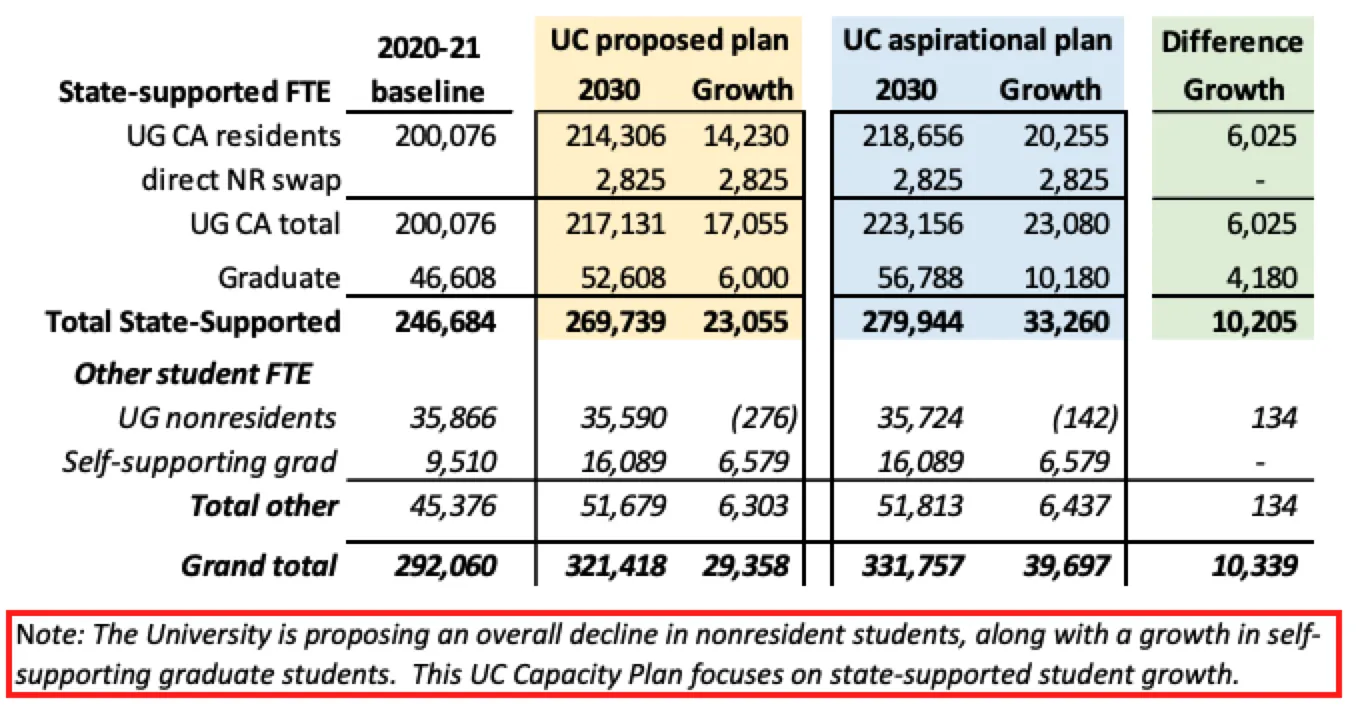
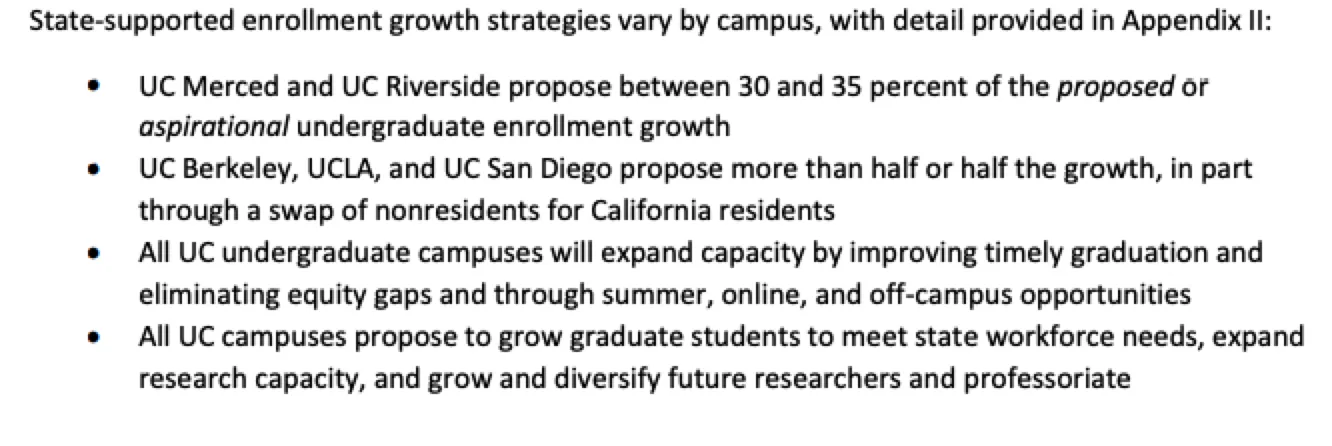
Moreover, UCLA and UCB have clearly stated that they will use alternative admission methods to admit more California residents, thereby increasing overall enrollment numbers.
What Does the New Policy Mean for International Students?
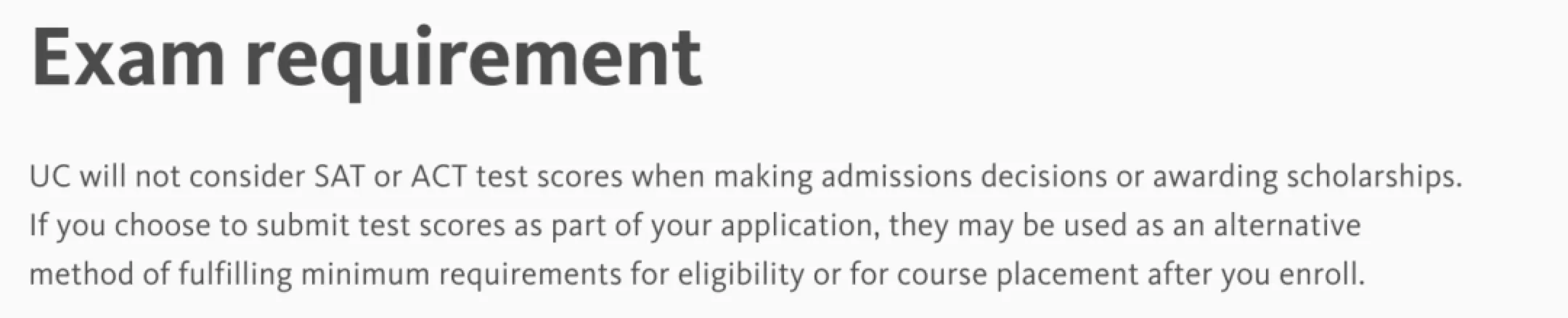
Since the UC system announced the elimination of the SAT/ACT requirement in 2020, the number of undergraduate applicants has risen sharply each year.
However, as a public university system constrained by limited on-campus resources, admission standards have become increasingly stringent, and acceptance rates have declined year after year, even hitting new lows in recent years.
Even more disheartening, the number of admitted out-of-state and international students continues to decrease. UCLA's expansion policy also seems to offer no substantive benefit to international students.
For international students aiming to enter the UC system for undergraduate studies in the future, every step of the application process must be taken with care.
What Kind of Students Does UC Hope to Admit?
The UC admissions office clearly states on its website that it evaluates each application based on 13 criteria, not just the student's GPA.
The school comprehensively assesses an applicant's academic performance by considering the resources and opportunities available to the student as well as the abilities demonstrated.
Here are the 13 review criteria from UC Admission:
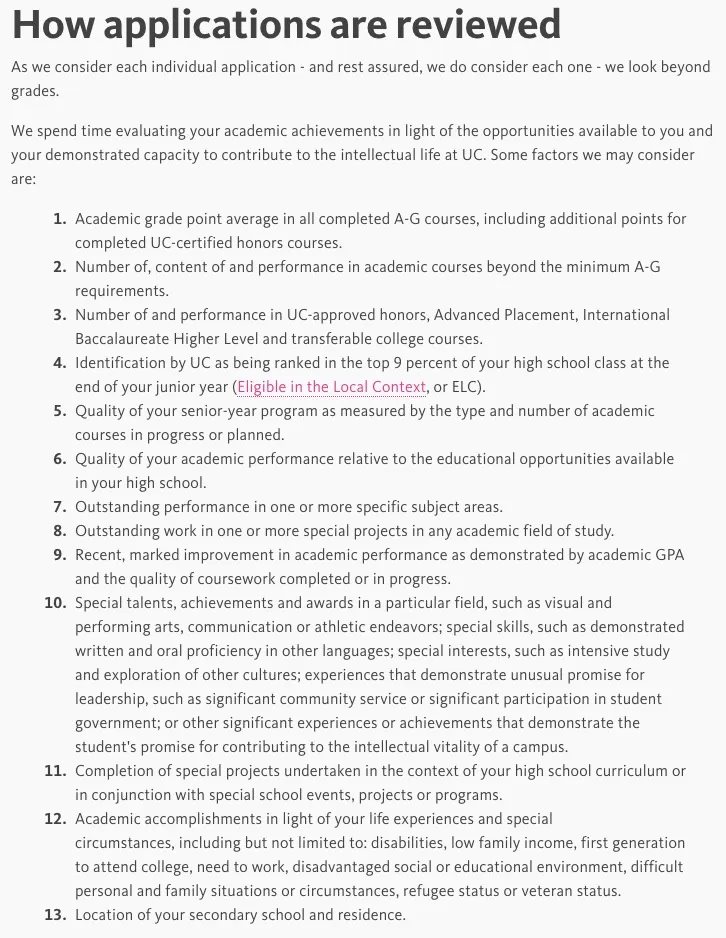
1. Average grade in completed A-G courses, i.e., GPA
2. Number and difficulty of courses taken beyond the A-G requirements
3. UC-approved honors courses, Advanced Placement, International Baccalaureate higher-level courses, etc.
4. Ranking in the top 9% of the class by the end of junior year
5. Planned coursework and rigor for the 12th grade
6. The relationship between your school's academic context and the educational opportunities available at your high school
7. Outstanding performance in specific academic fields
8. A special academic achievement or award
9. Significant recent academic improvement or progress
10. Special talents, achievements, or awards in a particular field
11. Completion of special projects or participation in special school activities
12. Ability to overcome challenges based on life experiences and special circumstances
13. Location and environment of your school
Based on these criteria, after the elimination of SAT/ACT scores, UC will place greater emphasis on students' high school academic achievements and the presentation of their overall profile, including GPA, course rigor, extracurricular activities, essays, and other application materials.
Furthermore, each UC campus evaluates applications independently and does not consider the admission decisions of other campuses when reviewing an applicant. Therefore, the preparation of application materials must be even more meticulous and comprehensive.
The review mechanism for transfer students is somewhat different from that for freshmen. For freshmen, UC focuses on overall ability, while for transfer students, UC places greater emphasis on professional competence.
As a public university, many decisions made by UC are inevitably influenced by the local political environment—a harsh reality.
With UC application competition intensifying day by day, whether you are a freshman applicant or a transfer applicant, it is advisable to plan early, prepare early, enhance your own capabilities, and make effective use of resources in order to remain competitive.