"HK Top 3" refers to the three universities at the pinnacle of Hong Kong's higher education: the University of Hong Kong (HKU, founded in 1911, ranked 21st in the world), the Chinese University of Hong Kong (CUHK, founded in 1963, ranked 38th in the world), and the youngest, the Hong Kong University of Science and Technology (HKUST, founded in 1991, ranked 40th in the world). These three consistently rank among the world's top 50 in the QS World University Rankings, with HKU often vying for the top spot in Asia alongside National University of Singapore and Peking University. Therefore, whether for undergraduate or graduate applications, these three elite schools are the dream destinations for Hong Kong university applicants. Below, CheersYou(清柚教育) will introduce these three schools and focus on their finance-related master's programs.
University of Hong Kong (HKU)
Located in the bustling northwest of Hong Kong Island, HKU has a history of over 110 years and its campus is the closest to the city center among the three. In 2001, HKU merged its School of Economics and Finance with the School of Management to establish the Faculty of Business and Economics, which was renamed HKU Business School in 2020.
HKU Business School offers two finance-related master's programs:
- Master of Finance
(The most orthodox finance program at HKU, full-time and can be completed within one year. Currently, it has three concentrations: Corporate Finance, Financial Engineering, and Risk Management.)
- Master of Finance in Financial Technology
(Note: Although this is also an MFin, its application channel is separate from the Master of Finance. This program focuses more on fintech training, and the university explicitly prefers applicants with undergraduate backgrounds in computer science, engineering, mathematics, physics, statistics, and technology. Therefore, students from business undergraduate programs must make sure to supplement their quantitative courses and computer science knowledge.)
Official minimum admission requirements for both programs:
- TOEFL 80
- IELTS 6 (with sub-score 5.5);
- Two recommendation letters;
- GRE not required;
It looks simple, but given the intense competition in Hong Kong applications in recent years, our consultant Anne recommends that applicants have the following profile:
- GPA: 3.5+ for domestic 985 undergraduates, 3.7+ for non-prestigious universities;
- GRE: recommended, at least 325 (quant 165+);
- TOEFL: 90 or IELTS 6.5;
- Two or more relevant internships;
- Internship recommendation letter + academic recommendation letter.
.png?x-oss-process=style/opt-webp)
Chinese University of Hong Kong (CUHK)
CUHK has a unique organizational structure—it is formed by a federation of nine non-teaching colleges. There is actually an interesting story behind its name: in the 1960s when CUHK was about to be established, the only university in Hong Kong was HKU, which, due to its colonial government background, was built entirely on the British higher education system. Therefore, to "integrate the realm of Chinese culture into various disciplines," the school was given its current name.
For pre-experience applicants (those without full-time work experience), CUHK offers two finance-related programs:
- Master of Science in Finance
- Master of Science in Risk Management Science and Data Analytics
As the names suggest, the second program emphasizes how quantitative tools are applied in financial industry scenarios and focuses on managing financial risks. The affiliated faculties make it even clearer: the MSc in Finance belongs to the CUHK Business School, while the Risk Management program is under the Department of Statistics.
Official minimum admission requirements:
- Undergraduate degree with at least a second-class honours or average grade B
- TOEFL 79 or IELTS 6.5
- GRE is mandatory
- Interview required
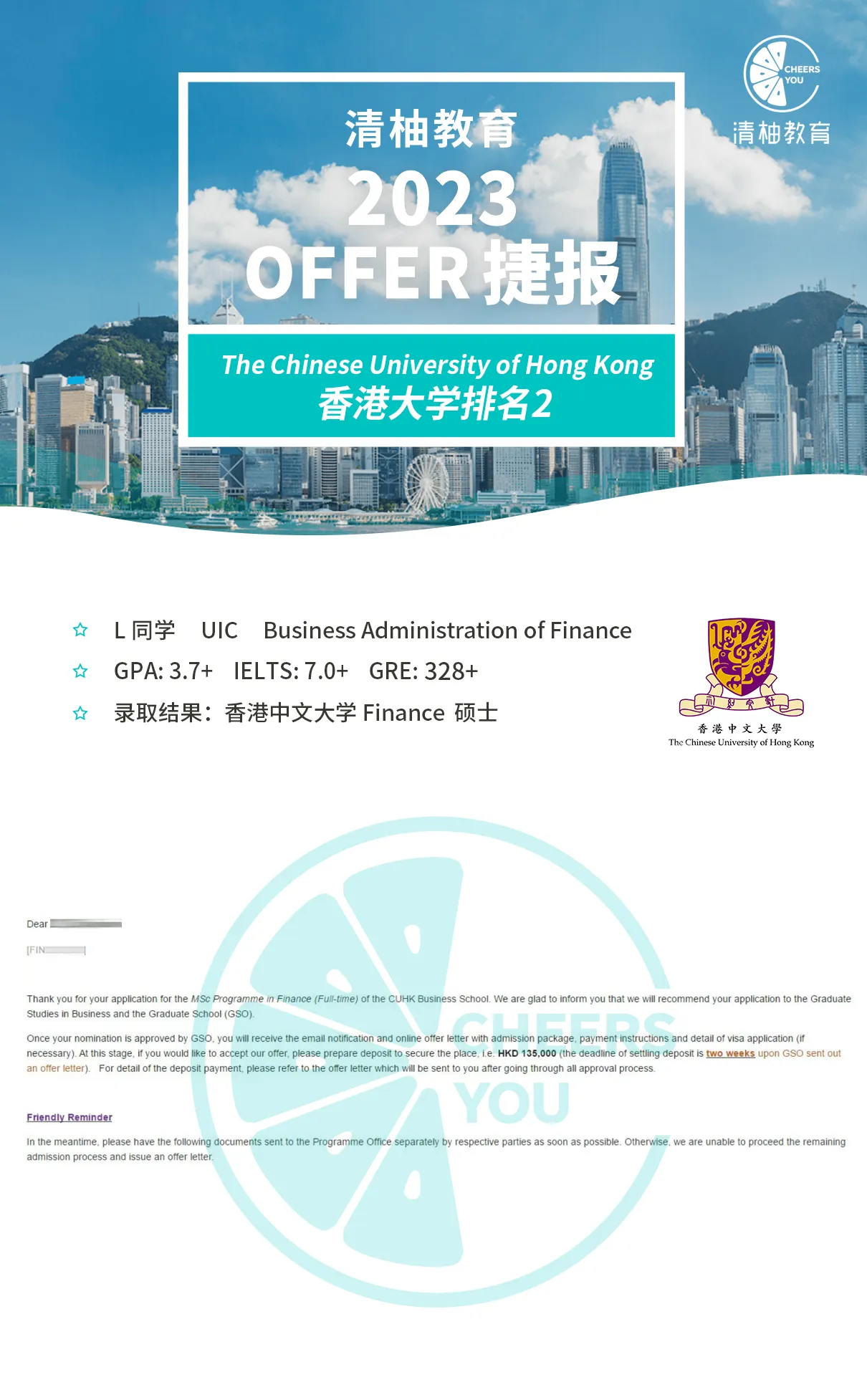
Of course, our consultant Anne again provides a set of realistic standards:
- GPA: 3.4+ for domestic 985 undergraduates, 3.6+ for non-prestigious universities;
- GRE: at least 325 (quant 165+);
- TOEFL: 90 or IELTS 6.5;
- Two or more relevant internships;
- Internship recommendation letter + academic recommendation letter.
Hong Kong University of Science and Technology (HKUST)
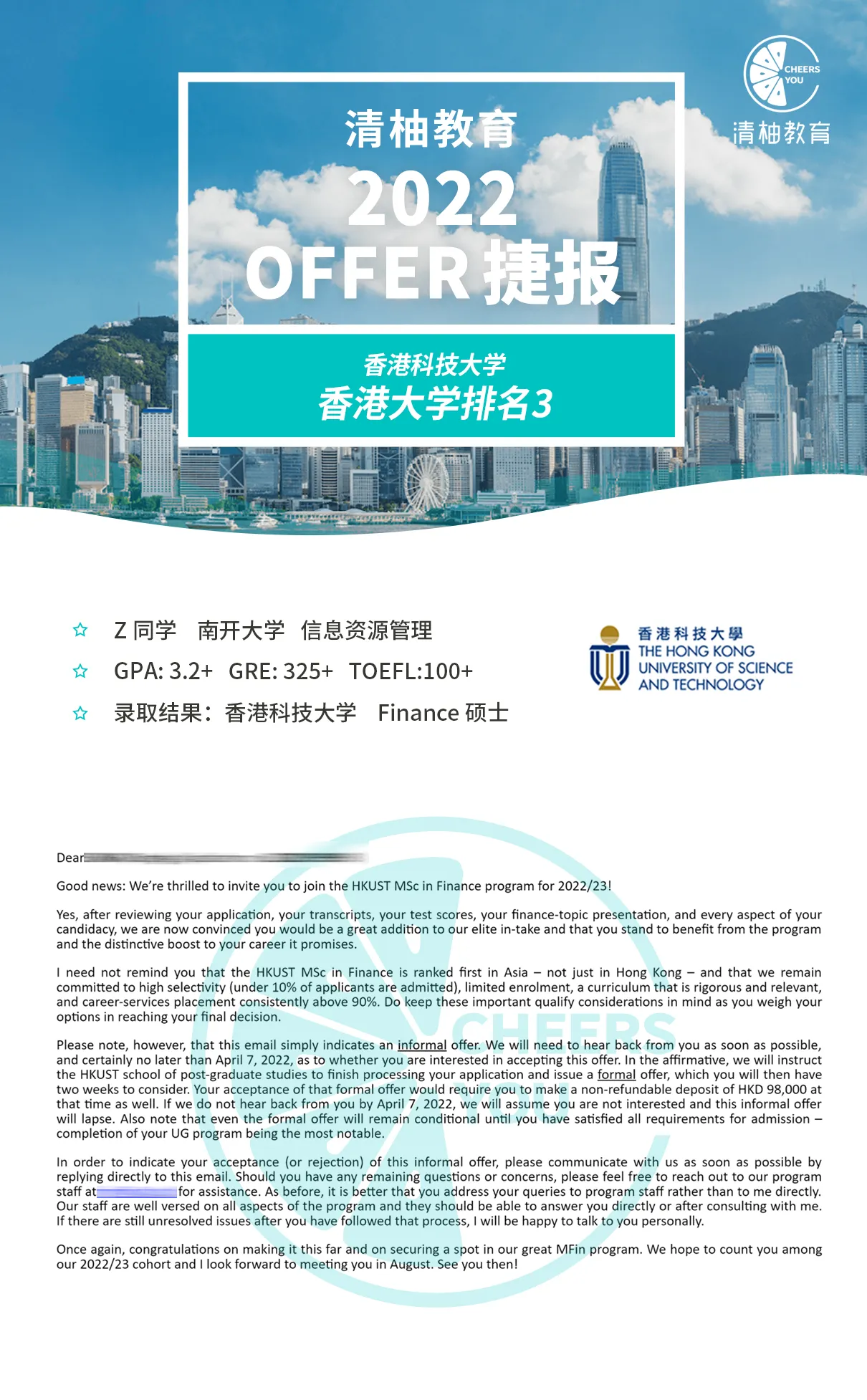
HKUST is one of the youngest universities in Hong Kong, with only 31 years of history. However, it is by no means weaker than its older counterparts in comprehensive rankings, and its business school occasionally even surpasses HKU and CUHK. The campus is located in Clear Water Bay, Tseung Kwan O, far from the city center, with no MTR or even public bus access. The trade-off for the inconvenience is a beautiful campus nestled between mountains and sea, offering a quiet academic atmosphere—ideal for those who want to focus on research (though commuting for internships may be less convenient).
HKUST offers a number of finance programs. Here are some with a broad appeal:
- MSc in Finance
(The orthodox finance program at HKUST, with two concentrations: Investment Management and Financial Analysis.)
- MSc in Financial Mathematics
(A program under the Mathematics Department, naturally placing more emphasis on mathematical ability; suitable for students who wish to pursue quantitative research in investment.)
- MSc in Financial Technology
(A program under the Engineering Department, leaning towards computer applications; suitable for students with a computer science background who want to work on trading strategy maintenance and financial product development.)
Since these programs are offered by different faculties, we won't list the minimum requirements here. Please refer to the backgrounds required for the first two schools.
It's important to note that Financial Mathematics and Financial Technology require more background in mathematics/statistics/computer science. Financial Mathematics looks more at math and statistics, while Financial Technology emphasizes computer science. After reading this, you should have a basic understanding of the programs themselves. In fact, no matter the school or program, our consultant Anne advises that the key to getting admitted to a top program is to plan early, choose your courses wisely, maintain your GPA, and enrich your background. Wishing everyone great results in their application season!
Additionally, students interested in studying in Hong Kong are welcome to consult our consultant Anne~
.png?x-oss-process=style/opt-webp)