The SMART program at the Ivy League University of Pennsylvania (UPenn) is arguably a very popular choice for students aiming to get into an Ivy League school. It is an excellent option for those with humanities or business backgrounds who want to change fields and work in the U.S. So, what exactly is this popular SMART program at UPenn? What are its curriculum and career development directions? What kind of students are suitable to apply? And what are the specific application requirements? Let's dive into the details below—
About the University of Pennsylvania (UPenn)

.png)
The University of Pennsylvania, commonly referred to as UPenn, is located in Philadelphia, Pennsylvania. It is a world-class private research university and one of the eight prestigious Ivy League institutions. In the 2023 U.S. News & World Report National Universities ranking, it placed 7th in the U.S., and in the QS World University Rankings, it ranked 13th globally.
SMART: MSEd in Statistics, Measurement, Assessment, and Research Technology
(MSEd in Statistics,Measurement,Assessment,and Research Technology)
Introduction to UPenn's SMART Program
The University of Pennsylvania's SMART program, officially known as the M.S.Ed. in Statistics, Measurement, Assessment, and Research Technology, is offered by Penn's Graduate School of Education. It is a STEM-designated program, allowing international students to benefit from STEM OPT extension. The program is designed for individuals aiming to pursue research and evaluation careers in education, psychology, and social services. Through this curriculum, students learn data collection, management, and processing; measurement theory and test construction; survey design; experimental design; evaluation strategies; and statistical analysis and reporting. The curriculum primarily focuses on understanding and skills in data collection, management, and processing; measurement theory and test construction; survey design; design and implementation of randomized controlled trials and quasi-experiments; evaluation strategies; and statistical analysis and reporting.
SMART Program Curriculum
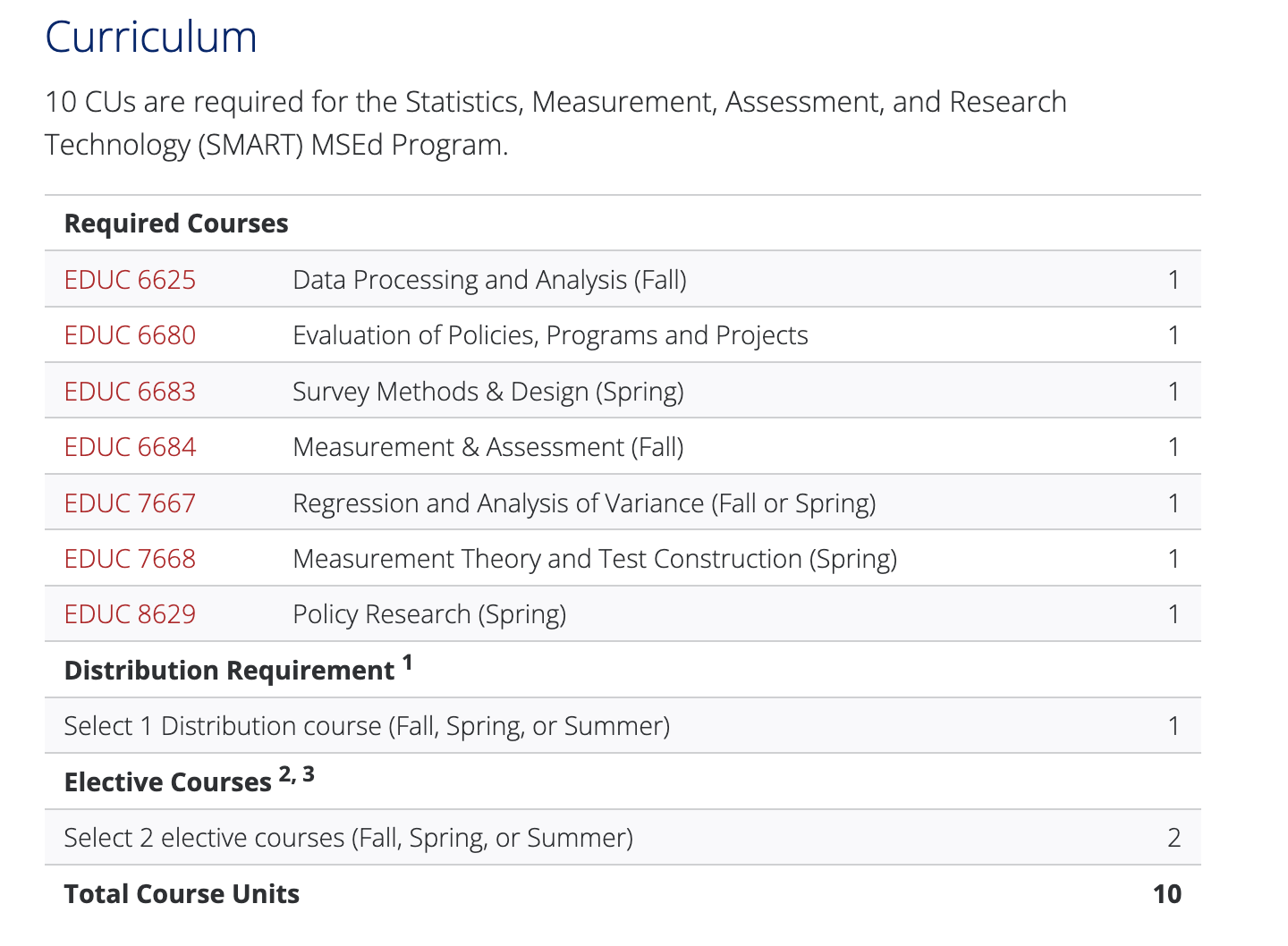
The program requires completion of 10 courses, including seven core courses, two electives, and one group discussion course. Courses may be taken at other qualified institutions in Pennsylvania with advisor and relevant school approval. Students must earn a grade of 'B' or better.
Students entering the SMART master's program are required to have completed an introductory statistics course, such as EDUC 667 or an equivalent, beforehand. If an admitted student is found to be insufficiently prepared in statistics, they will be required to take EDUC 667, which will count as one of their required elective courses.
Core Courses
EDUC 625 Data Processing and Analysis
This course focuses on the effective construction of various datasets using statistical software, including SAS, to address a range of empirical research questions. It also covers the application of SAS and other statistical software by evaluating traditional methods for handling missing data.
EDUC 680 Evaluation of Policies, Programs and Projects
This course primarily covers fundamental evaluation policies and methods for assessing the nature and severity of issues, project implementation, relative effectiveness and cost-efficiency of interventions aimed at reducing problems, and the design and implementation of evaluation research in education, social services, and criminal justice. Case studies are drawn mainly from the United States and a few other countries.
EDUC 683 Survey Methods & Design
This course covers methods and designs for field surveys in education, social sciences, criminal justice research, and other fields in the U.S. and other countries. It addresses methods of obtaining information through household, mail, and telephone surveys, ensuring privacy, improving cooperation rates, and related matters. Finally, the course offers an opportunity to learn the fundamentals of statistical sampling and sample design. Most course cases are based on real data from the National Center for Education Statistics and other federal, state, and local agencies.
EDUC 684 Measurement & Assessment
This course focuses on how to conduct assessment analysis, including fundamental theoretical principles, types and purposes of assessment instruments, levels of measurement, standardization and norms, and methods for supporting reliability and validity.
EDUC 767 Regression and Analysis of Variance
This course covers theoretical knowledge including controlled randomized experimental design, survey data analysis, and controlled field experiments. Assignments primarily involve building statistical models, conducting hypothesis testing, analyzing relevant data, and writing reports.
EDUC 768 Measurement Theory and Test Construction
The main content of this course includes enhancing design capabilities and developing performance indicators, such as those applied to high-stakes decisions in large-scale assessments and those for individual diagnostics and classification. Students can use real data and item response theory to conduct reliability analysis and differential item functioning analysis.
EDUC 829 Policy Research
This course mainly involves studying the role of scientific inquiry in the development and evaluation of contemporary education and social policies. Through the analysis and application of basic research, statistical, and psychometric methods, it informs a variety of policy topics and related issues encountered in policy formulation and evaluation.
Who is UPenn's SMART Program Suitable For?
- Students who wish to work in government agencies, research centers, educational research institutions, etc., in the future.
- Students aspiring to become researchers and statistical analysts.
- Students looking to graduate quickly in one year and leverage an Ivy League platform for employment and networking.
SMART Program Career Paths and Development
Graduates of this program can pursue careers as researchers and statistical analysts in government agencies, educational institutions, research organizations, and more. Specific job titles include: community analyst, policy maker, data analyst, and educator. According to employment trends over the past three years, most graduates have taken on statistical analysis roles in government agencies and financial institutions worldwide.
UPenn SMART Program Admission Requirements and Materials
• Submit a personal statement
• Submit a resume/CV
• Submit three letters of recommendation
• Submit undergraduate transcripts
• Submit valid GRE scores
• Valid TOEFL or IELTS scores (this requirement is waived for graduates of institutions where English is the only medium of instruction)
Below are some offer letters for the UPenn SMART program—
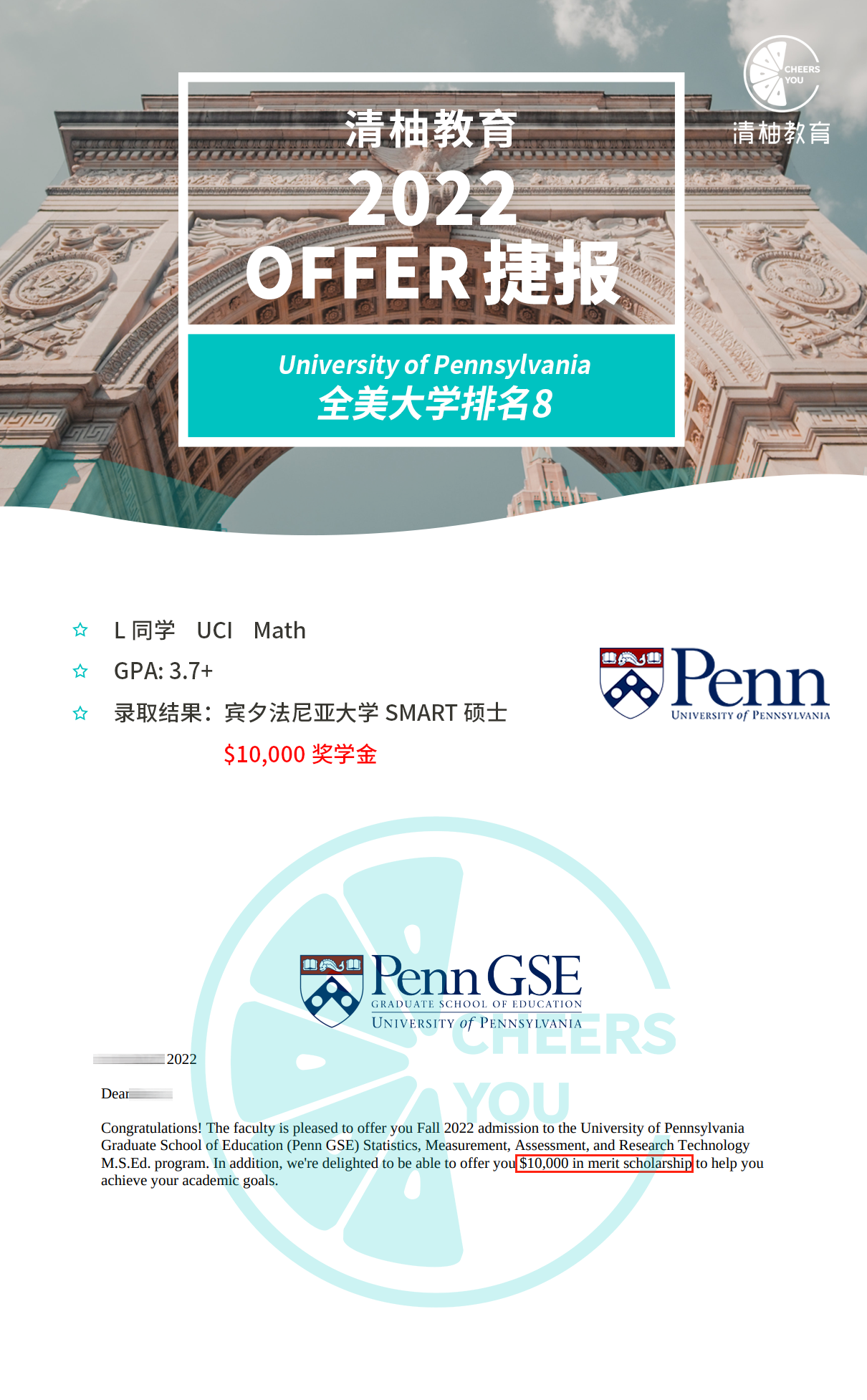
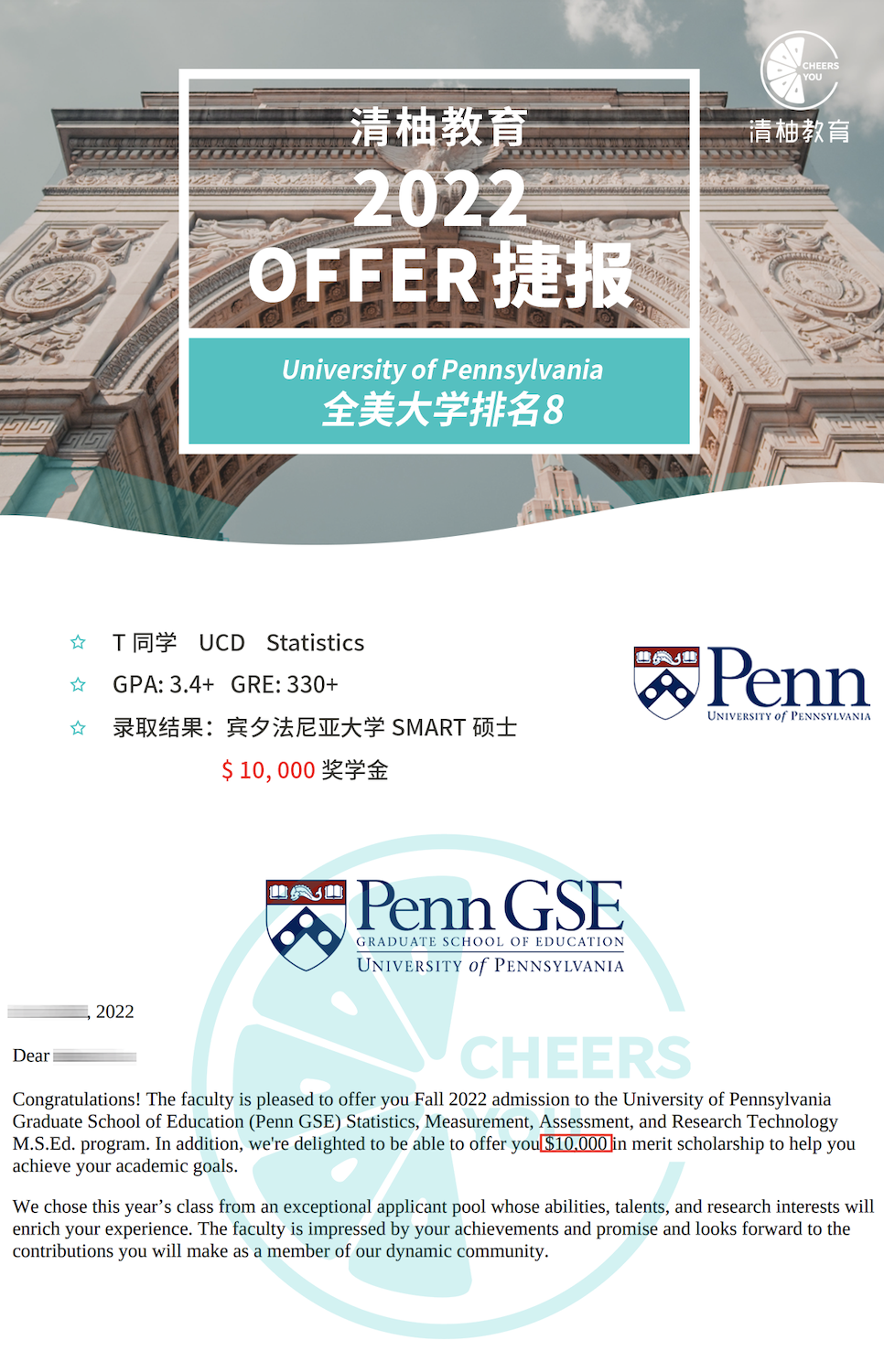
If you are interested in applying to the UPenn SMART program for graduate studies, feel free to scan the QR code below for a one-on-one consultation!
.jpg?x-oss-process=style/opt-webp)