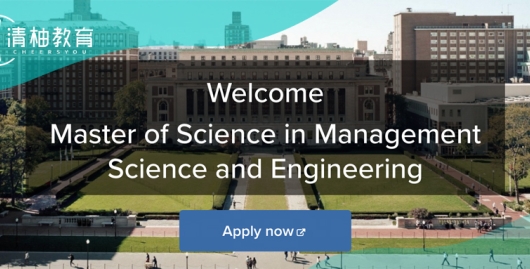
In recent years, more and more students have been eyeing BA and financial engineering programs. Besides those directly named Business Analytics, there are actually programs that blend engineering and business, with high employment rates and strong value. Even econ undergraduates can apply! Today, CheersYou(清柚教育) introduces the Management Science and Engineering (MS&E) program at Columbia University, which ranks second only to Stanford's equivalent, along with its specific admission requirements and curriculum.
Program Overview
Columbia University's Management Science and Engineering (MS&E) program is a STEM-designated program offered jointly by the School of Engineering and the Business School under the IEOR department. Compared to other IEOR programs, MS&E provides greater priority access to business school resources. This is similar to the MSBA program also under IEOR, but MS&E has a much longer history. Overall, the program focuses on cultivating future industry leaders who combine management and technology/engineering.
.png?x-oss-process=style/opt-webp)
The program duration is 1.5 years, consisting of three semesters: Fall, Spring, Fall. The cohort size ranges from around 80 to 105, with slight growth in recent years (e.g., before 2018 it was below 90, and in recent years it has increased to 90-105). No significant expansion is expected in the future. Official admission rates are not available, but overall, the selectivity of MS&E is top-tier among similar programs, comparable to Columbia IEOR's MSBA. However, due to the intense popularity of BA programs, MSBA might be more competitive, while MS&E's lower profile could slightly ease the difficulty (no official data available). MS&E admissions heavily favor industry experience. Students' undergraduate backgrounds are rarely in the humanities; most are from engineering with a few from business.
Columbia University's overall ranking needs no introduction—it has always been a golden draw for students. Among comparable programs (MSE programs), it ranks second in the U.S., arguably only after Stanford's MSE.
Program Official Website: https://mse.ieor.columbia.edu/
Curriculum
The hallmark of this program is its integration of management and technology, so the curriculum is quite flexible, allowing students from various backgrounds to choose the development path that suits them best.
The signature course that must be highlighted first is Operations Consulting, where students work in groups on consulting projects for three companies simultaneously. Typically, it runs from September to April the following year, but this year, due to the pandemic affecting students' start dates, it was postponed to begin in December and end in late April. This course is extremely time-consuming, but it is also the best practical experience.
Client companies range from major names like Citi, AT&T, Kearney, Louis Vuitton, United Nations to startups at various stages. The project types include strategy-oriented management projects and technical projects requiring modeling.
Since each student works on three company projects simultaneously, they can choose different companies and project types to balance their development needs. The course also features renowned b-school professor Hitendra, who teaches systematic problem-solving techniques and methods to expand strategic influence, making it especially suitable for students aspiring to enter consulting. It also includes ongoing guidance from Professor Kachani, with students presenting their group project progress and discussing consulting cases.
Curriculum Structure: Three Components
- Required Core (12 credits, 4 core courses)
- Semi Core (18 credits, approximately 6 courses)
- Concentrations (free electives)
.png?x-oss-process=style/opt-webp)
Since the range of electives is too broad to list here, we can highlight some representative examples within each category. The opportunity for MS&E students to take business school courses is highly attractive to many engineering-background students, as these courses are taken alongside MBA students and taught by business school faculty, helping to broaden their way of thinking.
Application Requirements
International undergraduate institutions: Essentially, many well-known public universities across various states and top-ranked schools nationwide are represented, and there are also Columbia undergraduates who choose to pursue MS&E.
Mainland Chinese undergraduate institutions: MS&E admissions are relatively friendly, with the vast majority being from 985-level universities, though there are also cases from 211 and other institutions.
Beyond the key metrics (GPA, test scores, etc.), MS&E places great emphasis on your resume background. Although backgrounds vary widely—ranging from chemical engineering, EE, ME, IE in engineering to finance, management in business, and mathematics, OR, computer science, etc.—applicants all have distinctive profiles with internship/research/extracurricular experience across various industries. Many Indian and European students have 1-2 years of full-time work experience.
Previous Admission Cases
.png?x-oss-process=style/opt-webp)
.png?x-oss-process=style/opt-webp)
For more questions regarding studying abroad and graduate applications, you can add Teacher Anne to start a 1-on-1 consultation~
.png?x-oss-process=style/opt-webp)