

Finance and Economics are both business disciplines, and these two fields have always been popular choices among Chinese international students. However, many students confuse the two, treating them as identical and thinking that economics equals finance. In reality, the career paths corresponding to these two majors are quite divergent. Below, let’s quickly understand the conceptual differences between the two, as well as the distinctions in curriculum design and career development, and we’ll also recommend some top U.S. university programs in economics and finance~
Conceptual Differences Between Economics and Finance
Economics
As a foundational discipline, economics studies the various economic activities and corresponding economic relations at different stages of human society, as well as their operation and development patterns. Its core ideas center on material scarcity and efficient resource utilization, and it can be divided into two main branches: microeconomics and macroeconomics.
Finance
Finance focuses on the economic activities involving the circulation of money and monetary funds. It specifically examines how individuals, institutions, and governments acquire, spend, and manage funds and other financial assets. Finance emerged as a branch of economics. Traditionally, finance generally encompasses two directions: the first is Money and Banking, and the second is International Finance.
Key Conceptual Differences
Finance deals more with money, funds—in essence, with cash; whereas economics leans towards a social science, primarily concerned with macro-level issues like goods, services, distribution, and consumption.
Curriculum and Field Differences for Economics and Finance Study Abroad
Economics Courses
Introductory Economics,
Advanced Mathematics,
Intermediate Microeconomics,
Statistics,
Intermediate Macroeconomics, etc.
Elective courses include:
Monetary Economics Theory,
Urban Economics,
Labor and Human Resources,
Economic Systems,
Economic Development,
Economic and Institutional Analysis,
Law and Economics, etc.
Finance Courses
Money and Banking
International Finance
Investments
Corporate Finance
Financial Engineering
Financial Market Studies
Public Finance
Financial Economics
Mathematical Finance
At the undergraduate level, the curricula for finance and economics are very similar, with a course overlap rate as high as 70%. However, at the graduate level, finance and economics are clearly differentiated.
Research Directions in U.S. Economics and Finance:
· Finance delves deeper into monetary behaviors such as financial markets, financing, and risk, analyzing various market activities;
· Economics, on the other hand, begins to focus on the management and allocation of assets by national and related policies, the rational use of resources, and theories promoting different industries, elevating from market behaviors to higher-order aspects of national policies and world trade rules.
Career Prospects for Studying Economics and Finance in the U.S.
Career Prospects in Economics
1. Macroeconomics
Future careers include working in government economic departments to research and coordinate economic policies, or serving as a professor in related fields at a university.
2. Microeconomics
Similar to macroeconomics. Generally, employment is found in universities or government departments.
3. Labor Economics
Often involves working in support departments of enterprises, or in government economic departments coordinating the research and implementation of economic laws and labor regulations.
4. International Economics
Careers include coordinating international economic policy research in government economic departments, or engaging in international trade-related work at international trading companies. The employment prospects are very good, with substantial room for growth.
5. Econometrics
Future employment prospects are mainly in large multinational corporations doing economic strategy analysis, with very generous compensation.
6. Development Economics
Employment prospects are highly regarded. Opportunities exist in comprehensive economic management departments, policy research institutions, financial institutions, and enterprises for economic analysis, forecasting, planning, and economic management.
Career Prospects in Finance
1. Portfolio Manager
Portfolio managers need to be familiar with financial market instruments such as fixed income, bonds, equities, commodities, and derivatives, as well as fundamental investment logic. Their main tasks involve analyzing and allocating capital, managing assets in a diversified manner to achieve risk diversification and enhanced efficiency.
2. Financial Advisor
Primarily provide private wealth management services to clients. They recommend quality projects to investors and are familiar with asset management and risk management. Another type offers third-party professional services for corporate financing.
3. Financial Analyst
More corporate-oriented than individual-focused. Mainly analyze a company's current financial condition based on financial statements, and provide rational recommendations for future development, proposing adjustments or improvements based on surplus, liabilities, cash flow, etc.
4. Consultant
A highly sought-after position in recent years, requiring extensive data analysis and industry research. The essence of consulting is to help clients solve a series of problems that may arise during company operations: whether to enter a new market, whether to acquire a new company, etc. Employment is primarily with investment banks, brokerages, Big Four accounting firms and consulting firms, funds, trusts, private equity and venture capital institutions, insurance companies, or Fortune 500 conglomerates.
Recommended U.S. Graduate Programs in Finance and Economics
Recommended U.S. Economics Programs
Columbia University
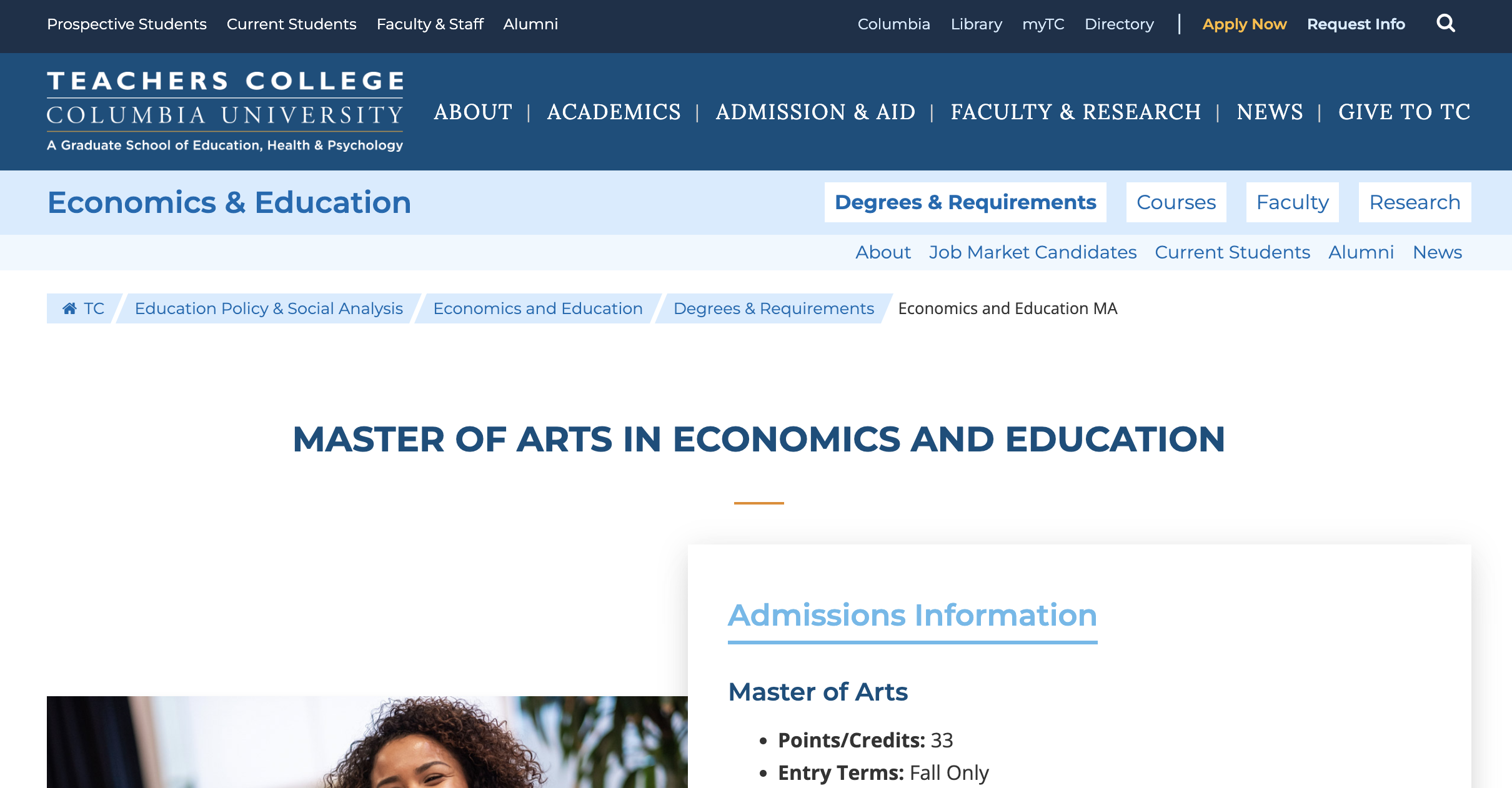
MA in Economics and Education
Recommended U.S. Finance Master's Programs
Johns Hopkins University
MS in Finance

Below are admissions offers from top U.S. economics and finance programs~


If you're interested in applying to graduate programs in economics or finance in the U.S., scan the QR code below to start a one-on-one consultation~
.jpg?x-oss-process=style/opt-webp)