
In the eyes of many, the finance industry sits at the top of the pyramid, and the various related majors are the first choice for students pursuing further education. Among these, financial engineering (Financial Engineering) is paramount. As a powerful interdisciplinary field, graduates of financial engineering programs enjoy clear employment advantages. So what are the requirements for applying to these programs? Which schools offer the best value? Today, CheersYou(清柚教育) will break it all down for you, along with the QuantNet ranking of Master's in Financial Engineering programs across the U.S.!
Overview of Financial Engineering Programs
Financial engineering is an interdisciplinary field typically taught jointly by faculty from business schools, mathematics departments, and engineering schools. The curriculum integrates computer science, finance, and mathematics, focusing on the use of mathematical tools and engineering approaches to solve real-world financial problems. The program places a strong emphasis on applicants' quantitative backgrounds, so students with undergraduate degrees in mathematics, statistics, computer science, or related fields have a significant advantage.
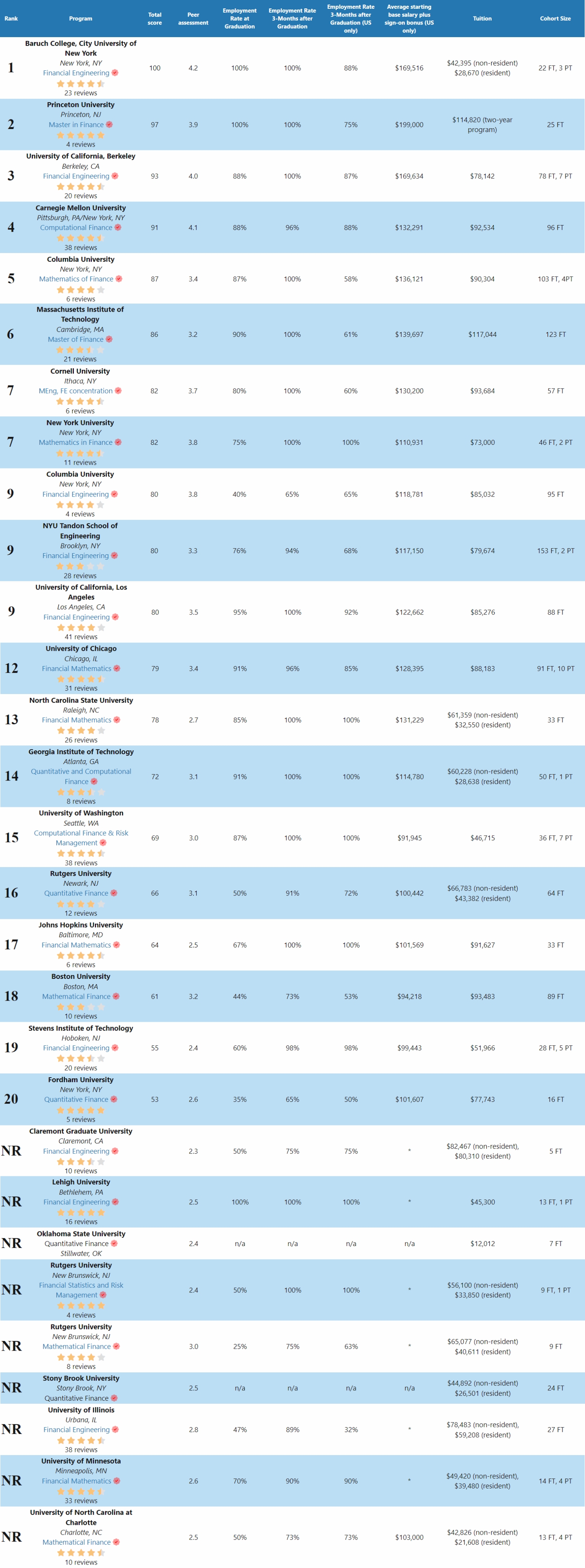
2023 QuantNet Ranking of U.S. Master's in Financial Engineering Programs
Generally, when choosing financial engineering or financial mathematics programs, students refer to the QuantNet ranking of U.S. financial engineering programs. QuantNet surveys 36 financial engineering, financial mathematics, and quantitative finance programs, evaluating them on admissions, employment outcomes, and career services. A key component is average starting salary; the QuantNet ranking serves as a crucial guide for students, especially those planning to work in the U.S. for some time. Students can use this ranking to inform their decision-making.
2023 QuantNet Top 10 Financial Engineering Programs
Top 1: Baruch College – Master of Financial Engineering
Top 2: Princeton University – Master in Finance
https://bcf.princeton.edu/academic-programs/master-in-finance/
Top 3: University of California, Berkeley – Master of Financial Engineering
https://mfe.haas.berkeley.edu/
Top 4: Carnegie Mellon University – Master of Computational Finance
Top 5: Columbia University – Mathematics of Finance
https://www.math.columbia.edu/mafn/
Top 6: Massachusetts Institute of Technology – Master of Finance
Top 7: Cornell University – MEng, FE concentration
https://www.orie.cornell.edu/orie/cfem
Top 7: New York University – Master of Science in Mathematics in Finance
https://gsas.nyu.edu/admissions/arc/programs/mathematics-in-finance.html
Top 9: Columbia University – Master of Financial Engineering
https://msfe.ieor.columbia.edu/
Top 9: New York University – Master of Financial Engineering
https://engineering.nyu.edu/academics/programs/financial-engineering-ms
Top 9: University of California, Los Angeles – Master of Financial Engineering
https://www.anderson.ucla.edu/degrees/master-of-financial-engineering
Looking at this year’s ranking, Baruch College’s MFE program tops the list, while last year’s number one, Princeton’s Master in Finance, now ranks second, and UC Berkeley’s MFE is third.
Taking NYU Tandon as an example, according to the latest graduate outcome data:
- Average salary: $91,434
- Employment rate: 73%
- Employment rate within 90 days of graduation: 86%
Required Background for Applications
Financial engineering and financial mathematics programs typically favor applicants with strong computer science and mathematics skills.
Recommended mathematical prerequisites generally include calculus, probability theory, linear algebra, and statistics, as well as stochastic processes, differential equations, numerical analysis, operations research, and time series. It is advisable to master at least one object-oriented programming language such as C++ or Python, which is a plus.
Finance prerequisites include Financial Engineering, Financial Risk Management, Fixed Income Securities, Financial Mathematics, Econometrics, and Securities Investment.
In comparison, having fewer finance core courses is not a fatal drawback, but if your mathematics and computer skills are poor, your chances of admission will decrease. To strengthen your finance background, you can take elective or online courses during your studies, participate in finance and business competitions, or intern at financial companies.
Program Recommendations
Columbia University – Financial Engineering (MSFE)
- Recommended GPA: 3.5+
- Three letters of recommendation
- Personal statement
- Resume/CV
- Video interview (three random questions, 90 seconds to answer each, 3 minutes recording time)
- Language proficiency: TOEFL 100 required, IELTS generally 7.0
- GRE scores
New York University – Financial Engineering (MSFE)
Average admitted student profile (2021):
- GPA: 3.89
- Quant GRE: 167.7
- Verbal GRE: 155.2
- Personal statement
- Two letters of recommendation
- 1-minute video
- Language proficiency
Undergraduate background requirements:
Linear algebra, probability theory, multivariate calculus, applied statistics, computer programming

University of Southern California – Financial Engineering (MSFE)
- Recommended GPA: 3.5+
- GRE not required but optional
- Resume/CV
- Letters of recommendation

Cornell University – Financial Engineering (MEng with FE concentration)
- Average GPA: 3.69
(Soft skills and personal competencies weigh more heavily)
- GRE scores no longer required starting Fall 2022
- Personal statement
- Resume/CV
- 2 letters of recommendation
- TOEFL or IELTS language test scores
University of California, Los Angeles (UCLA) – Financial Engineering (MFE)
- Recommended GPA: 3.5+
- GRE or GMAT required
- Personal statement
- Resume/CV
- 2 letters of recommendation
- Interview required

If you are interested in applying to financial engineering or financial mathematics programs for graduate study, please scan the QR code below to start a one-on-one study-abroad consultation right away~