Although the humanities have been sung into decline for many years, it was only in the post-pandemic era that things became this bleak.
Even The New Yorker lamented that the humanities are finished. The author, a graduate of both Harvard and ASU, found that the number of humanities majors at his alma mater ASU had plummeted by more than half, including English and history.
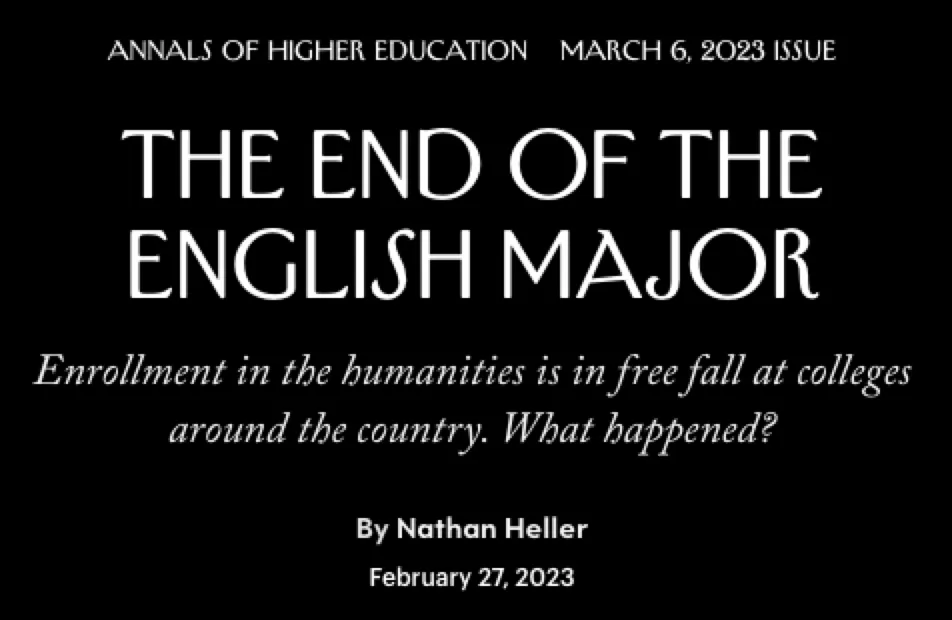
The State of Humanities: A Sinking Titanic
In 2022, only 7% of Harvard freshmen planned to major in the humanities.
.png)
In the past 15 years, the number of English majors at Harvard has dropped by about three-quarters, with fewer than 60 in 2020. The same is true for philosophy and foreign literature.
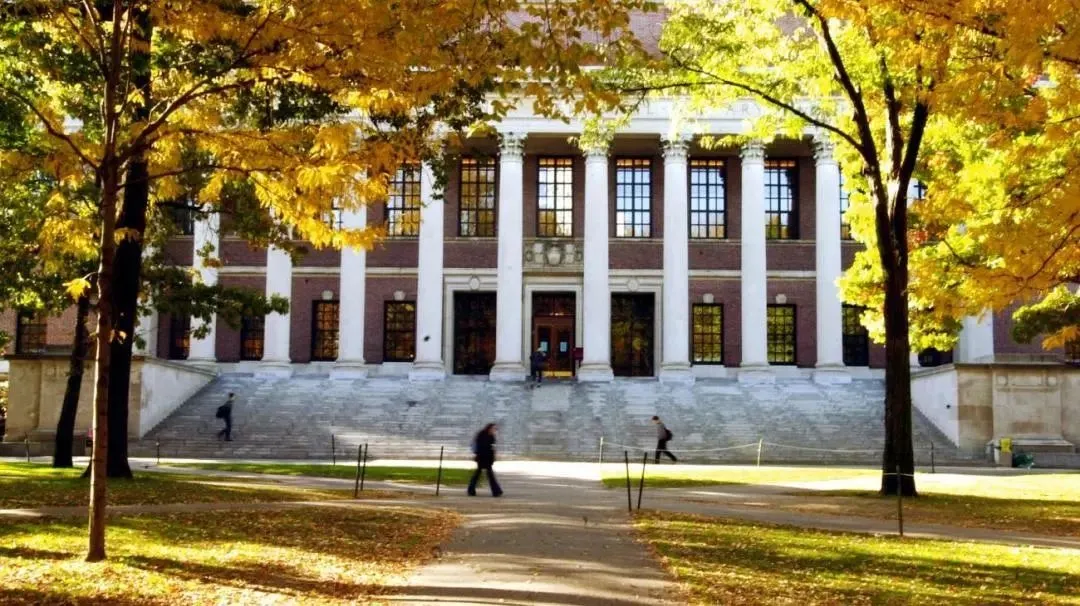
This is just a microcosm of the decline of the humanities.
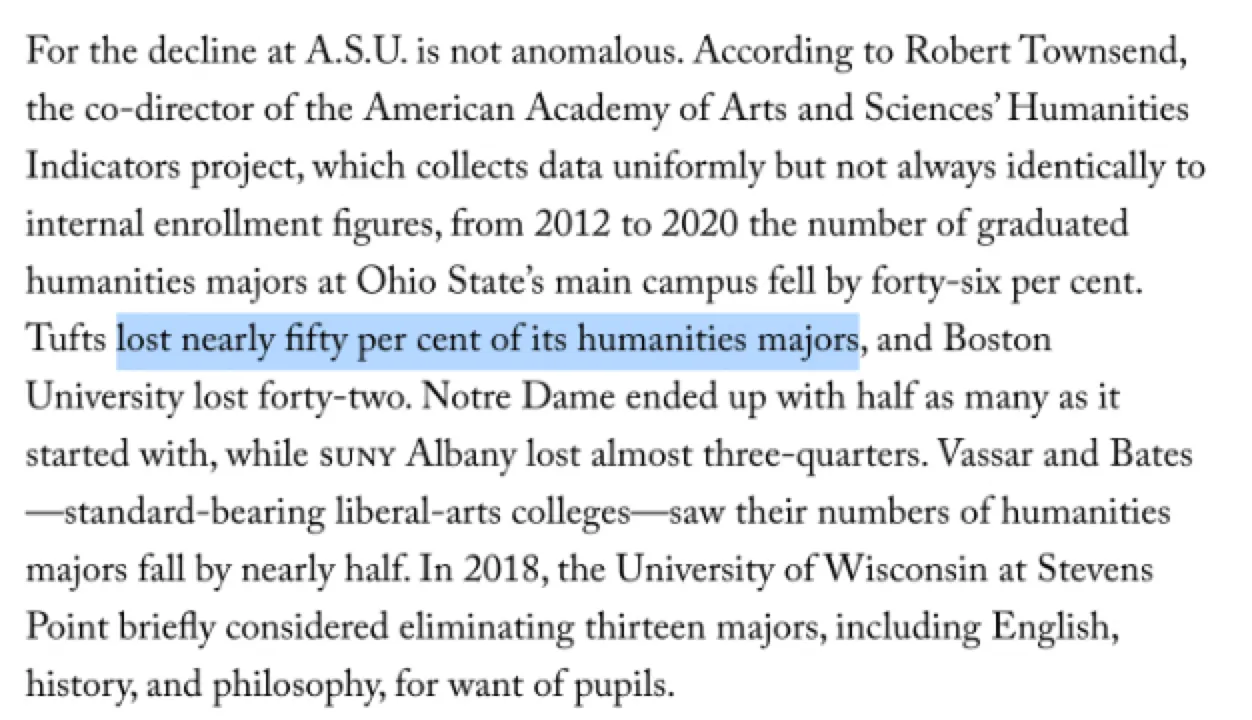
According to statistics, between 2012 and 2020, humanities graduates at Ohio State University decreased by 46%; Tufts University closed nearly half of its humanities programs; Boston University also closed 42; only half remained at the University of Notre Dame; and the University at Albany, SUNY, shut down as many as three-quarters.
Meanwhile, the proportion of degrees in health sciences, medicine, natural sciences, and engineering has surged. At Columbia University, for example, the share of English majors dropped from 10% to 5% between 2002 and 2020, while the number of computer science graduates grew.
Shakespeare's sonnets are beautiful, and Don Quixote's chivalry is fascinating, but ultimately they cannot compete with the harshness of reality.
Among the students the author interviewed, some loved Italian but ended up choosing business; some were passionate about literature but chose data science. The reason is simply that these were "safer bets."
The high cost of U.S. college tuition and the pressure of finding a job after graduation have deterred many humanities enthusiasts.

James Shapiro, a professor of English at Columbia, said that under the weight of the decline of print media and the supremacy of money, the decline of the humanities is almost irreversible.
Especially after 2007, funding for the humanities from the federal government, state governments, and even universities themselves has been decreasing.
For example, at the author's alma mater ASU, the share of federal funding plummeted from 28% in 2007 to just 9% last year, forcing the school to adopt a market-driven approach. In fact, many top U.S. public universities have begun operating like private enterprises.
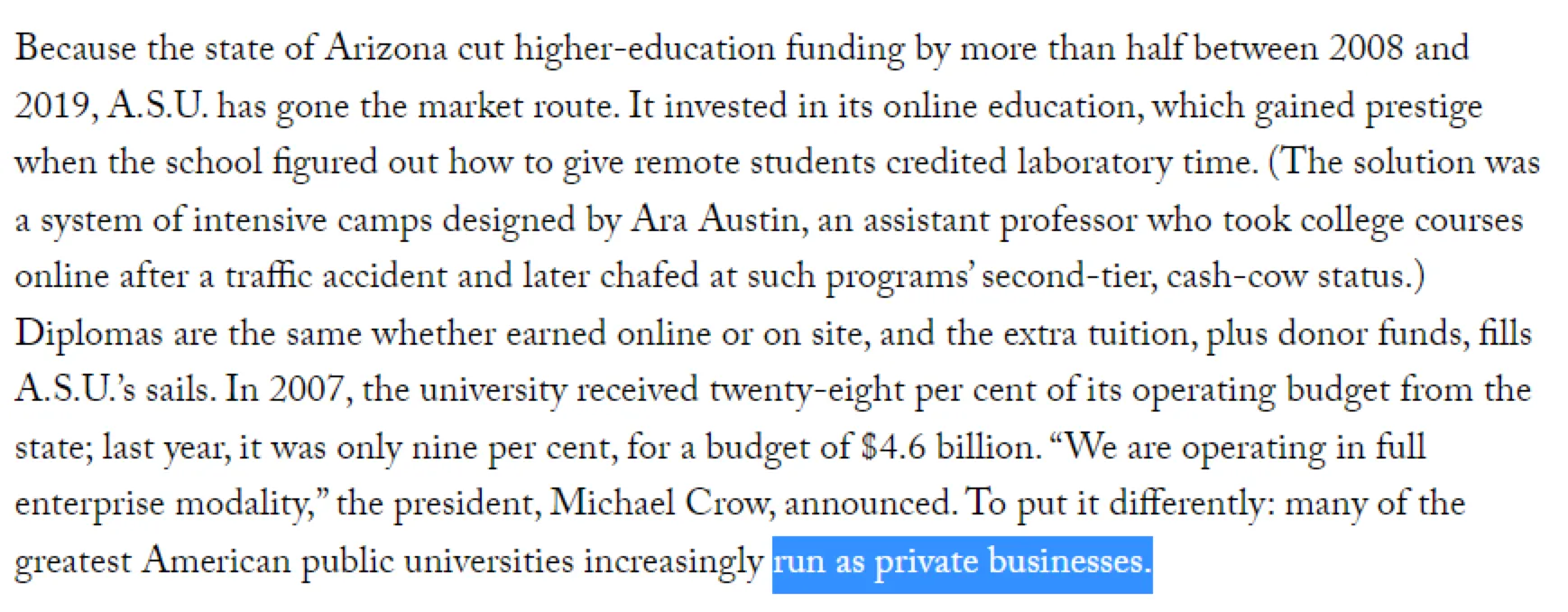
Capital is profit-driven, so disciplines like the humanities, which have long cycles and low returns on investment, are bound to be marginalized.
University funding generally tilts toward STEM majors, and many humanities programs have aggressively pivoted to align with science and engineering, marketing themselves as facilitating good job placement.
Graduates from elite universities flock to high-paying industries, with Google, Meta, BCG, and Goldman Sachs becoming the dream companies of the best and brightest. According to the Harvard Crimson's annual survey, over 60% of Harvard's Class of 2020 entered the tech, finance, or consulting sectors.
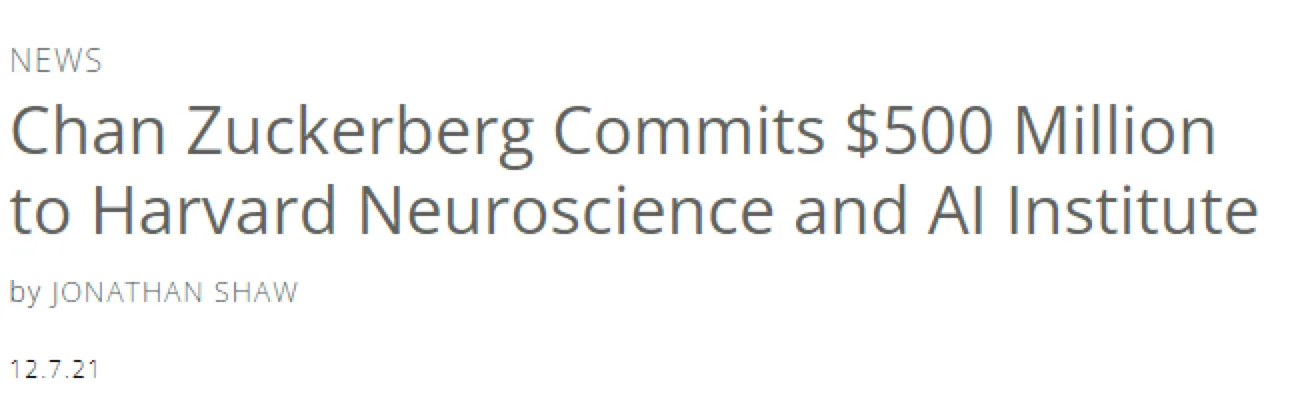
What Harvard students chat about over meals is that the Zuckerbergs have donated another $500 million to Harvard's AI initiative, and that the School of Engineering and Applied Sciences has another rockstar professor.
Nowadays, those who still insist on studying the humanities are either driven by pure passion or come from wealthy families.

Here are the top 10 "pitfall" majors as ranked by international students, with humanities heavily represented 👇
-
Art
-
Philosophy
-
Law/Medicine
-
Social Sciences
-
Architecture
-
Math/Physics/Chemistry/Biology
-
Less Commonly Taught Languages
-
Business
-
Education
-
Media/Communication
Humanities Grads Struggle to Find Jobs: Is Switching to Coding the Answer?
Some netizens joke that humanities majors only come in three types: those that prepare you for civil service exams, those that let you switch to coding, and those that should be eliminated.
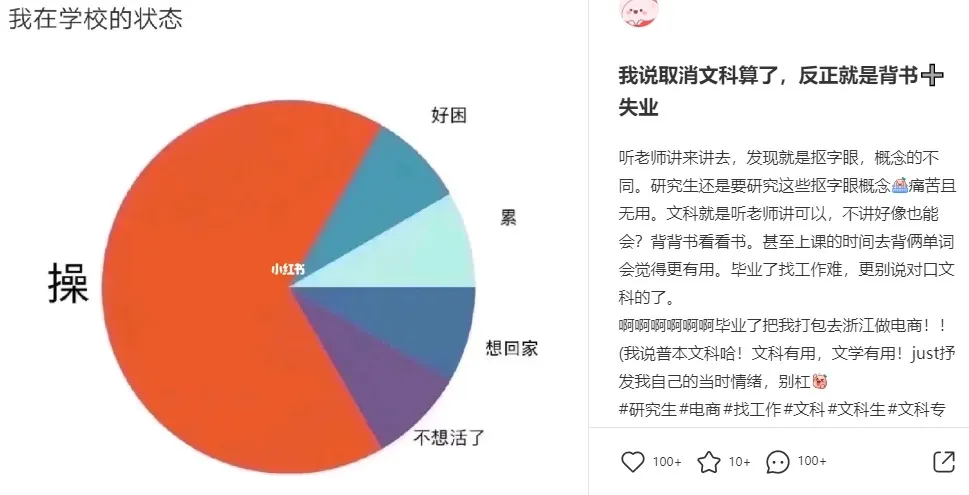
Some humanities students just give up: Why not just cancel the humanities altogether? After all, it's just memorization + unemployment.
Data from Zhaopin shows that in 2022, the job contract rate for humanities graduates was only 12.4%, far lower than that of STEM graduates.
Today's campus heartthrob, tomorrow's unemployed slacker.
Compared to STEM, humanities majors face employment difficulties both domestically and abroad. A blogger compiled the employment situations of themselves and their fellow humanities international student friends, and well... almost none of them ended up working in their field of study 😅

According to the "2022 Chinese College Graduates Employment Report" released by MyCOS Research Institute, the highest-earning majors for bachelor's degree graduates are unanimously popular STEM majors such as information security, software engineering, and information engineering.
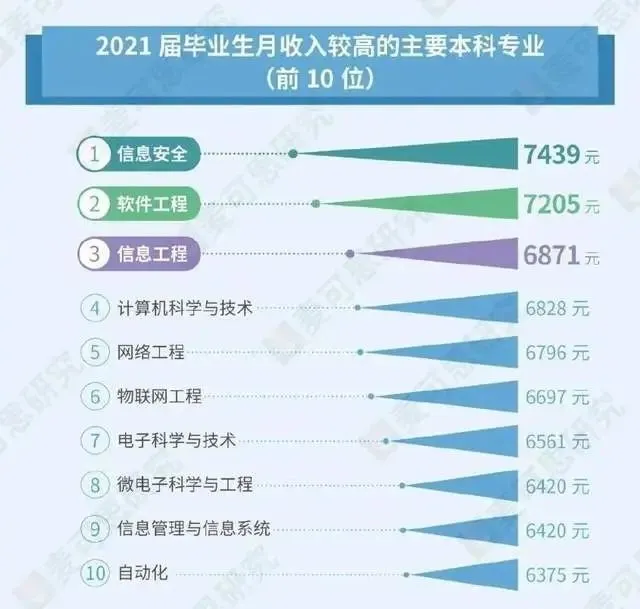
No wonder everyone wants to switch to coding for a lifeline—it's because the sea of suffering in humanities knows no bounds.
According to data from Douban, humanities students consistently rank first in their intention to switch to coding. They are followed by business, biology/chemistry/environmental/materials, and various other "pitfall" majors.
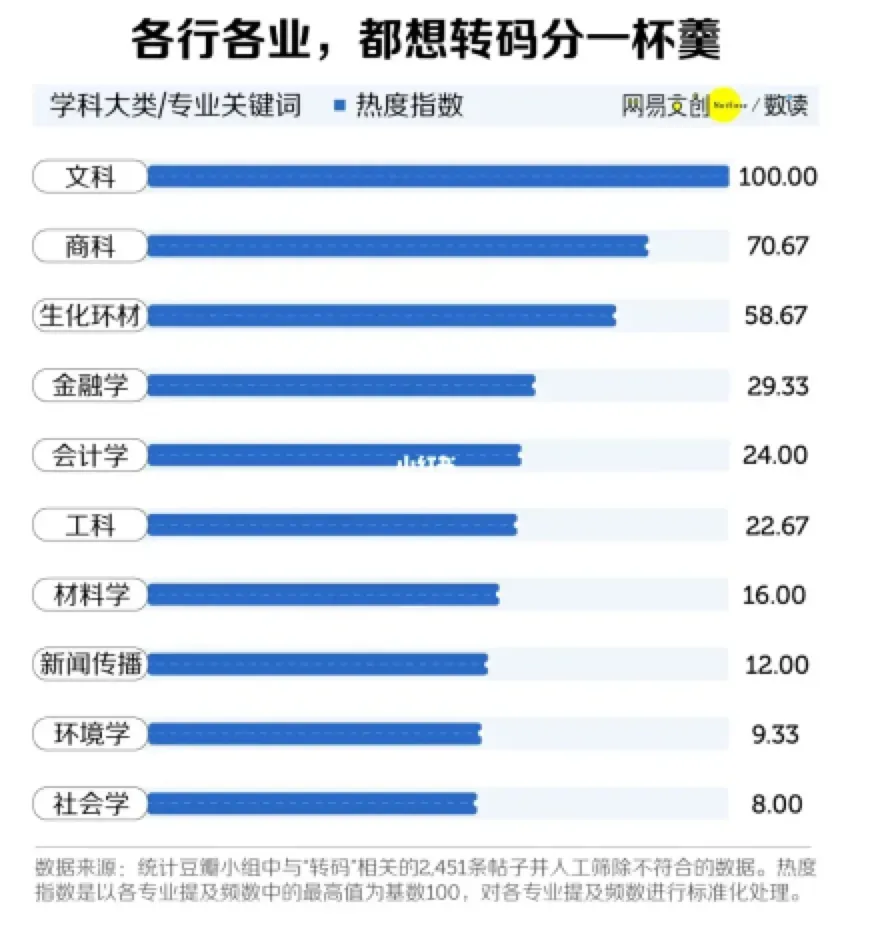
It's said that the first victims of these "pitfall majors" have already started hawking grilled sausages at street stalls 👇

Young graduates from humanities fields such as directing, HR, and architecture have, for various reasons, left industries considered relatively respectable by society to join the army of street vendors.


Needless to say, architecture is one such pitfall major—you study the most grueling course load for the least pay. After spending millions on an Ivy League degree, you return at thirty still just earning a little over 10,000 yuan a month.
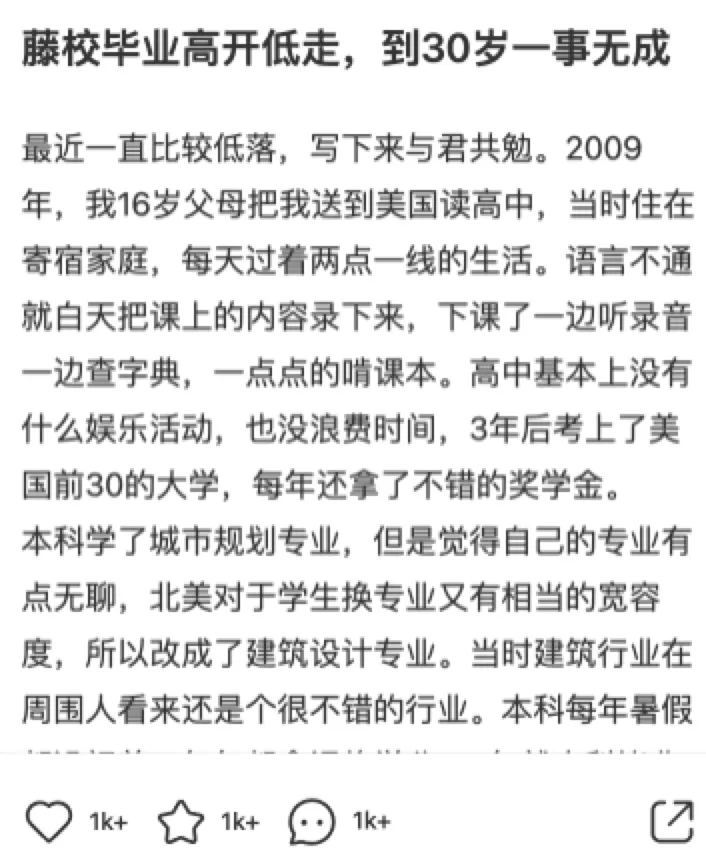
Meanwhile, AI algorithm positions at BAT (Baidu, Alibaba, Tencent) offer a minimum monthly salary of 20,000 yuan for fresh master's graduates, and with benefits the total package can exceed 400,000 yuan annually.
The packages at North American tech giants are even more astronomical: Meta offers an annual salary of over $220,000 for entry-level software engineer positions.
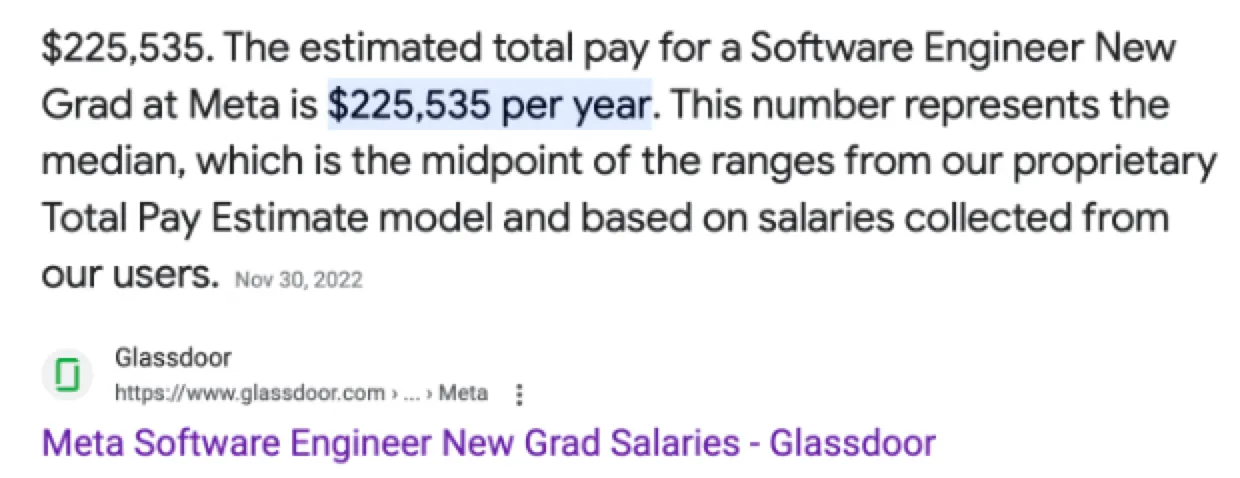
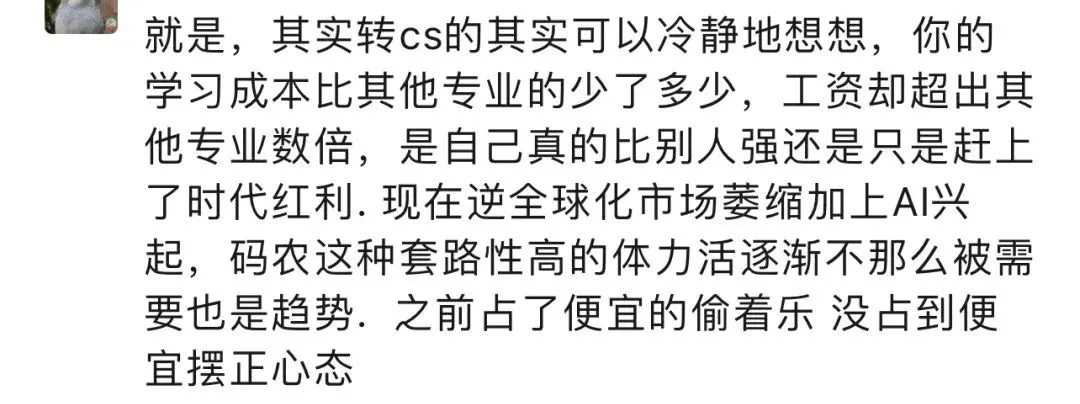
Thus we have arrived at an era where everyone wants to switch to coding, with various "30-day coding switch success stories" on platforms like Xiaohongshu.
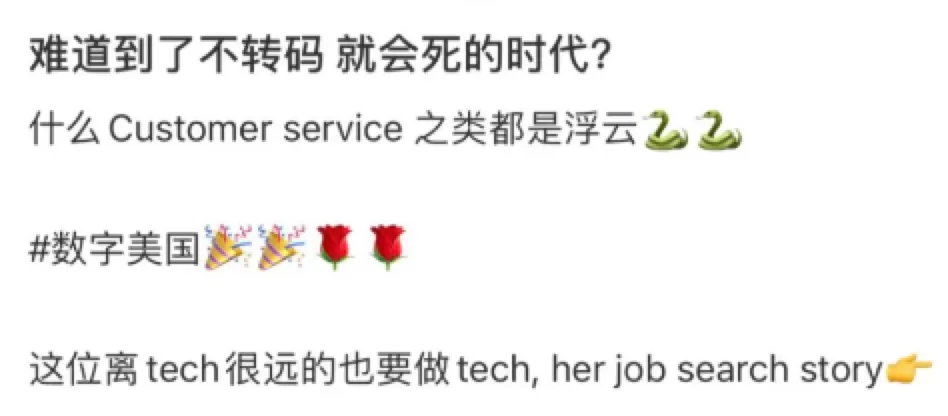
The answer is always high salary and good job prospects—it seems that no matter what you study, "you might as well switch to coding."
.jpg?x-oss-process=style/opt-webp)
When the Tide Goes Out, Is Switching from Humanities to Coding Still Appealing?
However, switching to coding is not without its barriers. Courses in HTML, Java, CSS, and JS all require systematic study, and you shouldn't blindly trust those "30-day coding success stories" on Xiaohongshu.
What's more, humanities students switching to coding often face limited job options, usually only qualifying for lower-paying entry-level tech positions like front-end development, testing, and operations with relatively lower requirements.
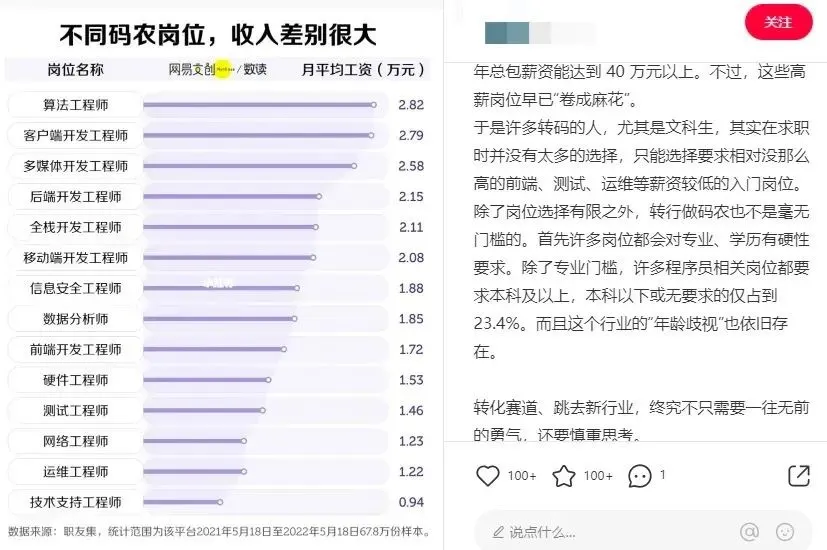
Not everyone is suited to switch to coding. The IT industry updates and iterates rapidly. To establish yourself in this field, you—a career changer—will have to compete with peers who have been on this track since their undergraduate studies. Many positions have hard requirements for specific majors and degrees, and age discrimination still exists in this industry.
Moreover, the massive layoffs at U.S. tech companies that have continued from late last year into this year also make the prospect of switching to coding uncertain.
.jpg?x-oss-process=style/opt-webp)
Before the end of Q1 this year, tech companies have already laid off more than 160,000 people, with Amazon and Google each cutting over 10,000 jobs. Meta's second round of layoffs is expected to be announced this week, reportedly affecting 13% of its workforce.
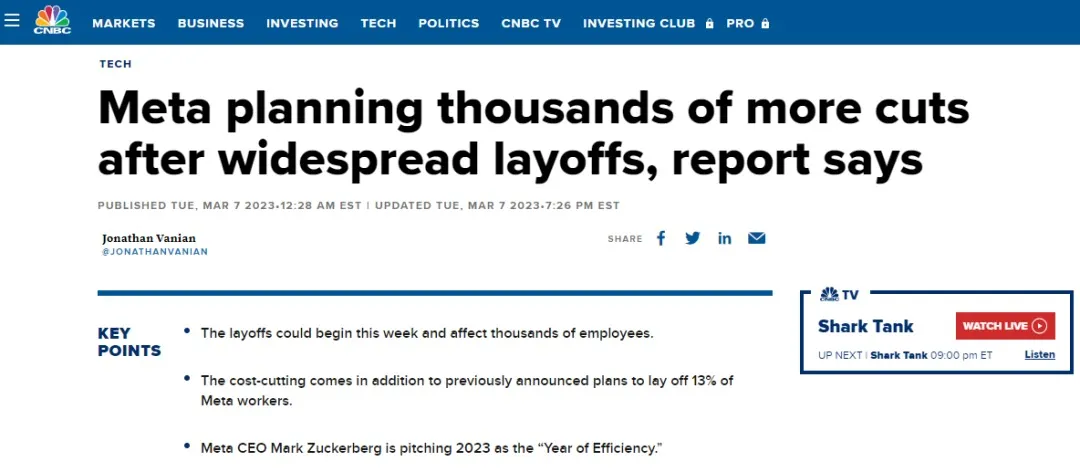
During these pandemic years, everyone has been frantically rushing into big tech companies, and coding has almost become every graduate's dream career. With packages worth hundreds of thousands of dollars, success stories of landing a job in 30 days after switching to code are everywhere. No one seemed to care whether this growth was sustainable.
Looking at the doubled employee growth rates at Silicon Valley giants, can that truly match revenue and profit growth? What we're seeing now is just a return to rationality.
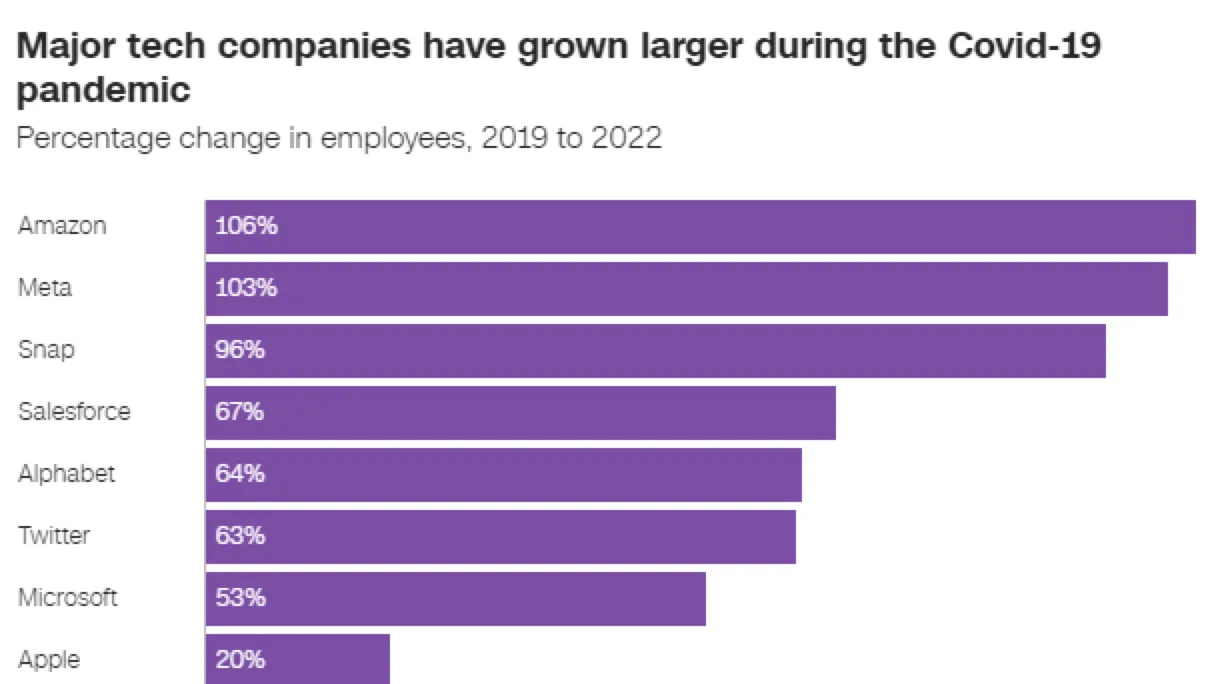
Only when the tide goes out do you discover who's been swimming naked.
Humanities students changing tracks and rushing into coding still need careful consideration.
Study What You Love
"Studying is for employment"
Is this truly the purpose of learning for everyone?
Does cutting traditional humanities programs and shifting funding toward STEM really help cultivate talent?
In this era where "everyone needs to switch to coding," should we go with the flow like this?
Those coding prodigies who mastered it in 30 days—the quality of their code doesn't matter, and what they truly like doesn't matter either. In this restless age, it seems everyone only cares about how big the paycheck is.
In the face of this flood of materialism, perhaps we have all lost our way.
Remember the emotion when first reading the "Four Sentences of Hengqu": to ordain conscience for Heaven and Earth, to secure life and fortune for the people, to carry on the lost teachings of past sages, to establish peace for all future generations. This is the spirit of the Chinese scholar-official, and it is precisely the mission of the humanities.
Liu Xiao, a professor at the School of History at Nankai University, said that the humanities are the spirit and soul of a nation.
In any era, there is a need for people to uphold this faith of taking the world as their own responsibility.
We also hope that everyone can courageously pursue what they truly love, without being overly swayed by outside voices. Every industry has its ups and downs; hold on to what you love instead of blindly chasing the next hot trend.
Keep your feet on the ground while reaching for the stars.

If you stubbornly believe that "only with money can you pursue your ideals," sometimes it can backfire.
Of course, study and employment environments vary across countries and regions. How to strike a balance and make choices may indeed have no absolute right or wrong.
But we still hope that everyone will think carefully and take the step that best suits them in this important stage of choosing schools and careers.