In recent years, media-related fields have become increasingly intertwined with emerging areas such as creative industries and digital media, offering students broader employment opportunities and room for growth. As a result, media programs have gained more and more attention among those pursuing graduate studies in the UK.
Today, we'll take a detailed look at media-related master's programs in the UK, along with application requirements and program introductions. For more application details, feel free to add CheersYou(清柚教育) consultant via WeChat: qingyouge23!

I. Advantages of Pursuing Graduate Studies Abroad
Considering the current domestic employment environment, studying abroad for a master's degree offers significant advantages.
Domestic master's programs: A master's degree is clearly beneficial for those taking civil service exams or entering state-owned institutions. However, with the continuous expansion of master's enrollment, voices about diploma devaluation have been growing louder in this year's job market. The prestige brought by a degree from a non-985/211 university is relatively limited. Moreover, the fierce competition for domestic postgraduate entrance exams has already discouraged many students.

This year, there were 4.57 million postgraduate exam candidates nationwide, while universities planned to enroll only around 1.1 million—meaning over 3 million candidates were unsuccessful. In the 2023 exams, it's common to see candidates retaking the test for the second, third, fourth, or even fifth time. Most believe that the number of exam takers in 2023 will surpass 5 million, a nearly certain fact.
Overseas master's programs: For those aiming to join Fortune 500 companies or leading firms in investment and accounting, studying abroad for a master's degree is clearly advantageous. Many renowned Fortune 500 companies have explicit school-ranking requirements in their hiring, such as requiring applicants to have studied at a university ranked in the top 100 globally by QS.
Furthermore, many first-tier and emerging first-tier cities in China have recently introduced various policies to attract international graduates for local employment and household registration, aiming to boost economic development. For those hoping to put down roots in a top-tier city, obtain a first-tier city’s household registration, or move overseas, studying abroad may be a more suitable choice compared to taking domestic postgraduate entrance exams.
From an employment perspective, in today's highly competitive job market, prestigious overseas degree certificates remain highly valued by well-known domestic enterprises and multinational corporations. For students from non-985/211 institutions, gaining admission to a counterpart domestic master's program is extremely challenging, but applying to a top-ranking overseas university (e.g., within QS top 100) is relatively more feasible.
II. Introduction to UK Media Programs
As a highly respected education powerhouse, the UK has long held a leading position in media education globally. With a long-standing media tradition and home to world-class media conglomerates such as the BBC and The Times, the UK serves as an important base for cultivating international media talent.
Overall, UK media programs can be divided into six main directions:
Media and Communication
Media and Culture
Media Management
Mass Communication
Advertising
Journalism
Among these, Media Management, Advertising, and Journalism place a stronger emphasis on practical learning. Additionally, there are some more specialized directions, such as Film Exhibition and Curation, which should be selected based on the applicant's specific needs and interests.
III. Application Requirements
Media programs generally do not have strict background restrictions, though a background in humanities or social sciences is preferred. While there is no rigid work experience requirement, having relevant internship experience in media, planning, journalism, etc., will be an advantage in the application.
Typically, an IELTS score of 6.5 to 7.0 is required, but specific requirements vary by institution. Journalism programs often have higher IELTS requirements, usually between 7.0 and 7.5—for instance, the University of Sheffield's journalism program requires IELTS 7.5.
Additionally, some schools' film and television production programs may require applicants to submit a personal portfolio.
It is well known that UK universities place heavy emphasis on an applicant's previous institution, and the difference in treatment between 985 universities and non-prestigious institutions is striking. Generally speaking, however, admission thresholds for non-business school programs are relatively lower, so it is advisable to check a university’s official acceptance list and your own university’s position on the Netbig ranking.
If you are from a non-985/211 institution but rank relatively high on Netbig, you may still have a chance to be admitted to a good program. A previous CheersYou(清柚教育) consultant helped a dual-non student with an 85 average score and a Netbig top-90 ranking gain admission to the University of Sheffield’s MA Global Journalism. Additionally, from the perspective of average scores, if other criteria are met, highly ranked UK universities are likely to issue conditional offers, with the condition that your four-year GPA remains above 85. Below, a CheersYou(清柚教育) consultant recommends several schools that are solid choices on balance:
University of Glasgow (MSc Media, Communication and International Journalism)
University of Sheffield (MSc Digital Media and Society)
University of Leeds (MSc New Media) – depends on the program and whether your university appears on the school’s approved list
University of Southampton (MSc Global Media Management)
Newcastle University (MSc Media and Public Relations)
There are also other media-focused institutions in the London area that rank highly in the subject but lower overall, such as the University of Westminster and Loughborough University. Whether to choose such schools ultimately depends on your personal priorities.
Finally, let’s share some real offers from the 23fall application cycle for media-related programs:
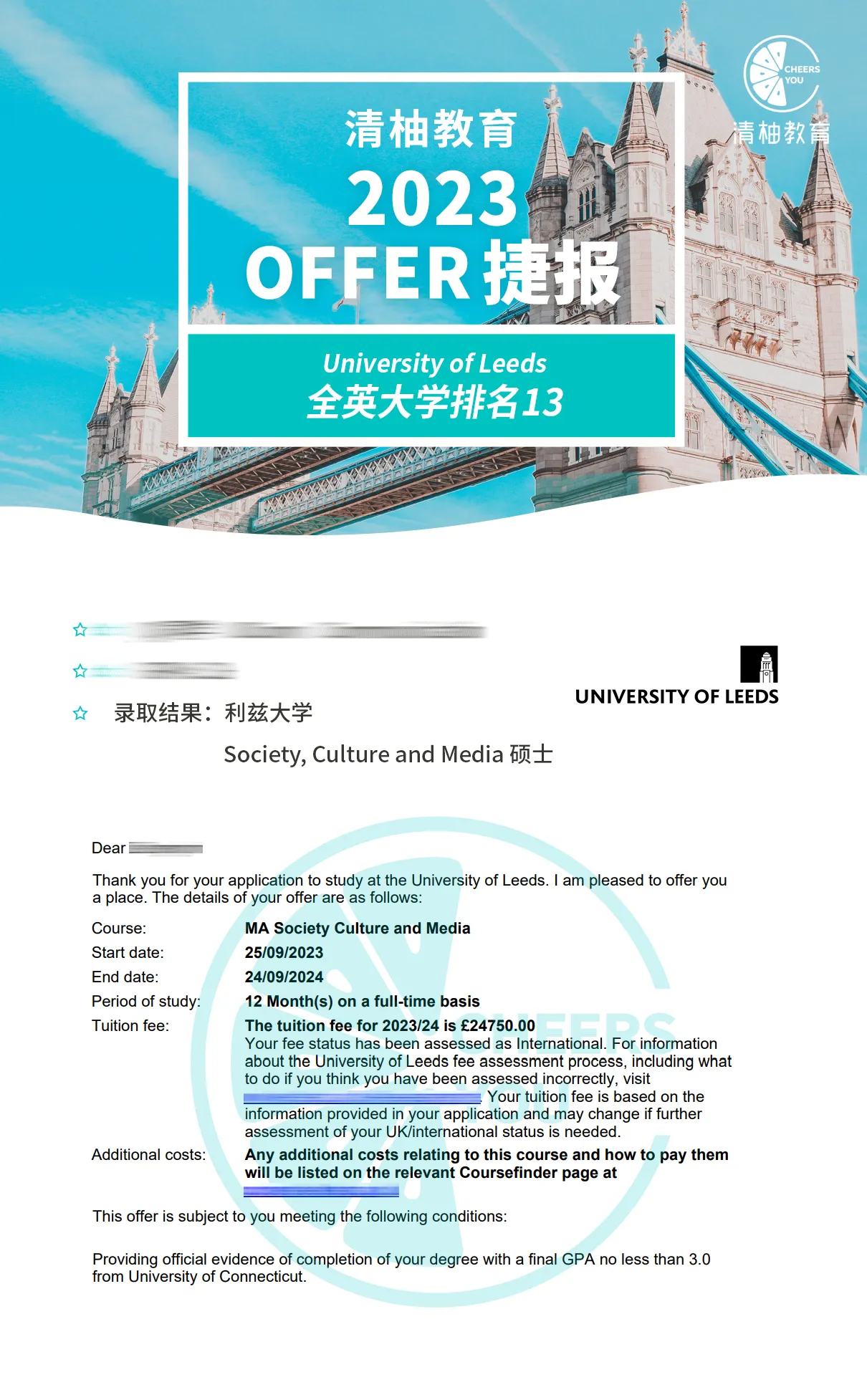
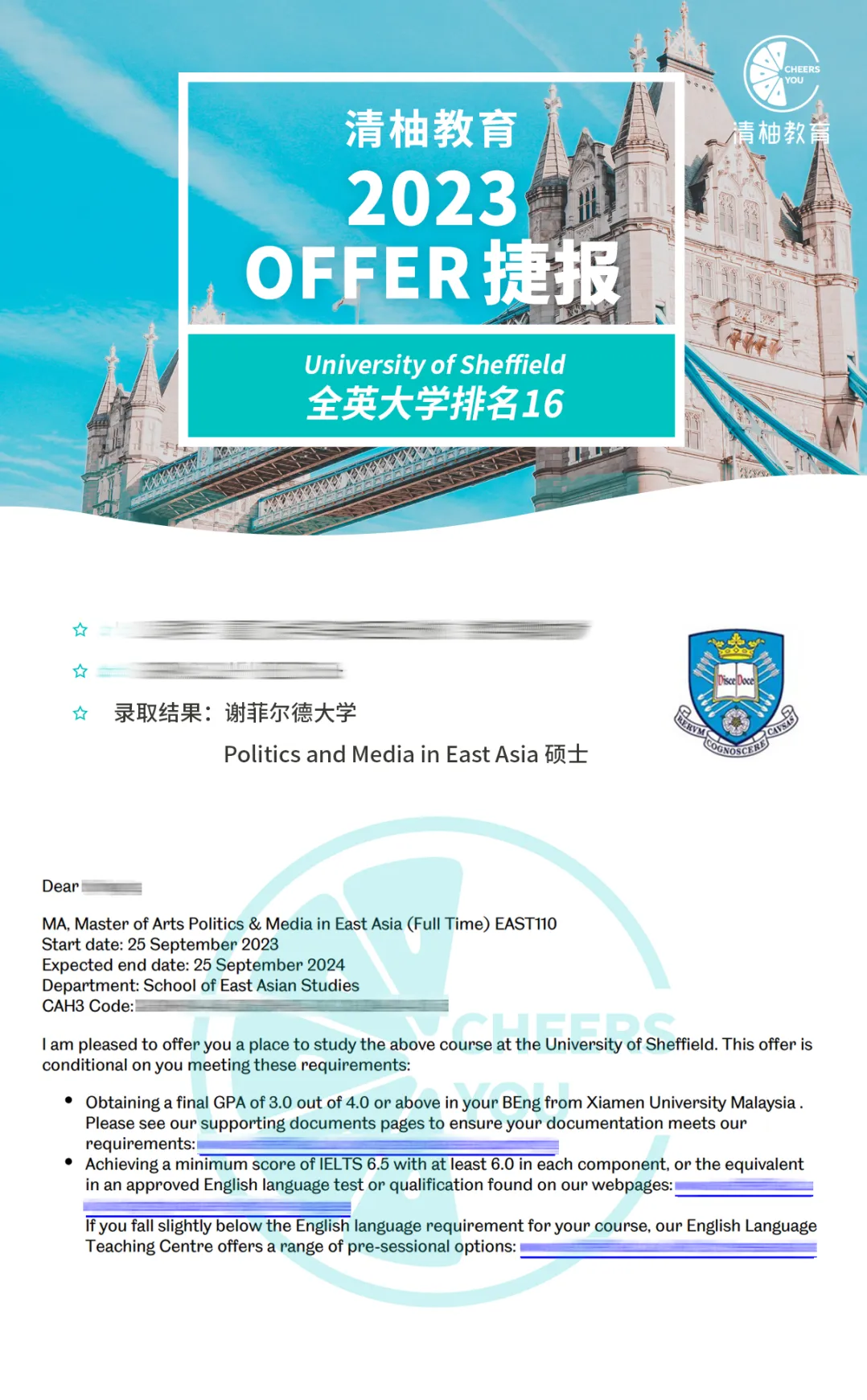
CheersYou(清柚教育) consultants offer one approach to school selection, which includes understanding your personal background, defining your program scope, narrowing down target schools, and setting specific application goals. In addition to the excellent UK media programs mentioned in this article, there are many other outstanding options available. For more application details and personalized school selection advice, feel free to scan the QR code below to consult with us~