For many, the academic journey doesn't always proceed as planned, often involving unexpected detours and forced Plan Bs. The most common scenario is failing China's postgraduate entrance exam. To seek better opportunities, many students turn to studying abroad as their Plan B. While it's still feasible, the timeline is undoubtedly tighter compared to those who prepared early. Take a look at the to-do list for Fall 2024 admissions:
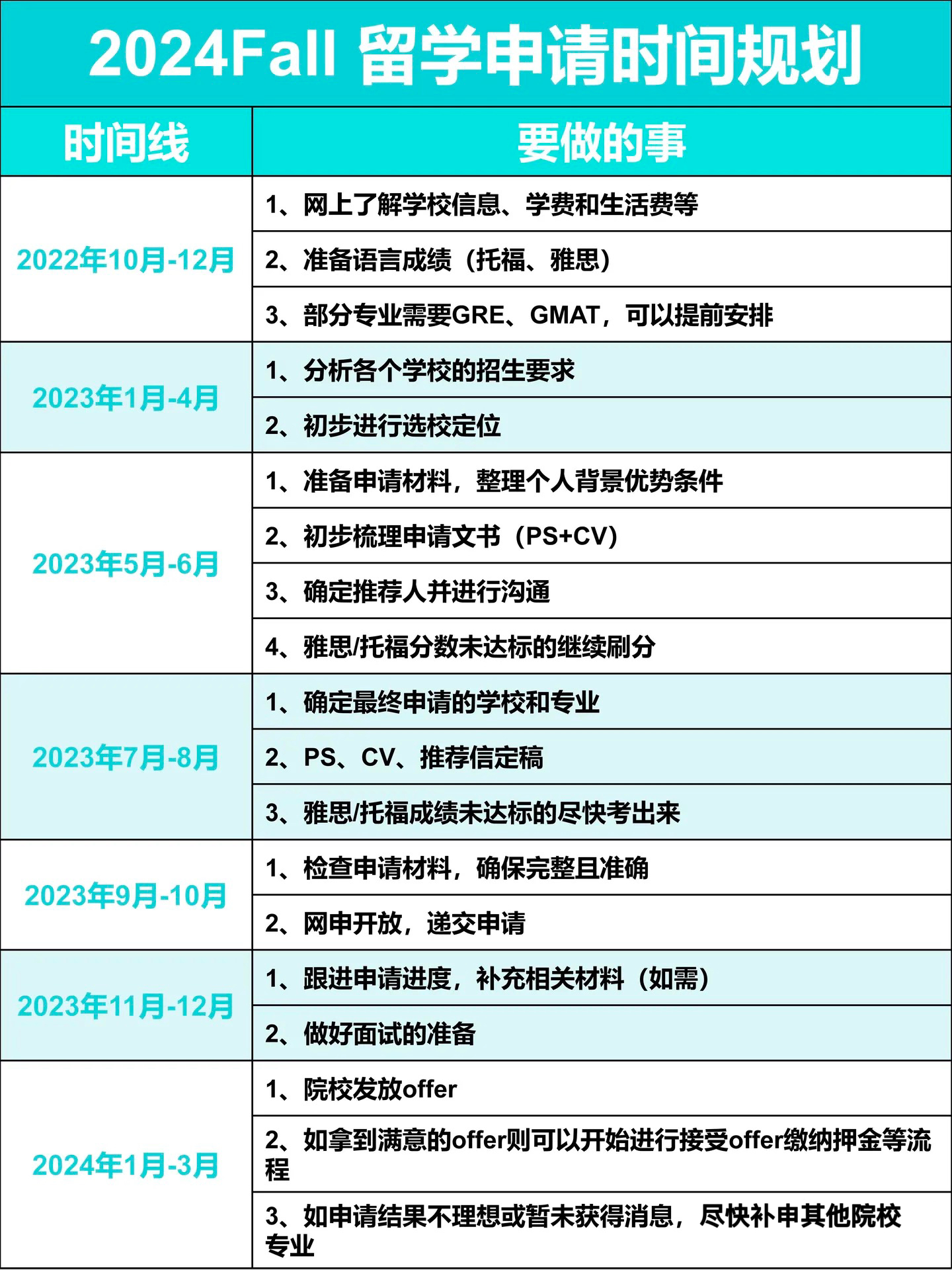
Typically, you'll know the exam outcome by January. If you can quickly gather relevant information and start preparing your application materials right away, it's still possible.
Although you'll be behind those who started early—possibly missing the first-round deadlines for top schools or the prime rolling admissions window—these are exceptions. For most programs, there's still enough time.
1. United Kingdom
Take the UK, a popular study-abroad destination. Many postgraduate programs have deadlines until June or July, and language test scores don't always need to be submitted with the application—they can be provided later. Even if your scores fall short, you can apply for university language courses.
2. United States
If you're considering the U.S., you have even more opportunities! With a large number of institutions, admission timelines are relatively flexible and generous. However, it's worth noting that top U.S. universities generally don't offer language programs, so an IELTS score of 7 or TOEFL score of 100 is usually essential. Therefore, some foundational preparation for these exams is advisable.
3. Australia
For Australia, some postgraduate programs with July intakes accept applications between January and March—still manageable. For those unwilling to accept a less desirable program after the re-examination or unsatisfied with their results, a February start the following year is also an option.
4. Asia
If you prefer Asia—specifically Hong Kong and Singapore—the number of institutions is relatively small, and most programs close applications before April. Also, these universities typically don't provide language courses, so if you haven't taken IELTS yet, you'll need to secure a language score quickly. That said, some programs at Hong Kong and Macau universities accept CET-4/6 or TEM-4/8 scores as proof of English proficiency.
From the above, it's clear that even after a disappointing exam result, applying to graduate programs abroad is still possible. Moreover, compared to domestic graduate studies or even retaking the exam, studying abroad offers many advantages you might not have previously considered!
1. Lower time cost for overseas graduate study.
Compared to China's 2–3 year graduate programs, most overseas and foreign programs take only 1–1.5 years. As we all know, today's job market changes rapidly. In any industry, early entrants often gain a head start. With the same degree but one to two years more work experience than your peers, your competitiveness speaks for itself.
2. More options compared to the exam-score-only approach of domestic postgraduate admissions.
When applying overseas, you can choose multiple institutions, programs, and even countries. In contrast, China's postgraduate exam allows you to apply to only one institution and one major. Naturally, the success rate is much higher abroad!
3. Flexible start dates abroad.
In China, programs start only in September, while many overseas institutions offer a significant number of January intake courses. While retaking the exam would mean waiting another whole year, applying abroad avoids wasting that extra time.
4. International experience broadens your horizons and makes your thinking more global.
Studying abroad immerses you in a completely unfamiliar language environment, enhancing your communication skills, language ability, and cultural inclusiveness—things a traditional domestic setting cannot provide. Many countries also offer post-graduation work visas, and international work experience can greatly benefit your career search back home.
In short, studying abroad can be an excellent choice. The right decision often trumps sheer effort! Be sure to make the choice that best fits your situation and aspirations.
For more graduate application questions, feel free to scan the QR code below to add a CheersYou(清柚教育) advisor for consultation~