When discussing why many now pursue graduate studies overseas, apart from the few focused on academia and research, most students do so to enhance their employment prospects. Therefore, employer satisfaction is a crucial factor when selecting a school. Many students chase prestigious names but overlook that rankings do not equal employer satisfaction, leading to career expectations that don’t align with reality. That’s why it’s vital to evaluate schools from multiple angles when making your choice. Today, we’ll discuss employer satisfaction for the U.S. top 30 graduate schools that many students care about, for your reference.
If you have more questions, feel free to reach out to a CheersYou(清柚教育) advisor via the contact below.

First, it’s important to understand that employment recognition cannot be discussed in isolation—it’s closely tied to your future personal development plan and your current situation. Here are a few simple examples:
- If you’re from a Double First-Class undergraduate program with top rankings, and you started planning early in your sophomore year, you can decide based on your own preferences: you could pursue a domestic postgraduate path at Tsinghua, Peking, Fudan, or Jiao Tong (2-3 years, low cost), or apply to top schools in the UK, US, or Hong Kong (1-2 years, requiring a budget). Whichever you choose, if you stick with it, your future prospects are bright;
- If you have a Double First-Class undergraduate GPA below 3.3 or even lower but still want a prestigious degree, and time permits, strongly consider applying mainly to the U.S., because you can quickly enhance your soft skills and tailor your application materials to have a solid shot at a top school;
- If you plan to return to China immediately after your master’s and don’t care about overseas work experience, then one-year programs in the US, UK, Hong Kong, or Singapore are top choices, because three years later, while peers who struggled through domestic exams might be placed in a less satisfying university and just graduating, you’ll already have a master’s degree plus two years of work experience, giving you a clear edge;
- If you aim to work in schools in the Shenzhen area or take public service jobs in certain districts of Shanghai, one-year master’s programs may not be recognized—consider applying to programs longer than one year (US, Canada, Australia);
- Or maybe
- you might pursue a PhD later
- obtaining overseas residency is a consideration
- your family has already arranged a job and you just want a decent master’s
- prioritizing local employment
And so on. In each of these scenarios, the relatively suitable choices and advice differ.
Many students nowadays often put the cart before the horse—instead of starting from their own situation, they first scour so-called “experience posts” on social media like Weibo or Xiaohongshu to decide which schools to pick.
Be aware that reviews on Weibo and Xiaohongshu truly shouldn’t be taken seriously. What social platforms want you to see is always entertainment and marketing-driven. The anxiety they create and the values they present have nothing to do with employer recognition.
True large companies with professional HRs absolutely won’t rely solely on QS rankings to screen resumes or decide offers—individual effort and ability matter much more.
Another point that must be made: domestic recognition is sometimes partly due to a school’s marketing. For example, Brown, an Ivy League institution, is far less known in China than Columbia; Vanderbilt, ranked 14th, is less famous than NYU.
Why is Vanderbilt’s visibility so much lower than NYU’s?
Let’s explore the reasons. First, Vanderbilt simply hasn’t done much marketing in China, unlike some already well-known schools, so many people don’t understand it. Additionally, historically, the proportion of Chinese students admitted is relatively small, naturally resulting in fewer alumni to spread the word. In contrast, UIUC, though ranked lower in the U.S., has Chinese students making up about 1/3 of the total, so you’re more likely to meet its graduates in China, which builds its reputation there. This is one reason for its lower domestic visibility.
Other factors like school size, curriculum richness, program enrollment numbers, etc., also influence domestic recognition. But public recognition and employer recognition aren’t the same thing. Just like the Wall Street investment banks that countless people vie to enter have their own Target Schools. During campus recruitment, students from target schools have an inherent halo compared to those from semi-target or non-target schools.
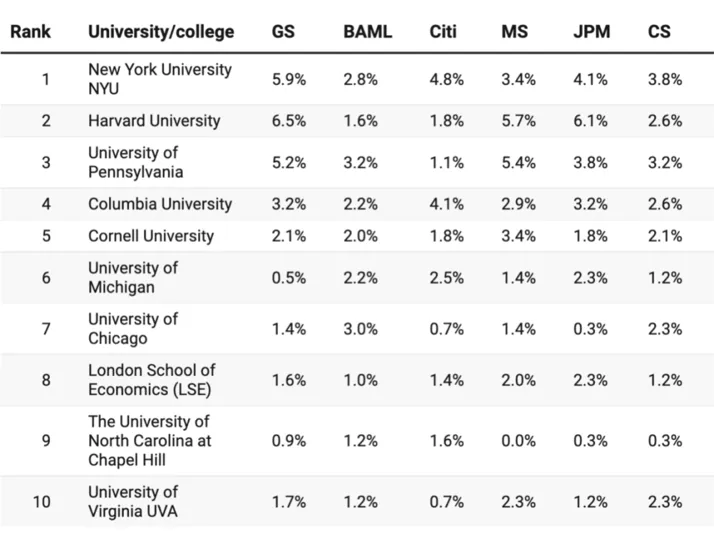
Source: WSO
Although many investment banks publicly say they recruit from all schools and majors, the fact is that for front office roles, positions are almost exclusively filled by top students from target schools. Data also shows that the success rate of getting hired by Goldman Sachs for target school students is 4%, while for non-target schools it’s less than 1%.
When recruiting, many top companies prioritize target schools, setting up dedicated recruiting processes, information channels, campus events, and so on. Students can submit resumes through the school’s internal website, and the companies allocate fixed quotas to these schools.
Advantages of Target Schools
1. Separate online application channels
Investment banks and other top firms regularly send teams to participate in Career Fairs at schools to give presentations. After these events, students can submit resumes via the school’s internal website, and each school has its own deadline.
2. Higher chance of getting an interview
Banks and top firms usually decide in advance how many interview slots to allocate to each school. After submitting, students from target schools are more likely to receive responses and interview opportunities.
3. More networking opportunities
Target schools have strong alumni networks, making it easier to network and build connections with insiders, gain deep industry insights, and even obtain internal referrals during job searches.
Some investment banks even organize pre-interview dinners the night before the first interview, getting to know candidates in an informal setting and answering their questions.
So a prestigious name doesn’t necessarily mean higher recognition, and high recognition doesn’t guarantee a positive impact on employment. Choosing a target school for your desired company may better support your future development.
In summary, we hope you won’t get hung up on what others say and pay less attention to external noise—rankings, “easy” programs, etc. Focus more on your inner self, communicate more with parents and industry seniors, clarify your broad career direction, set small phased goals, adjust according to reality, and steadfastly move forward!
For more grad school application questions, scan the QR code below to consult a CheersYou(清柚教育) advisor~