
Urban Planning (Urban Planning / City Planning / Regional Planning) is a comprehensive deployment project that studies the future development of cities, reasonable urban layout, and the integrated arrangement of various urban engineering constructions. Urban planning is a broad concept with many sub-fields. Applicants to this direction are generally preferred to have degrees in architecture, planning, landscape architecture, environment, etc. When mentioning urban planning, it is hard not to talk about Urban Design (Urban Design / Architecture and Urban Design). Compared with urban planning, urban design has stricter background requirements and usually requires submission of a portfolio. There is also a commonly applied direction, which is data-oriented projects (data/analytics). These are not many, but have much lower requirements for related backgrounds, mainly assessing quantitative and data capabilities.
1. Employment Prospects in Urban Planning / Urban Design
According to the American Planning Association, over 65% of urban planning graduates in the U.S. work in government departments, around 20% in various non-profit organizations, and less than 20% in private enterprises. Government planning work is mainly undertaken by master's graduates, involving planning policy design, physical planning, and planning management. Overall, the market demand for planning professionals is mostly for master's degree holders.
After studying urban design abroad and returning to China, mainstream employment directions include urban and regional planning design and management in government or corporate sectors, formulation and research of related policies and regulations, business consulting, real estate planning and development, etc.
Therefore, overall, the employment prospects in this field are very good.
2. Application Requirements Reference
1. Application Background Requirements
As mentioned above, applying to this direction generally requires a relevant undergraduate background, with a preference for applicants holding degrees in architecture, planning, landscape architecture, environment, etc. You can check the program curricula, graduate destinations, acceptance rates, and relevant rankings on official websites to decide on your school selection. Also, many programs require you to indicate your intended specialization when applying.
2. Hard and Soft Requirements
Language Scores: generally require IELTS 7 or TOEFL 100.
GRE has no specific score requirement, but a total score of 320+ and writing 3.5+ are recommended.
GPA: some schools require WES certification, so prepare in advance.
Recommendation Letters: generally three letters, two academic and one from an internship.
Portfolio is also very important. The urban design track within urban planning places more emphasis on portfolio quality, while other branches focus more on relevant research outcomes and internship experience. Some schools may require a Writing Sample.
3. Specific Program References
MIT - Urban Studies and Planning / City Planning
Harvard - Urban Planning / Urban Design
Columbia University - Urban Planning / Architecture and Urban Design
University of Pennsylvania - City Planning / Urban Spatial Analytics
Washington University in St. Louis - Urban Design
Cornell University - Regional Planning (Design track)
University of California, Berkeley - City Planning (2-year STEM program, with Design track) / Urban Design (1-year non-STEM program)
UCLA - Urban and Regional Planning / Architecture and Urban Design
Carnegie Mellon University - Urban Design
New York University - Urban Planning / Applied Urban Science and Informatics (Tandon)
University of Southern California - Urban Planning / Spatial Data Science / Spatial Economics and Data Analytics (SSI)
4. Taking Columbia University's Urban Planning as an Example
Columbia's Urban Planning program is part of GSAPP, one of the largest architecture schools in the U.S., so it has abundant teaching resources.
In terms of application requirements, the undergraduate degree should be in architecture, engineering, sociology, political science, geography, economics, or urban studies, though not strictly limited; backgrounds in humanities and pure sciences are also accepted. GRE scores are also required. For language, only TOEFL is accepted.
Columbia's Master of Urban Planning offers four tracks: Built Environment, Community and Economic Development, International Planning and Development, and Urban Analytics. Refer to the diagram below for the specific curriculum; detailed information can also be found on the official website.
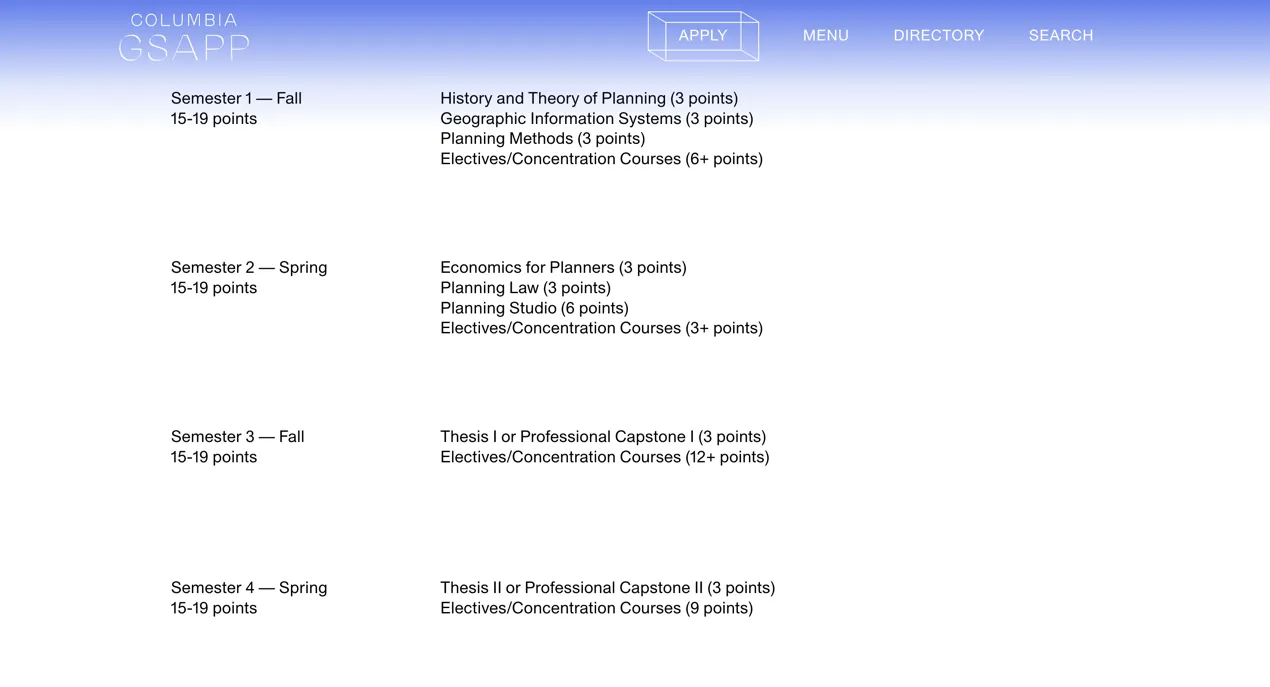
https://www.arch.columbia.edu/programs/10-m-s-urban-planning/degree-requirements
Columbia also offers many practical opportunities with numerous partner companies, providing students with rich practice projects in areas such as urban planning, landscape design, and transportation planning. Internship opportunities are also abundant, allowing students to apply their knowledge in practice. Additionally, for those interested in research, there are many research opportunities to participate in projects at the school's research centers and labs, exploring cutting-edge issues in urban planning.
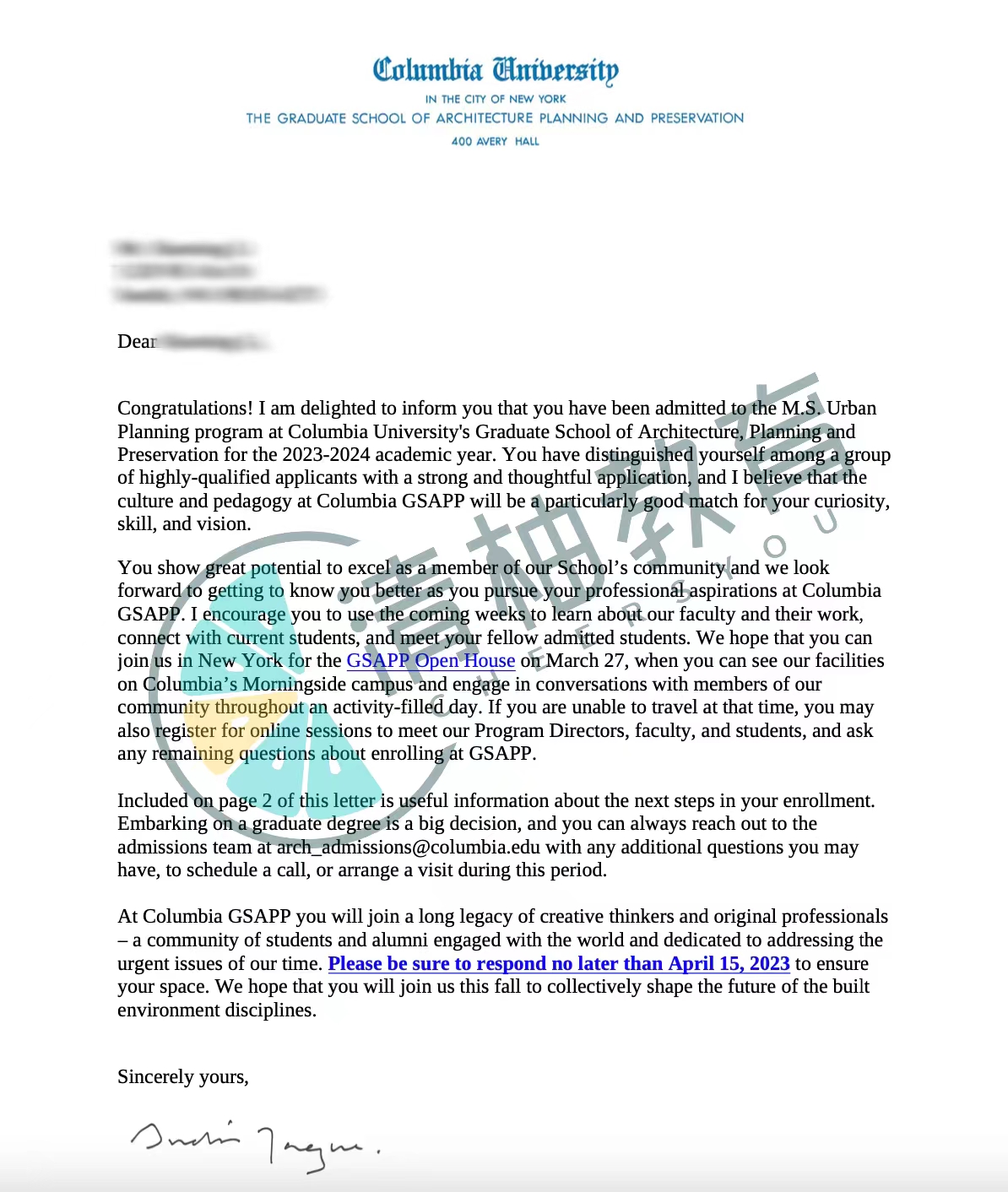
Finally, here is an admission offer from Columbia's Urban Planning program for reference~
For more study abroad inquiries, scan the QR code below to consult a CheersYou(清柚教育) advisor.